DigiMarCon World · Las Vegas · Day 2 · Nov 5, 2026
One Expert, One Hour, $7
Dollar a Day on top of the Content Factory. Here is every slide from the Day 2 talk, with a short narration so you can see what you missed.
Being there in person is always better. I answer questions and meet people during the whole conference — and after this session I stayed around so anyone with a question could ask. The slides get you the method; the room is where the conversations happen.
Yesterday was the agent harness: how a team of agents works together on one shared set of notes. Today we put that team to work on the part most people skip, which is getting the right content seen. The program calls this session One Expert, One Hour, $7. Here is what that means. One expert gives us one hour of real conversation. The Content Factory turns that hour into an article, clips and posts.
Slide 2 of 57
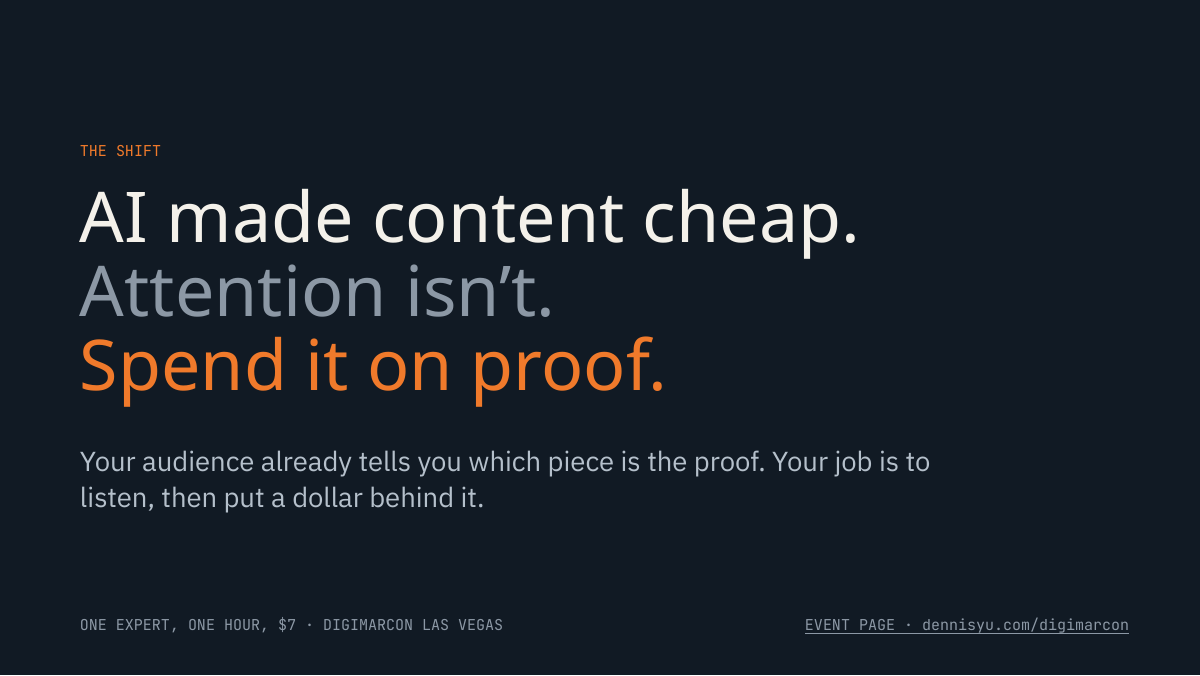
THE SHIFT
Here's the shift. AI made content cheap. Anyone can make fifty posts before lunch. But attention didn't get cheaper. Getting the right person to actually see the right thing still costs time or money. So the question isn't how do we make more. It's which of the things we already made deserves to be seen, and how do we find out cheaply. Your audience already answers that. Every organic post is a free vote. The ones that earn real engagement are your proof.
Slide 3 of 57
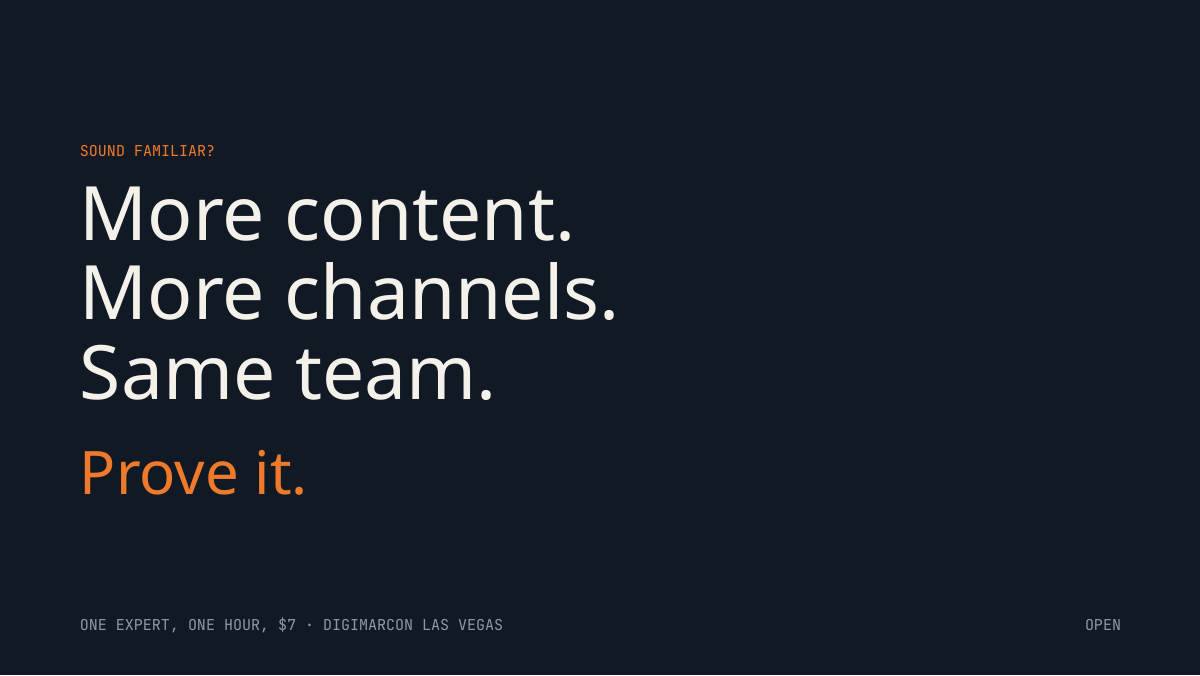
SOUND FAMILIAR?
Sound familiar? More content. More channels. Same team. And then somebody asks you to prove it worked. If you're the marketing person at a local company, that somebody is usually the owner. And they don't want impressions. They want to know if the phone rang. That's who today is for.
Slide 4 of 57
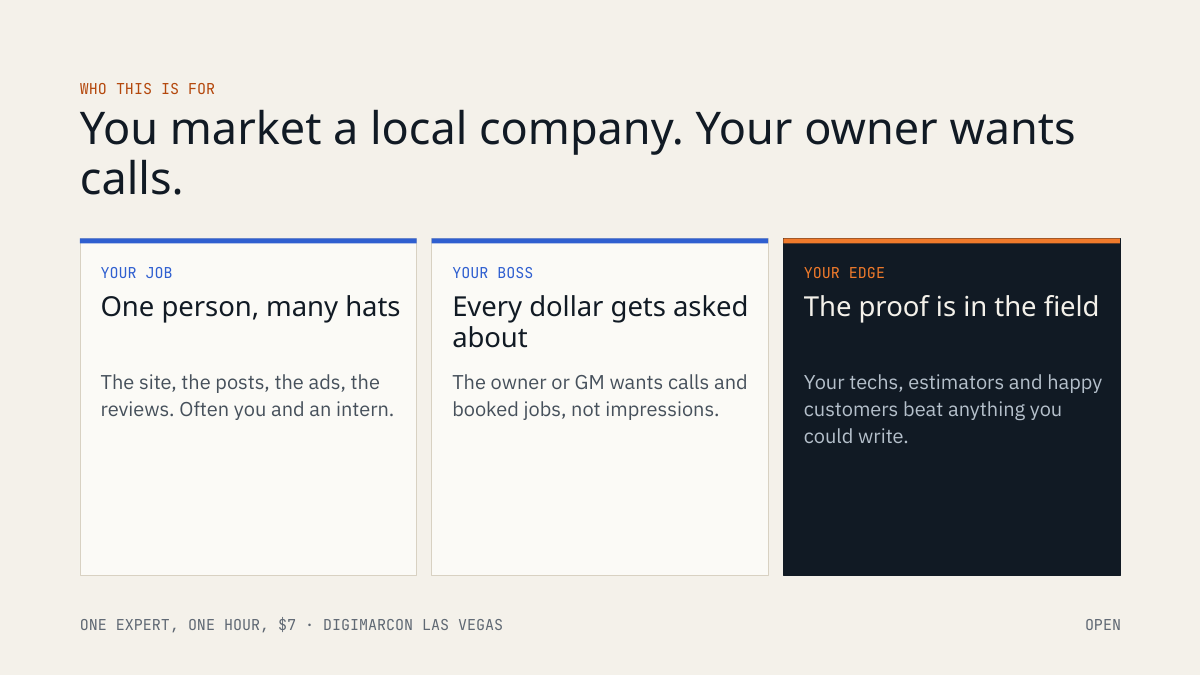
WHO THIS IS FOR
Quick show of hands. Who here is the marketing person, or the marketing team, for a local company? HVAC, plumbing, roofing, dental, law, a credit union, a landscaper. You wear every hat. The site, the posts, the ads, the reviews. Often it's you and an intern. Every dollar gets asked about. Your owner or your GM doesn't care about reach. They care whether the phone rang and whether jobs got booked. And here's your unfair advantage.
Slide 5 of 57
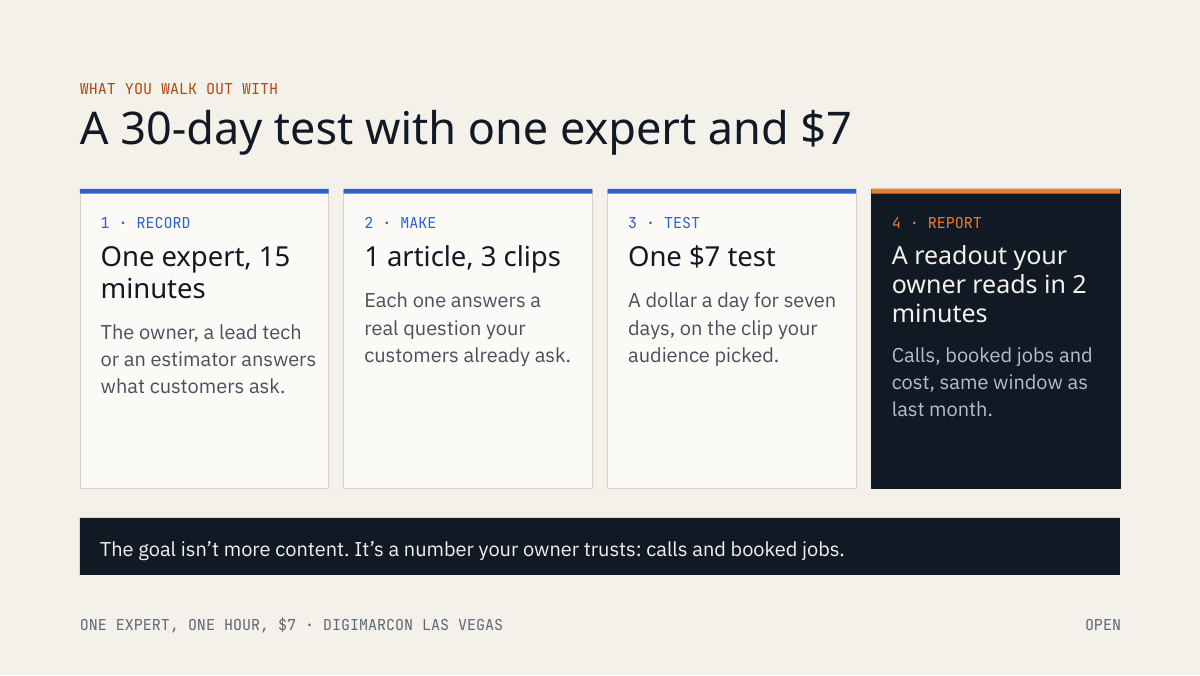
WHAT YOU WALK OUT WITH
So here's what you walk out with. Not a content strategy. A thirty-day test. Record one expert for fifteen minutes. Your owner, your lead tech, your estimator. They answer the questions customers already ask on the phone. Turn that into one article and three clips. Each one answers a real question. Run one seven-dollar test, a dollar a day for seven days, on whichever clip your audience already picked. And bring back a readout your owner can read in two minutes.
Slide 6 of 57
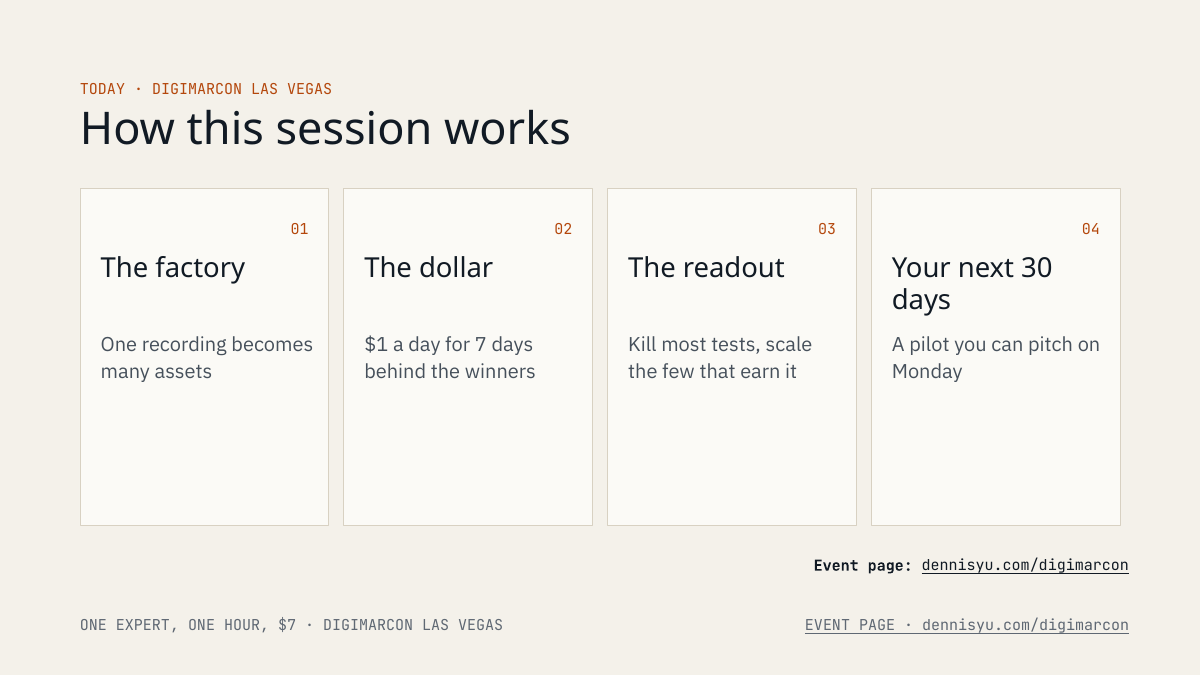
TODAY · DIGIMARCON LAS VEGAS
Here's how the next forty minutes go. First, the factory: how one recording with one expert becomes an article, clips and posts. Quick, because it's the foundation, not the point. Second, the dollar. A dollar a day for seven days behind the posts that already earned attention. Third, the readout. On day seven we look at the numbers, kill most of the tests, and scale the few that earned it.
Slide 7 of 57
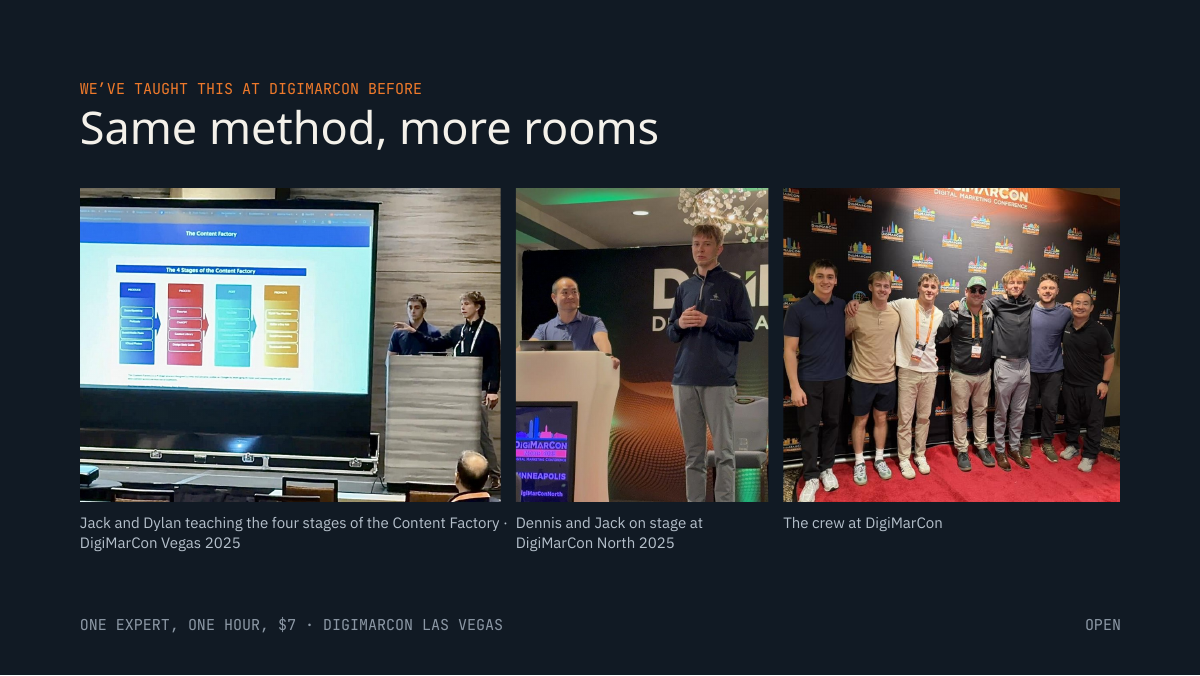
WE’VE TAUGHT THIS AT DIGIMARCON BEFORE
This isn't new for DigiMarCon. We've been teaching the Content Factory and Dollar a Day in these rooms for a while. That's Jack and Dylan from our team at DigiMarCon Vegas last year, teaching the four stages of the Content Factory. Same four stages you'll see in a minute. That's Jack and me on stage at DigiMarCon North in Minneapolis. And that's the crew at DigiMarCon.
Slide 8 of 57
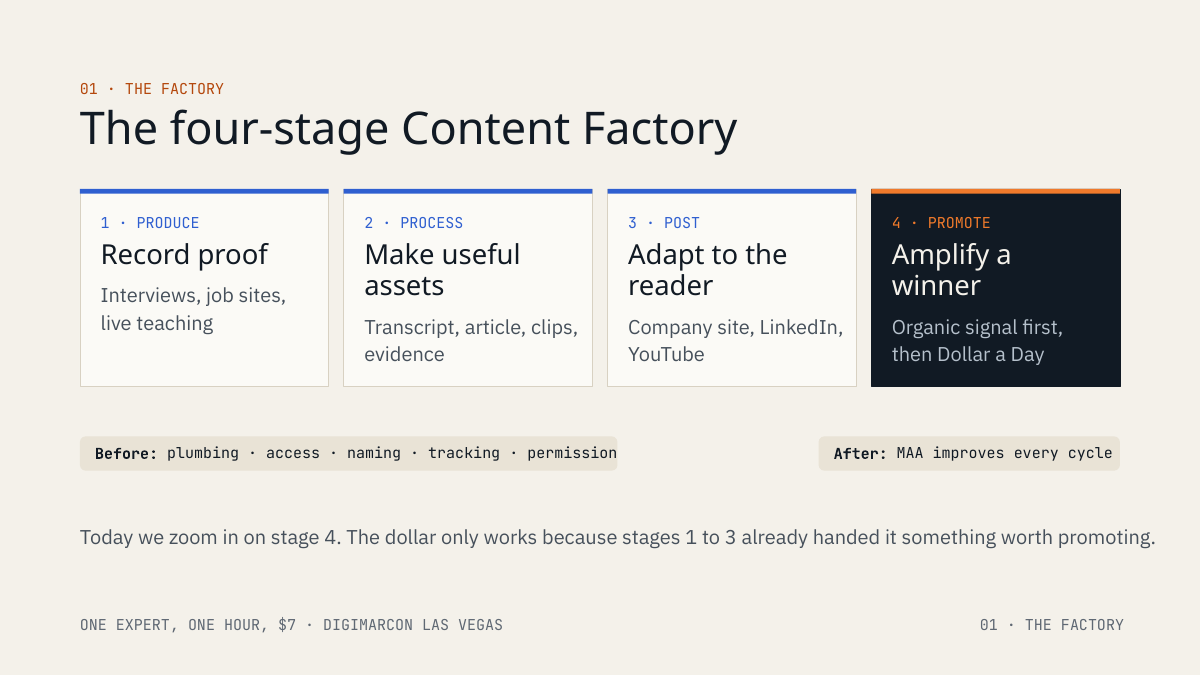
The four-stage Content Factory
This is the machine we teach. Four stages. Produce: record proof. Interviews, job sites, live teaching. Real people saying real things. Process: turn that recording into useful assets. A transcript, an article, clips, evidence. Post: adapt each piece to the reader. The company site reads differently from LinkedIn, which reads differently from YouTube. Promote: amplify a winner. Organic signal first, then a small paid test. That's Dollar a Day, and it's where we'll spend most of today. Two things sit outside the four stages.
Slide 9 of 57
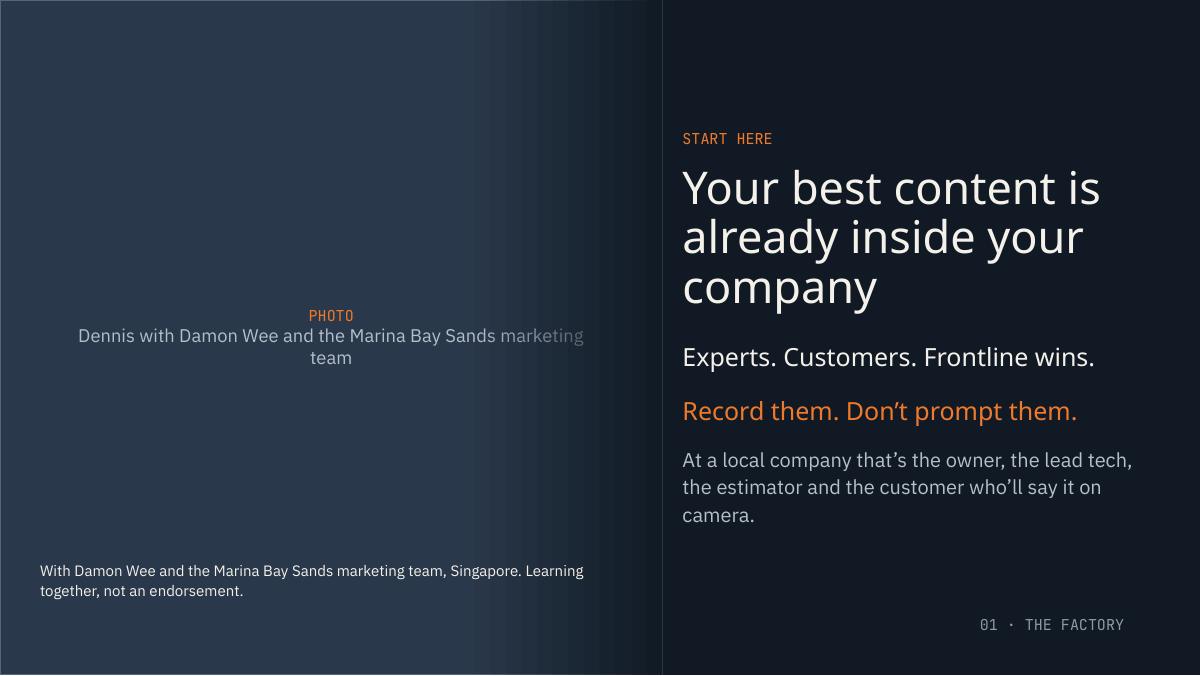
Dennis with Damon Wee and the Marina Bay Sands marketing team
Start here. Your best content is already inside your company. That's Damon Wee and the Marina Bay Sands marketing team in Singapore. Huge brand. And what we worked on together was the same thing I'm telling you: the experts, the customers and the frontline wins are already there. Record them. Don't prompt them. For a local company, that's your owner, your lead tech, your estimator, and the customer who's happy to say it on camera.
Slide 10 of 57
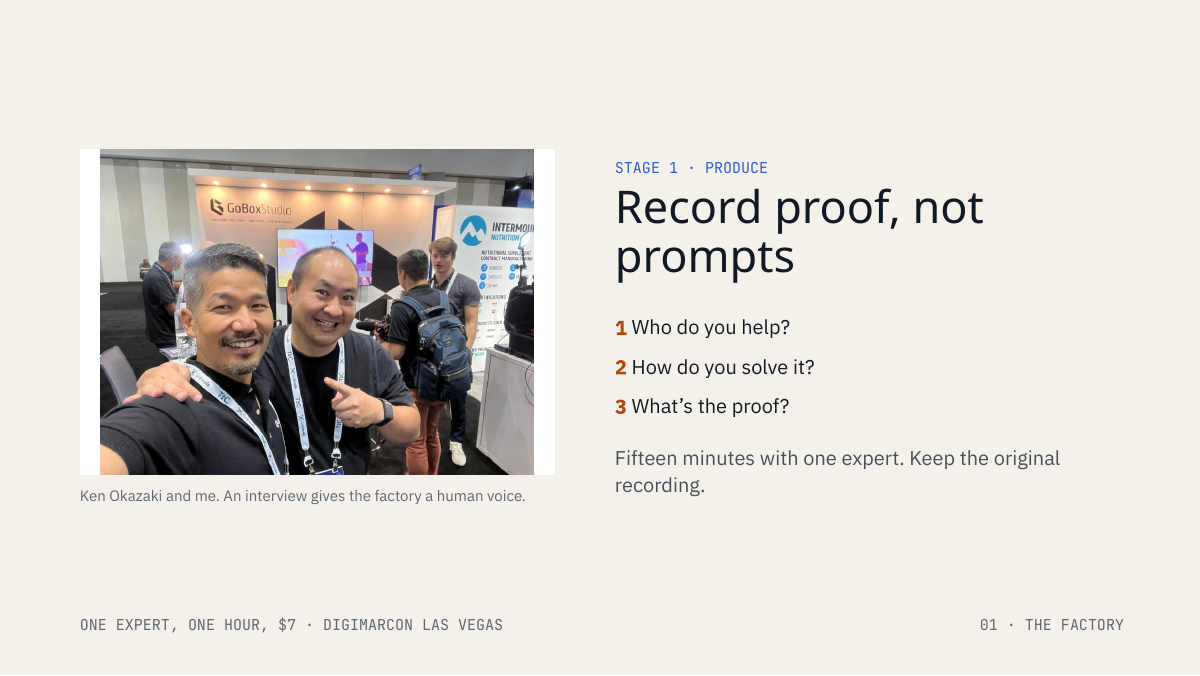
Ken Okazaki and me. An interview gives the factory a human voice.
Stage one. Record proof, not prompts. AI can write you a thousand words about anything. What it can't do is be you, with your customers, your job sites, your stories. That's the one thing nobody can copy, and it's what the ad dollar will eventually amplify. You only need three questions. Who do you help? How do you solve it? What's the proof? Fifteen minutes with one expert is enough to start.
Slide 11 of 57
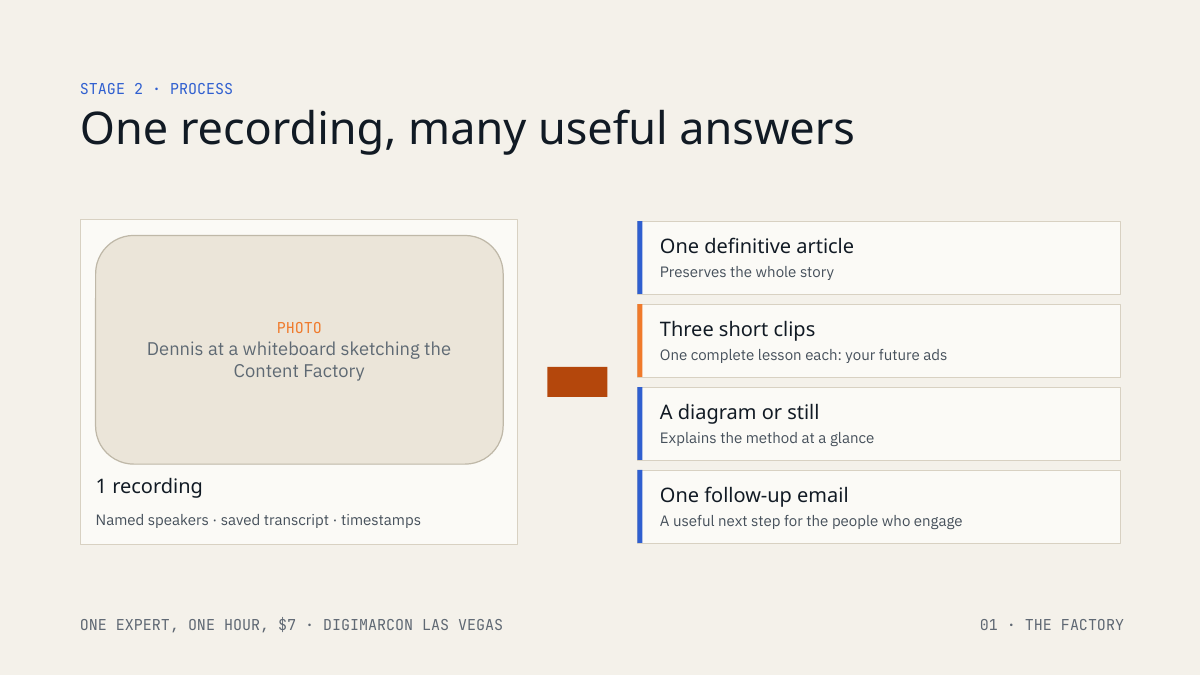
One recording, many useful answers
Stage two. One recording, many useful answers. Start with a clean One recording, many useful answers Dennis at a whiteboard sketching the Content Factory Named speakers · saved transcript · timestamps
Slide 12 of 57
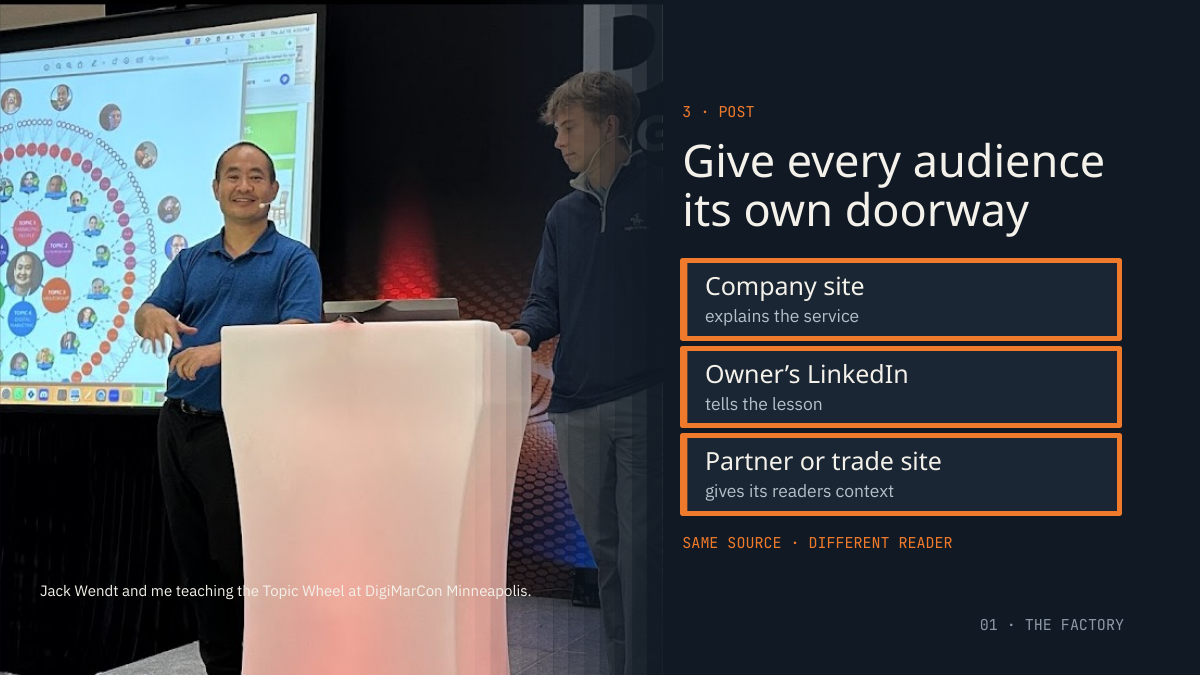
Jack Wendt and me teaching the Topic Wheel at DigiMarCon Minneapolis.
Step three, post. Give every audience its own doorway. That's Jack Wendt and me at DigiMarCon Minneapolis teaching the Topic Wheel. The same recording goes out three ways. On your company site, it explains the service. On your owner's LinkedIn, it tells the lesson in the owner's voice. On a partner or trade site, a supplier, the chamber, a trade association, it gives their readers context. Same source, different reader.
Slide 13 of 57
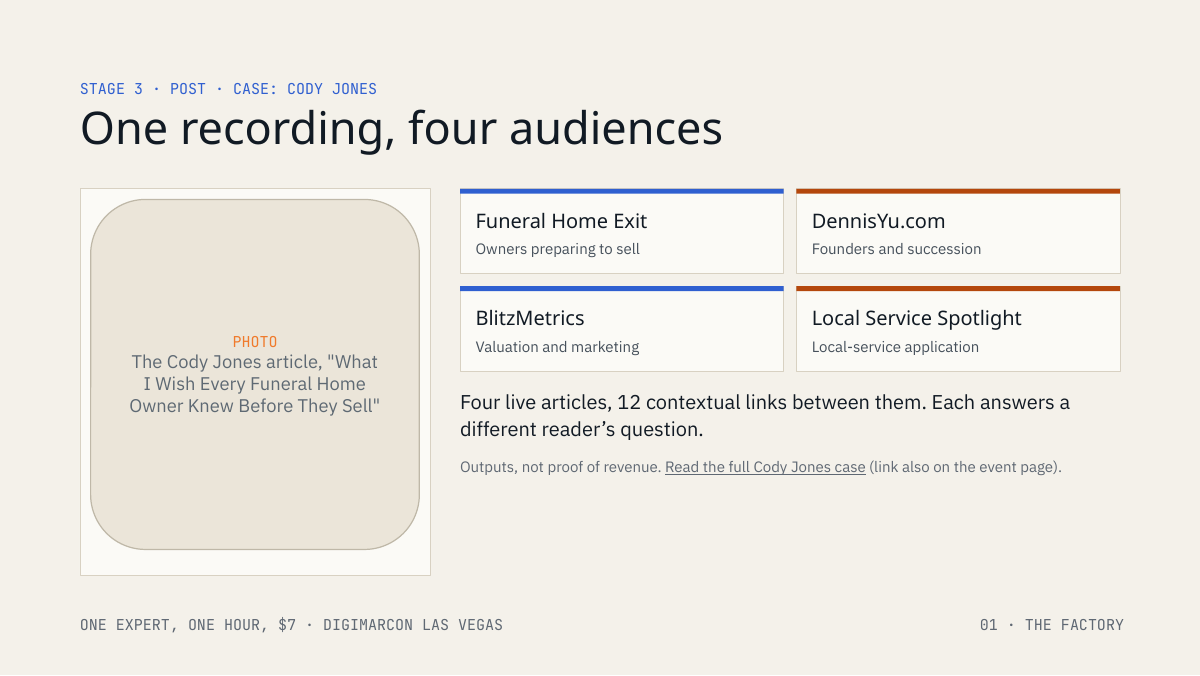
One recording, four audiences
Stage three. Post: give every audience its own doorway. Here's a real one. Cody Jones, one recording, four audiences. Funeral Home Exit for owners preparing to sell. DennisYu.com for founders thinking about succession. BlitzMetrics for valuation and marketing. Local Service Spotlight for how a local service business applies it. Four live articles, twelve contextual links between them. Same source, different reader. I'm careful here: these are outputs, not proof of revenue.
Slide 14 of 57
SAME MACHINE · YOUR COMPANY
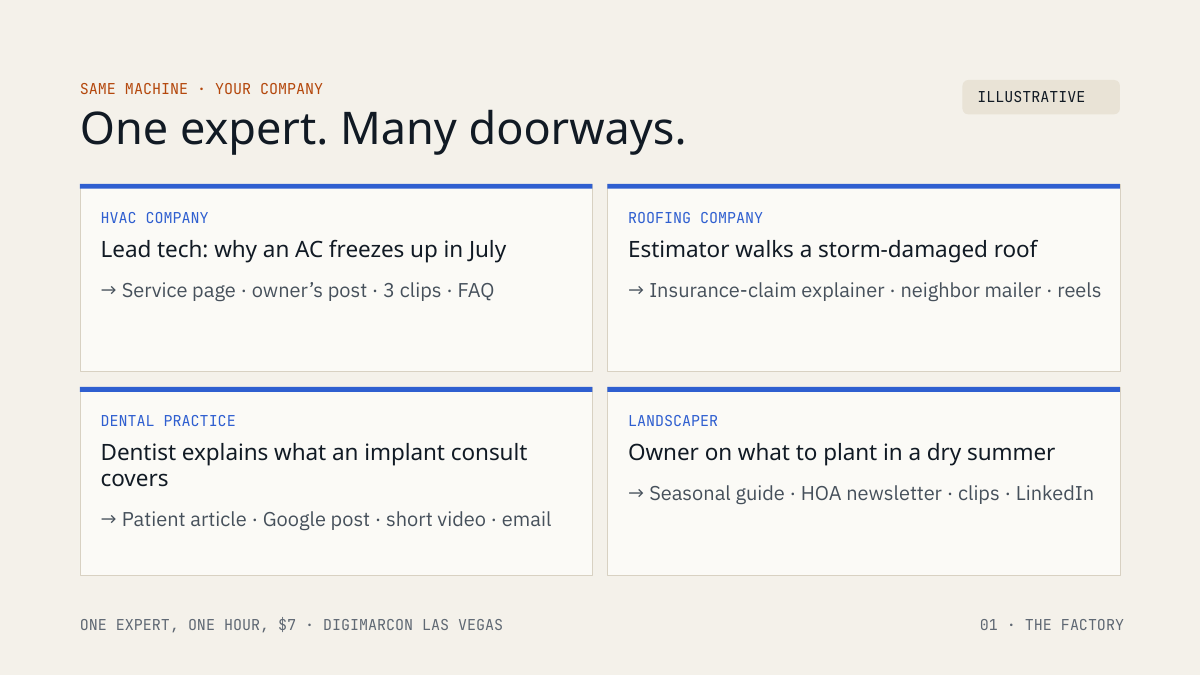
Here's the same machine, at companies like yours. These are illustrations, not case studies. An HVAC company: the lead tech explains why an AC freezes up in July. That becomes a service page, a post from the owner, three clips and an FAQ. A roofer: the estimator walks a storm-damaged roof. That's an insurance-claim explainer, a mailer for the neighbors, and reels. A dental practice: the dentist explains what an implant consult actually covers.
Slide 15 of 57
The DealCon Austin group photo, October 2026 (in your Drive; drop it in here)
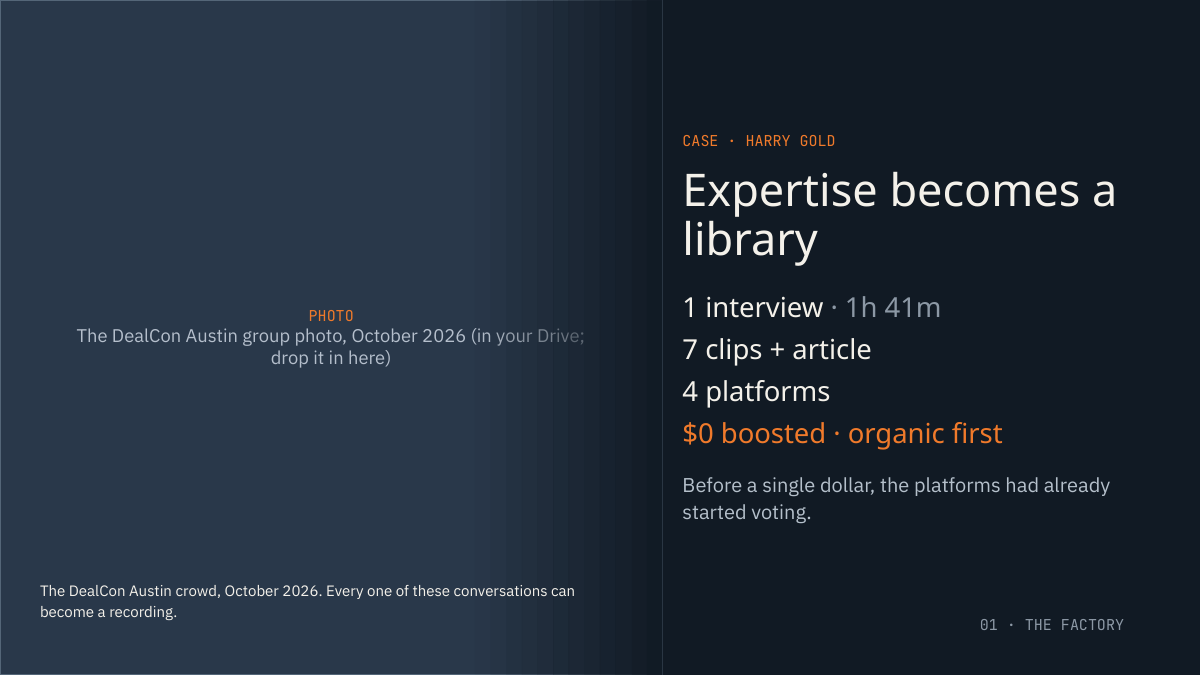
This is the DealCon Austin crowd last month. Rooms like this are where the factory starts: real people, real conversations, and every one of them can become a recording. Here's what the factory looks like on one real interview. Harry Gold. One interview, an hour and forty-one minutes. From that: seven clips and an article, posted to four platforms. And here's the important part. Zero dollars boosted. Organic first. We didn't spend a cent before the platforms told us what they liked.
Slide 16 of 57
THE AUDIENCE VOTES · HARRY GOLD
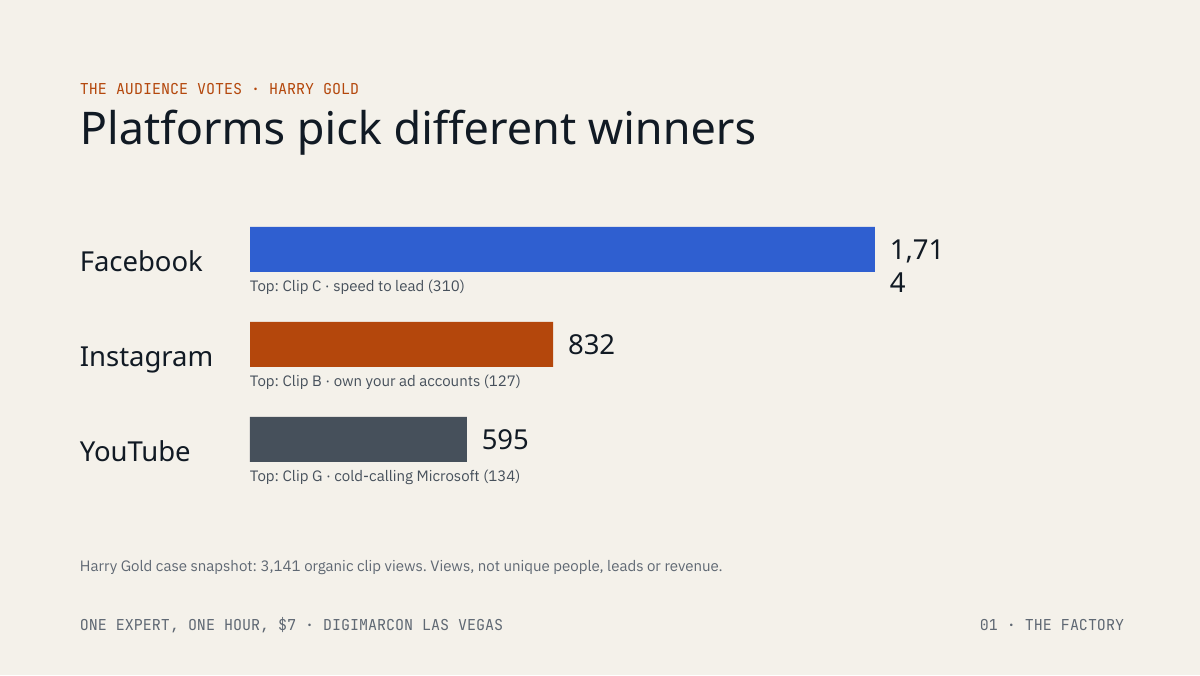
Here's the vote. Same seven clips, same week, three platforms. Facebook: 1,714 views, and the top clip was Clip C, speed to lead. Instagram: 832, and a different clip won: Clip B, own your ad accounts. YouTube: 595, and a third clip won: Clip G, cold-calling Microsoft. Three platforms, three different winners. If I had guessed which clip to boost, I'd have been wrong on at least two of them. That's why we post organic first and let the audience vote.
Slide 17 of 57
The Rule of 10
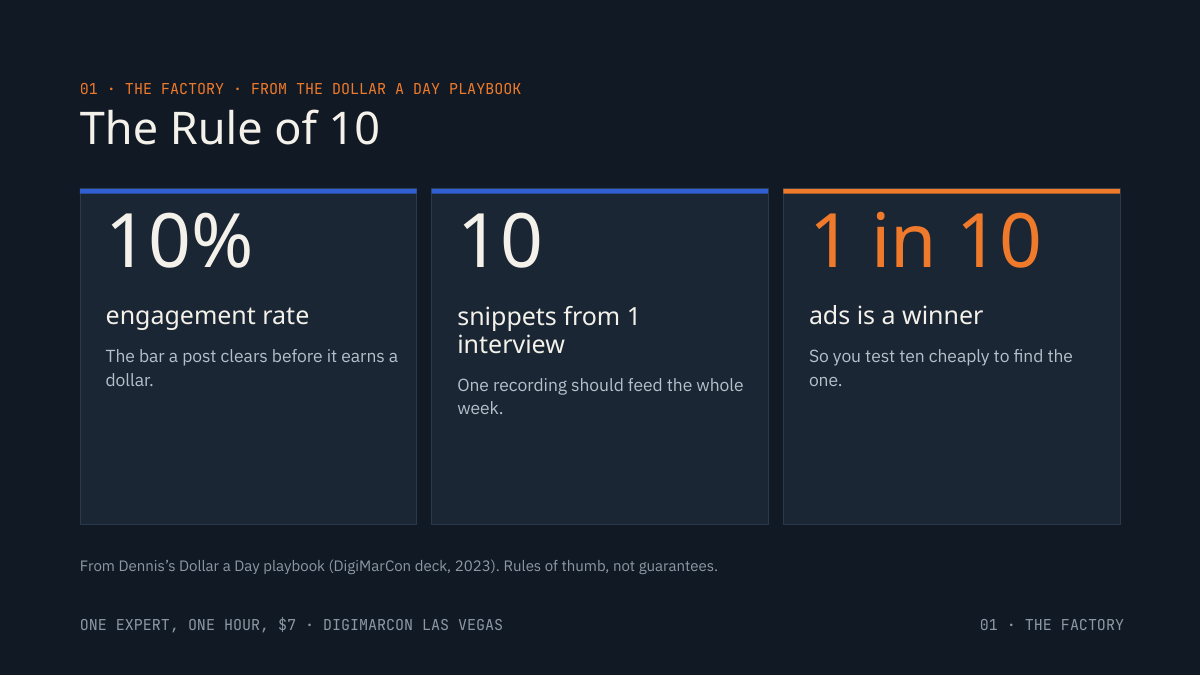
A rule of thumb I've taught for years: the Rule of 10. Ten percent engagement rate. That's the bar a post should clear before it earns a dollar. Ten snippets from one interview. One recording should feed your whole week. And one in ten ads is a winner. Which is exactly why you test ten of them cheaply instead of betting the budget on one. They're rules of thumb, not guarantees.
Slide 18 of 57
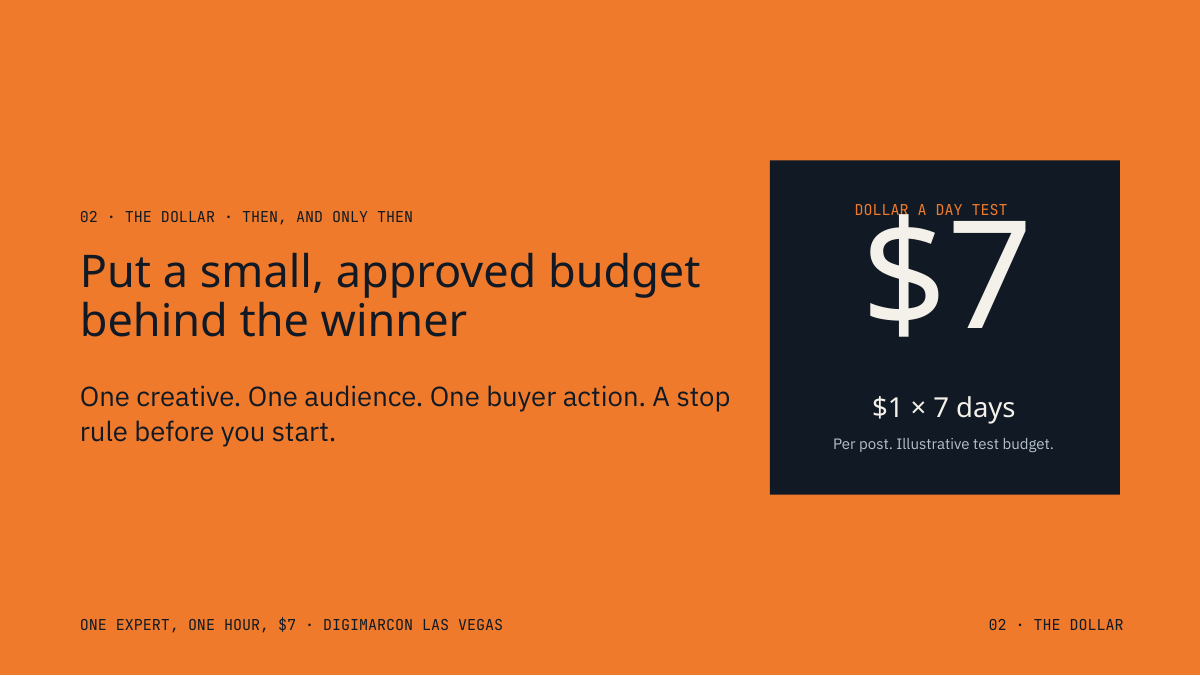
Put a small, approved budget behind the winner
Then, and only then, we spend. A small, approved budget behind the winner. One creative: the clip that already won. One audience. One buyer action we want them to take. And a stop rule written down before we start, so nobody argues with the numbers later. This is the seven dollars in the title of this session. A dollar a day, for seven days, per post. That's Dollar a Day. It's like having a PR team that works for a dollar a day.
Slide 19 of 57
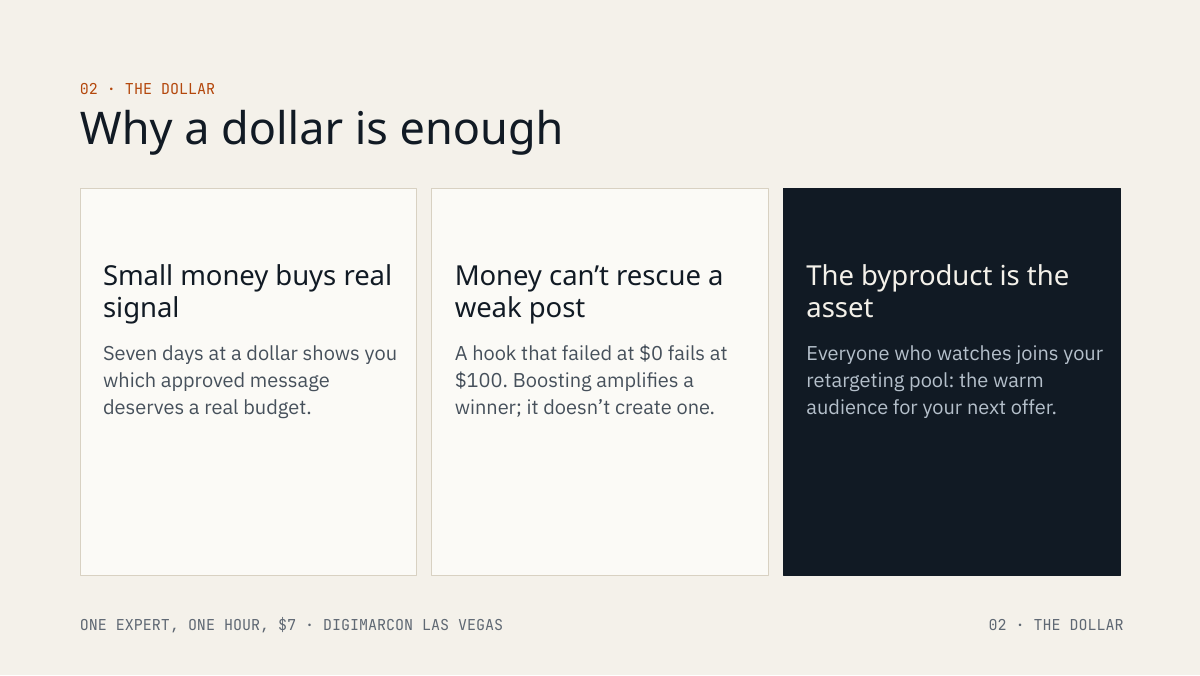
Why a dollar is enough
People always ask: why only a dollar? Three reasons. One. Small money buys real signal. Seven days at a dollar a day is enough to see which approved message deserves a real budget. You're buying information, not reach. Two. Money can't rescue a weak post. A hook that failed at zero dollars fails at a hundred. Boosting amplifies a winner; it does not create one. So we never boost what we hoped would work. We boost what already worked.
Slide 20 of 57
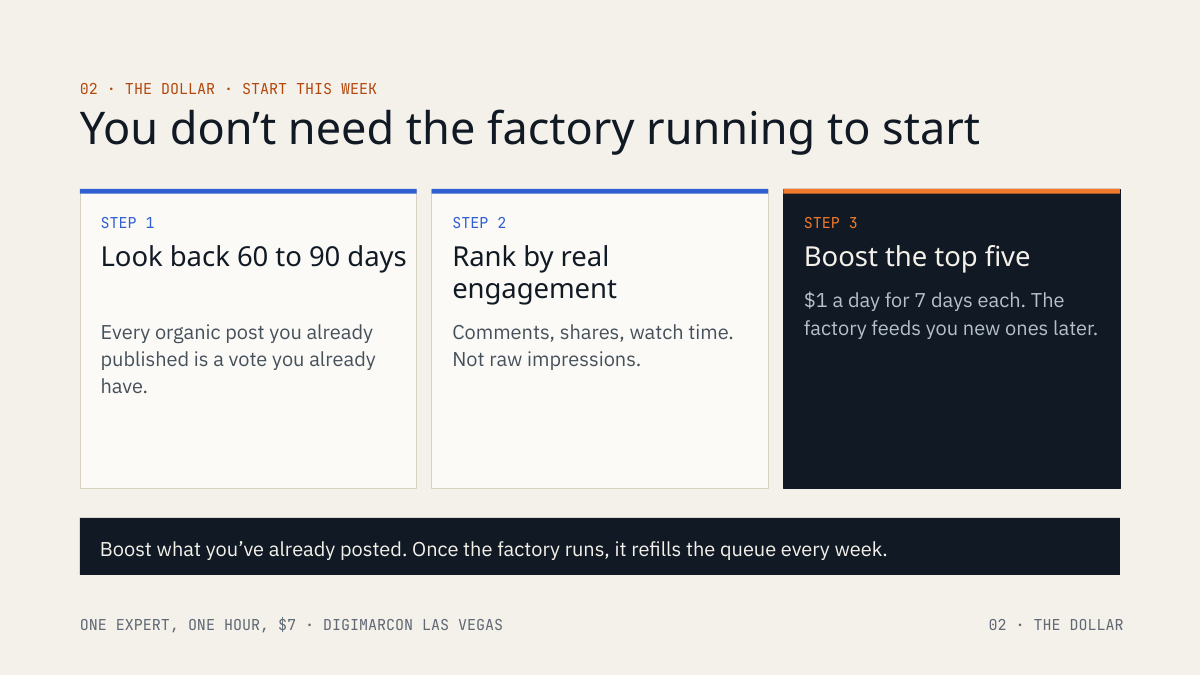
You don’t need the factory running to start
People hear all this and think they need the whole factory running first. You don't. Start this week. Look back sixty to ninety days at what you already posted. Rank it by real engagement: comments, shares, watch time, not raw impressions. Take the top five, and give each one a dollar a day for seven days. Once the factory is running, it refills that queue every week.
Slide 21 of 57
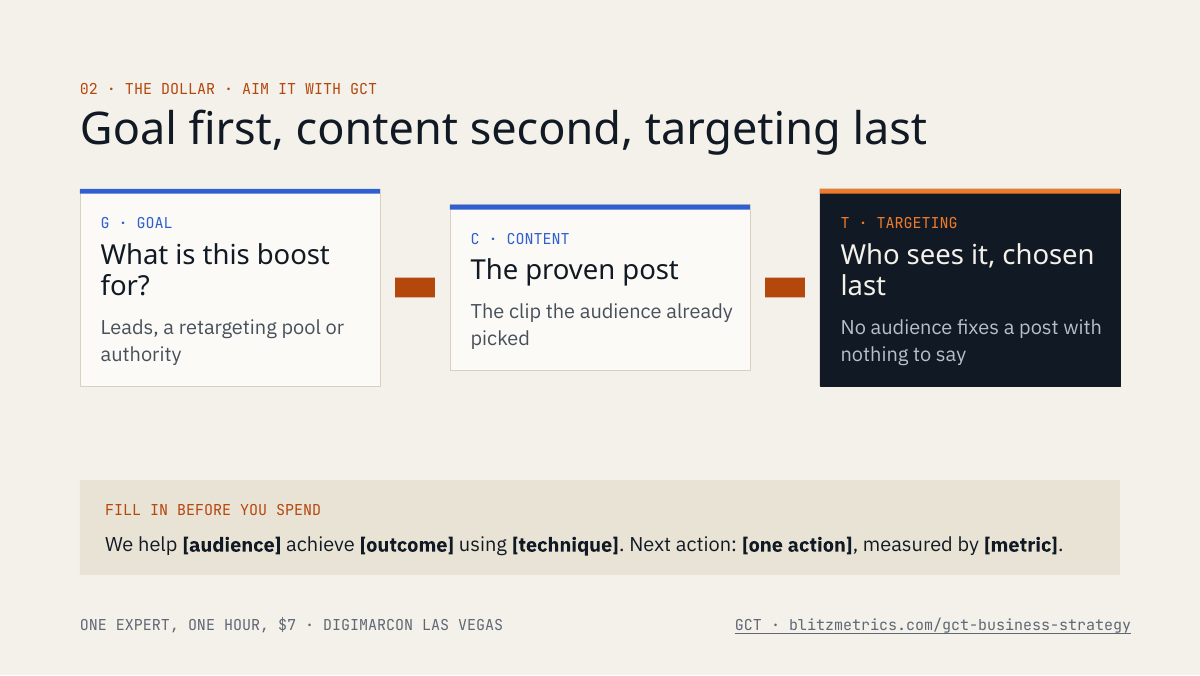
Goal first, content second, targeting last
Before any dollar goes out, we aim it. GCT: Goals, Content, Targeting. In that order. Goal: what is this boost for? Leads, a retargeting pool, or authority. Pick one. Content: the proven post. Not a new ad. The clip the audience already picked. Targeting comes last. Most people start here, picking interests and lookalikes before they know what they're saying. But no audience can fix a post with nothing to say. Here's the sentence to fill in before you spend.
Slide 22 of 57
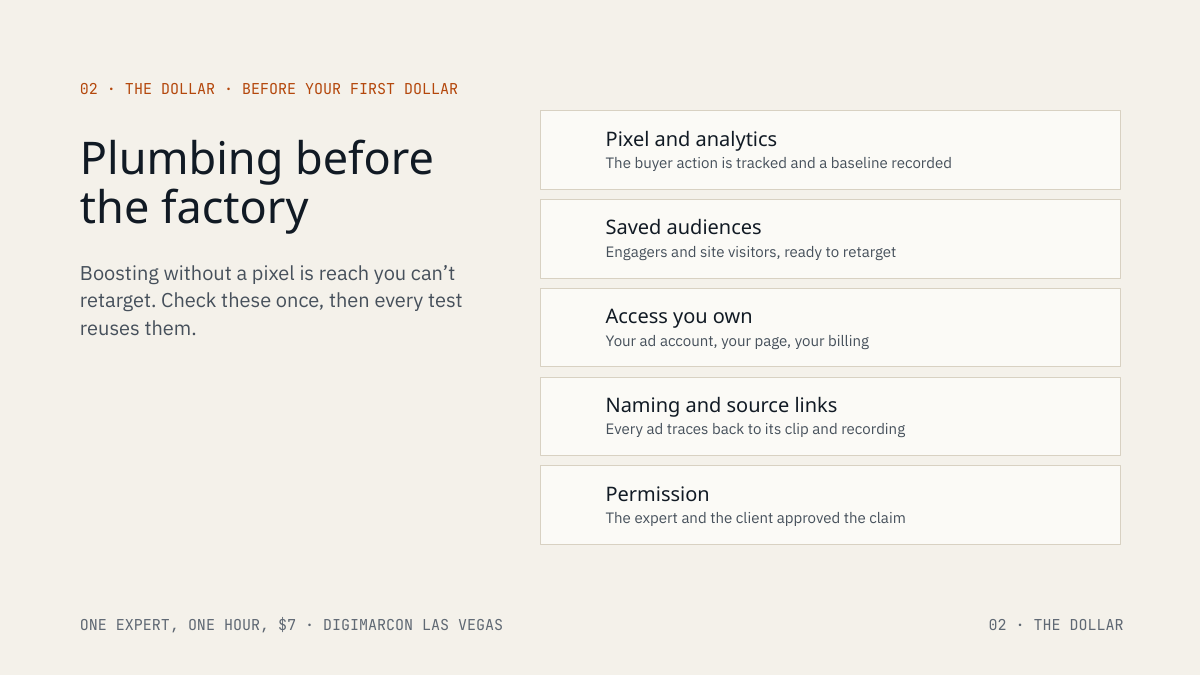
Plumbing before the factory
One more thing before the first dollar: the plumbing. Boosting without a pixel is reach you can't retarget. You paid for attention and then let it walk away. Five checks. Pixel and analytics: the buyer action is tracked and you've recorded a baseline. Saved audiences: engagers and site visitors, ready to retarget. Access you own: your ad account, your page, your billing. If your agency owns the ad account, you don't own the results.
Slide 23 of 57
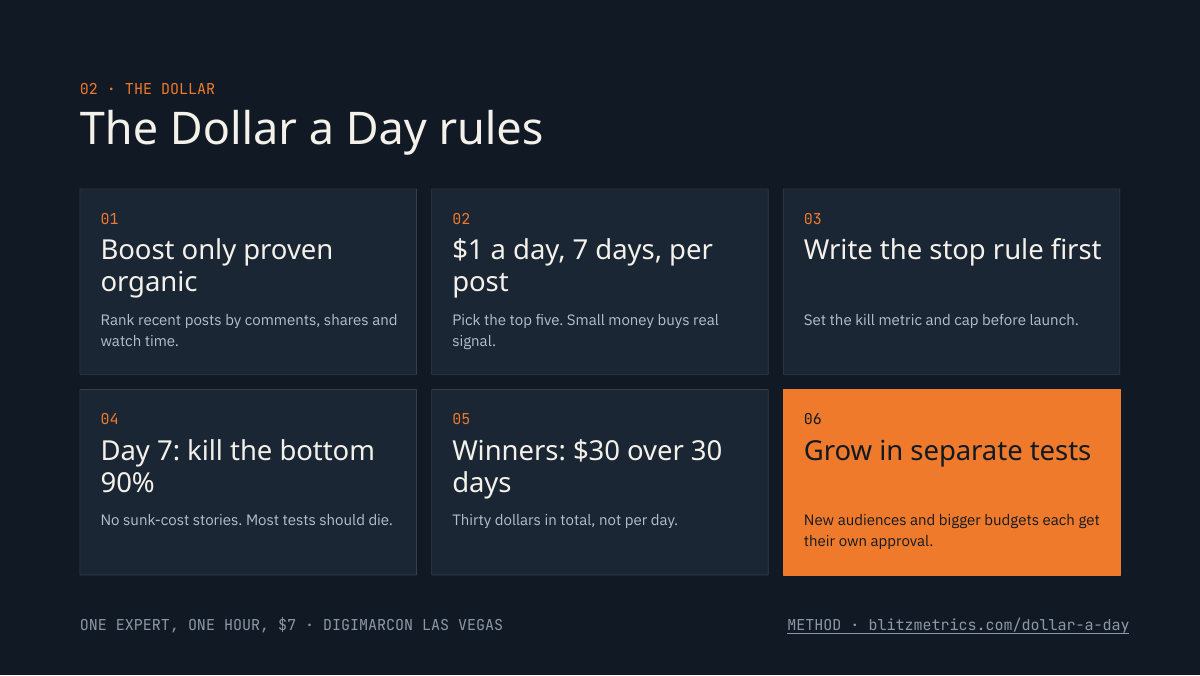
The Dollar a Day rules
Here are the rules. They're short on purpose. One. Boost only proven organic. Rank your last sixty to ninety days of posts by real engagement: comments, shares, watch time. Not raw impressions. The audience already voted; respect the vote. Two. A dollar a day, seven days, per post. Pick your top five. Three. Write the stop rule first. The kill metric and the cap are set before launch, so nobody argues with the numbers after. Four. On day seven, kill the bottom ninety percent.
Slide 24 of 57
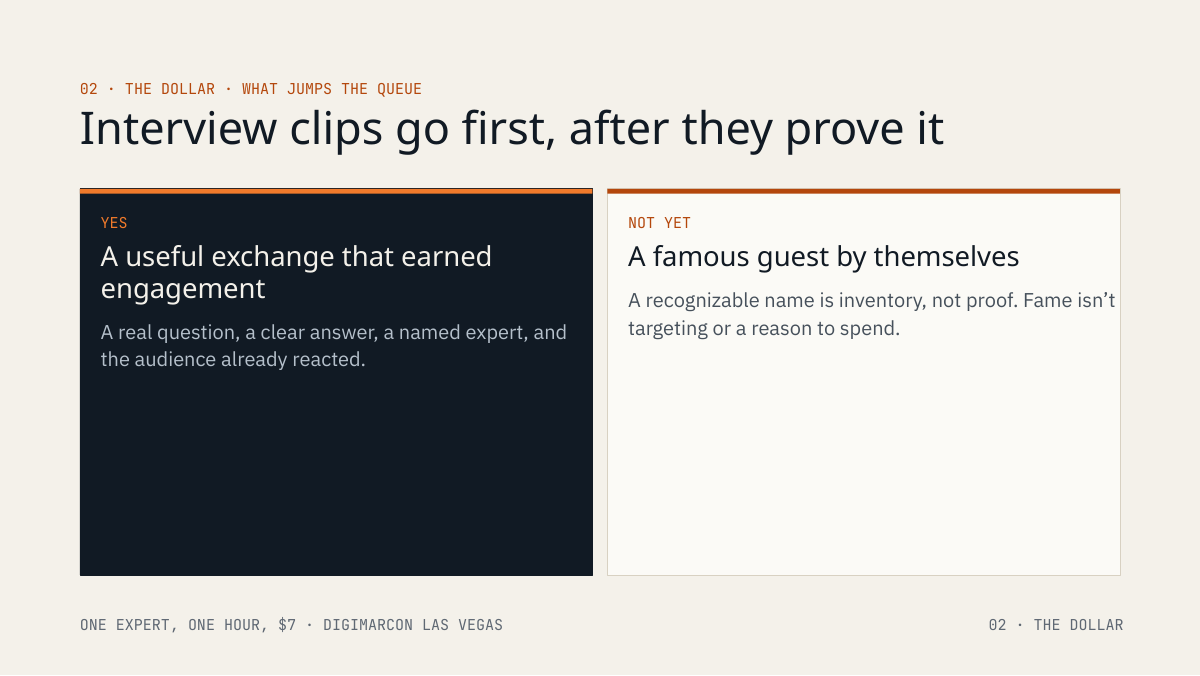
Interview clips go first, after they prove it
What jumps the queue? Interview and podcast clips. But only after they prove it. Yes: a clip with a useful exchange. A real question, a clear answer, a named expert, and the audience already reacted organically. Those go first. Not yet: a famous guest by themselves. A recognizable name is inventory, not proof. If the clip didn't earn engagement for free, it doesn't earn a dollar either.
Slide 25 of 57
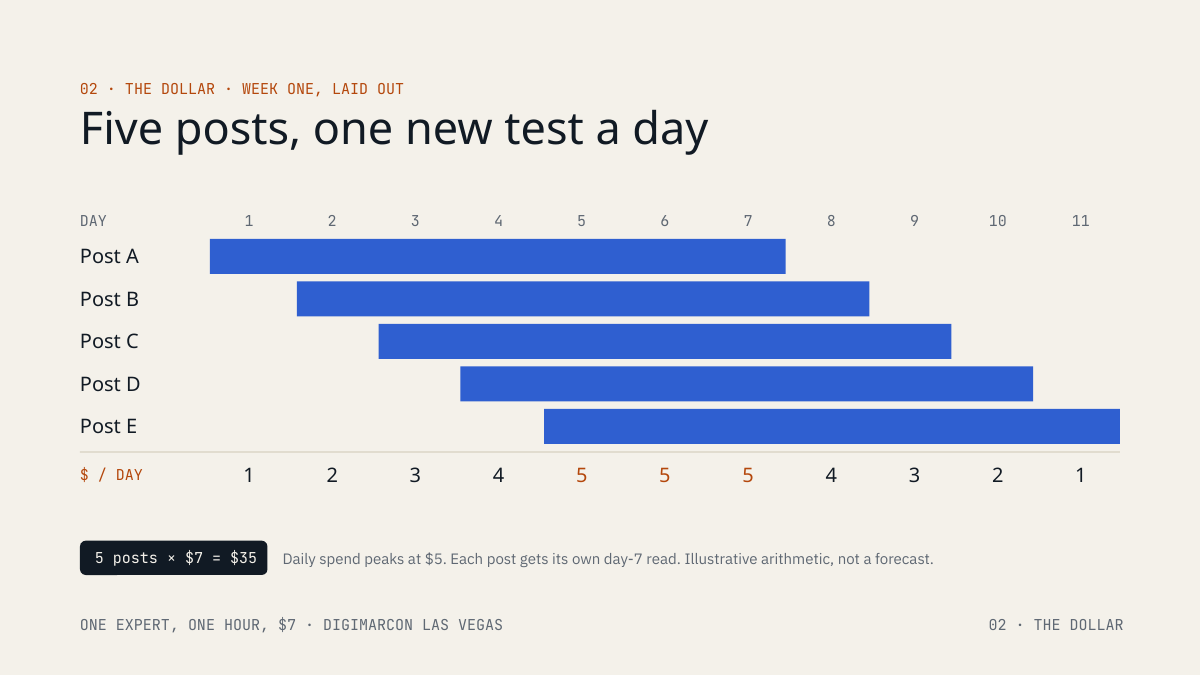
Five posts, one new test a day
Here's what week one looks like on a calendar. Five proven posts, A through E. We layer them in: post A starts on day one, post B on day two, and so on. Each one runs a dollar a day for seven days. So your spend ramps up: one dollar, two, three, four, and it peaks at five dollars a day. Then it ramps down as each test finishes. Add it up: five posts times seven dollars is thirty-five dollars.
Slide 26 of 57
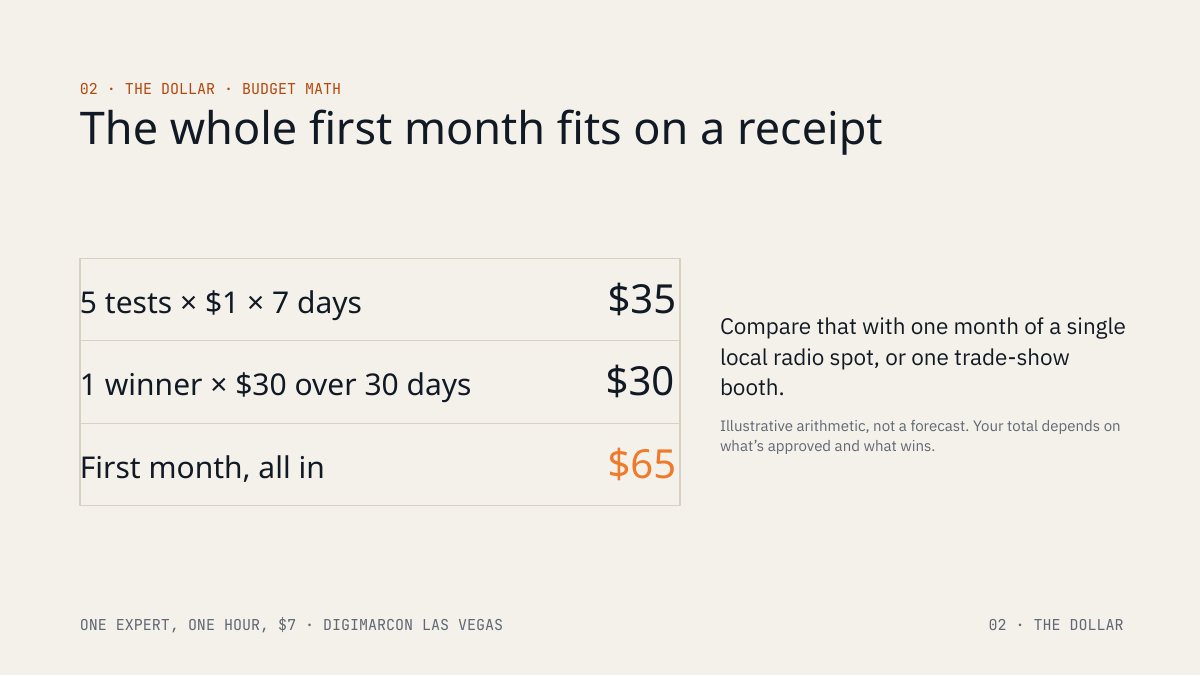
The whole first month fits on a receipt
Let's do the budget math for the first month. Five tests, a dollar a day, seven days each: thirty-five dollars. Say one wins. Thirty dollars over thirty days behind it: thirty more. Sixty-five dollars, all in. That's a rounding error next to almost anything else on a local marketing budget. This is arithmetic, not a forecast. What you actually spend depends on what gets approved and what wins.
Slide 27 of 57
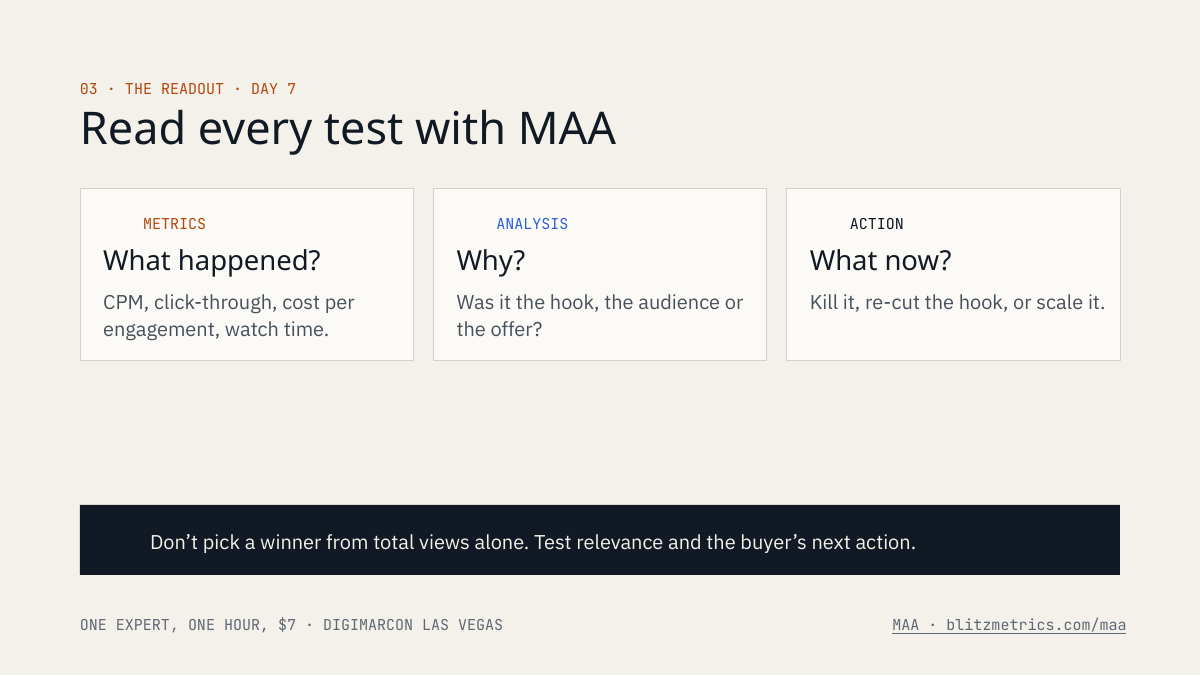
Read every test with MAA
Day seven. Now we read each test, one at a time, with MAA: Metrics, Analysis, Action. Metrics tell you what happened. CPM, click-through, cost per engagement, watch time. Analysis tells you why. Was it the hook, the audience, or the offer? Each one has a different fix. Action closes the gap. Kill it, re-cut the hook and test again, or scale it. One warning. Don't pick a winner from total views alone. Views are cheap.
Slide 28 of 57
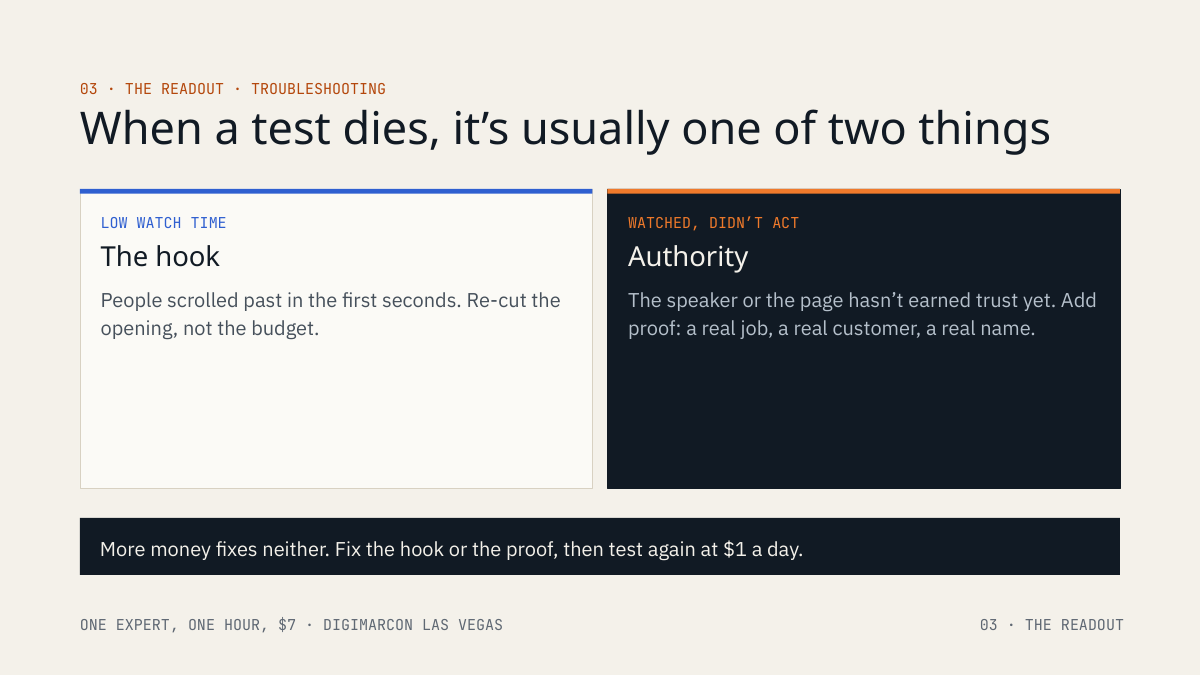
When a test dies, it’s usually one of two things
When a test dies, it's usually one of two things. The hook. Watch time is low; people scrolled right past. The hook is vital. Re-cut the opening, not the budget. Authority. They watched, but they didn't act. The speaker or the page hasn't earned enough trust yet. Add proof: a real job, a real customer, a real name. More money fixes neither.
Slide 29 of 57
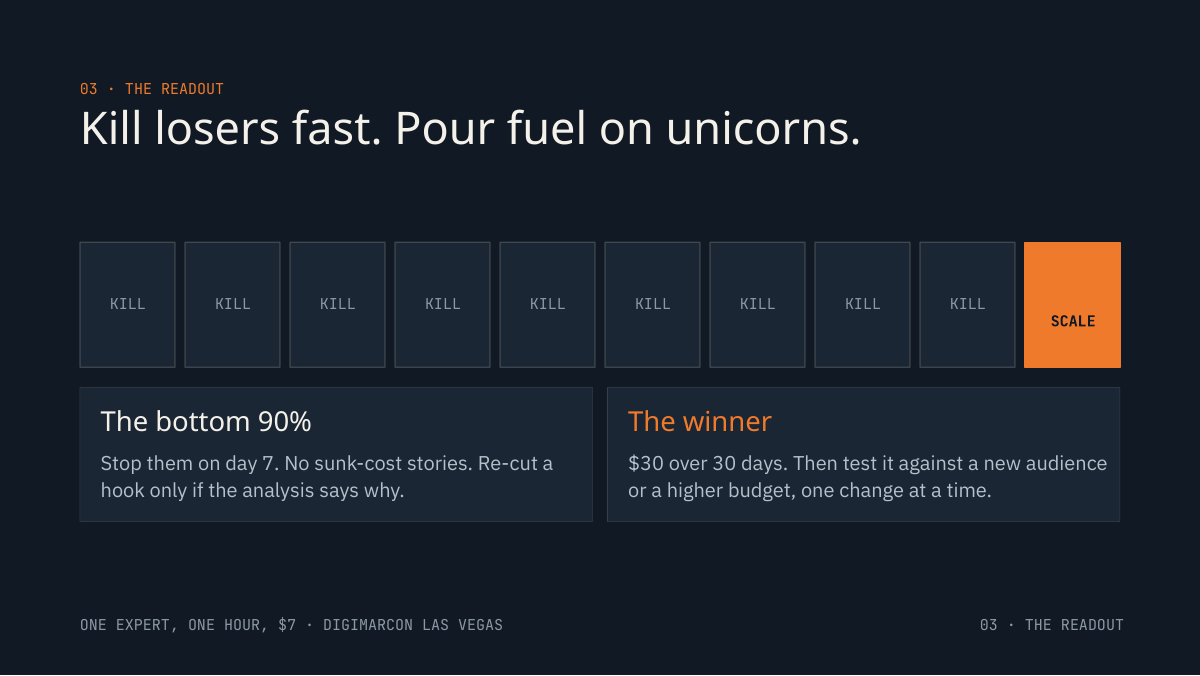
Kill losers fast. Pour fuel on unicorns.
This is the part people find hard emotionally. Most of your tests should die. The bottom ninety percent, stop them on day seven. No sunk-cost stories. "But I spent so long on that clip." Doesn't matter; the audience voted. If the analysis tells you why it failed, say the hook was slow, you can re-cut the hook and test again. Otherwise, let it go. The ninety percent is a guide from the day-seven read, not a quota.
Slide 30 of 57
Warm first, cold last
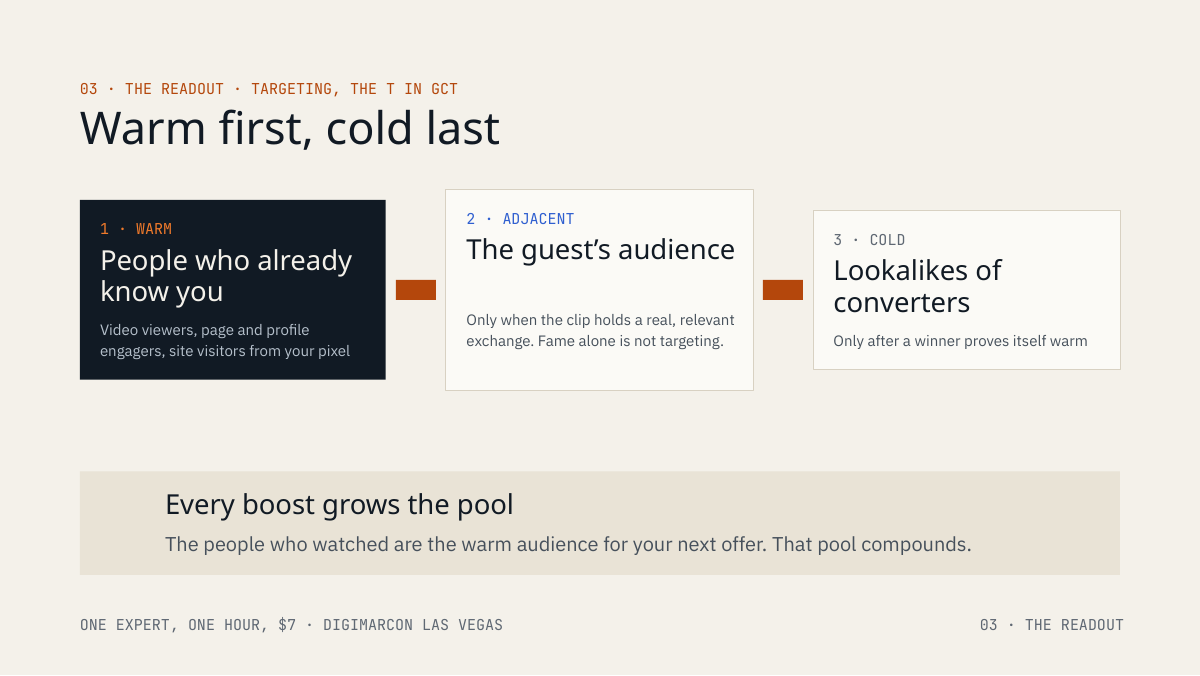
Now targeting, the T in GCT, and remember, it comes last. Warm first. People who already know you: video viewers, people who engaged with your page or profile, site visitors from your pixel. That's why the plumbing matters. Then adjacent. The audience of a guest or a brand in your clip, but only when the clip holds a real, relevant exchange with them. Fame alone is not targeting. A recognizable face in a clip with nothing useful to say is just a face.
Slide 31 of 57
Inspect the whole chain
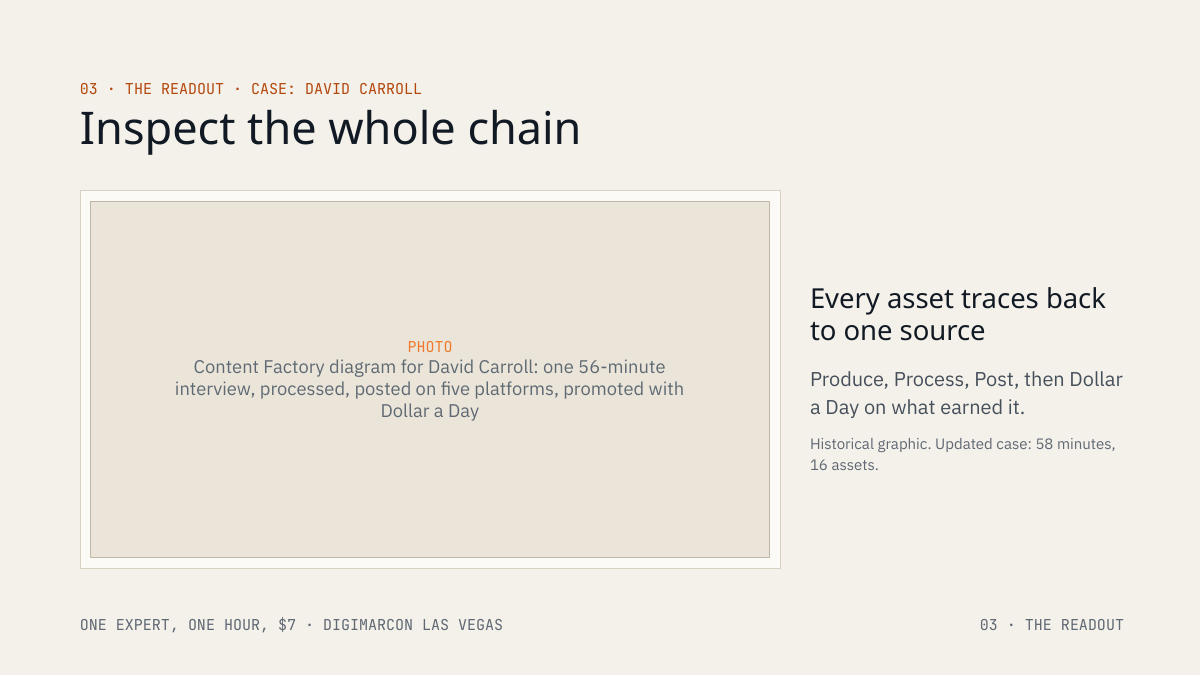
Here's the whole chain on one page. David Carroll. One long-form interview. Processed into clips, captions and metadata. Posted across platforms, each with its own numbers. And then, at the far right, Promote: Dollar a Day ads on the pieces that earned it. The point is that every asset traces back to one source. When something wins, you know exactly where it came from, so you can go back to the recording and find the next clip like it.
Slide 32 of 57
Small budgets, real results
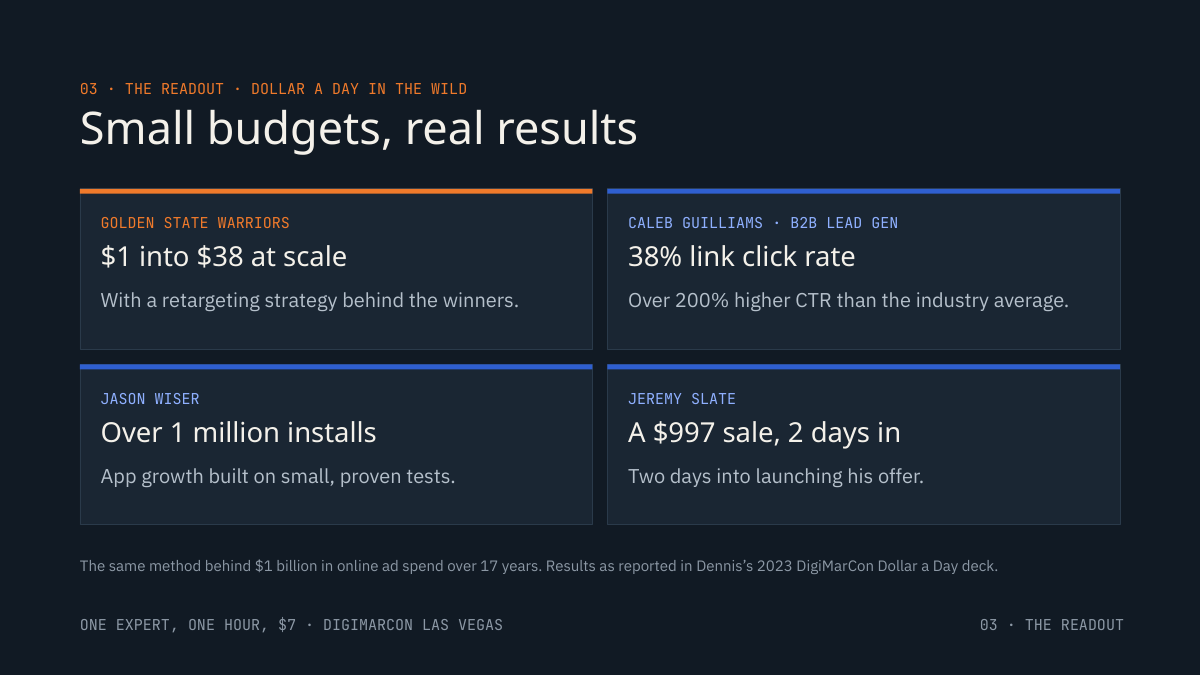
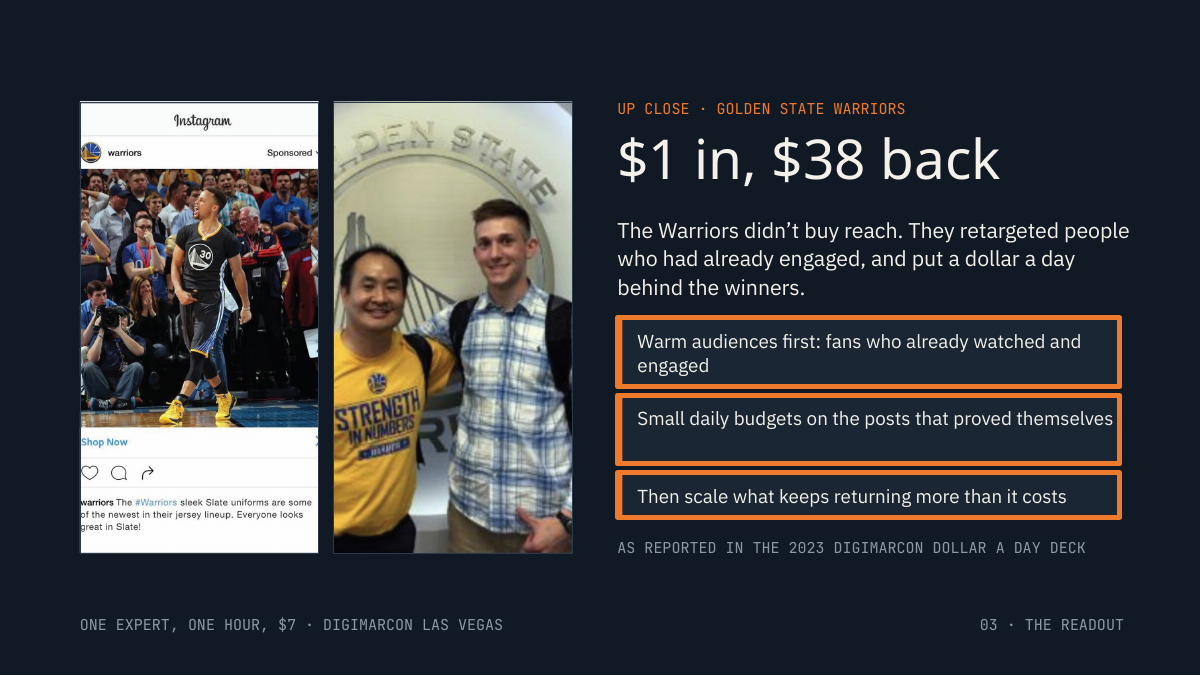
Does it work beyond local? Here are a few from my DigiMarCon Dollar a Day deck from 2023. The Golden State Warriors: a dollar into thirty-eight dollars at scale, with a retargeting strategy behind the winners. Caleb Guilliams, B2B lead gen: a thirty-eight percent link click rate, more than two hundred percent above the industry average. Jason Wiser: over a million installs. Jeremy Slate: a nine-hundred-ninety-seven-dollar sale two days after launching.
Slide 33 of 57
Twenty real Dollar a Day stories
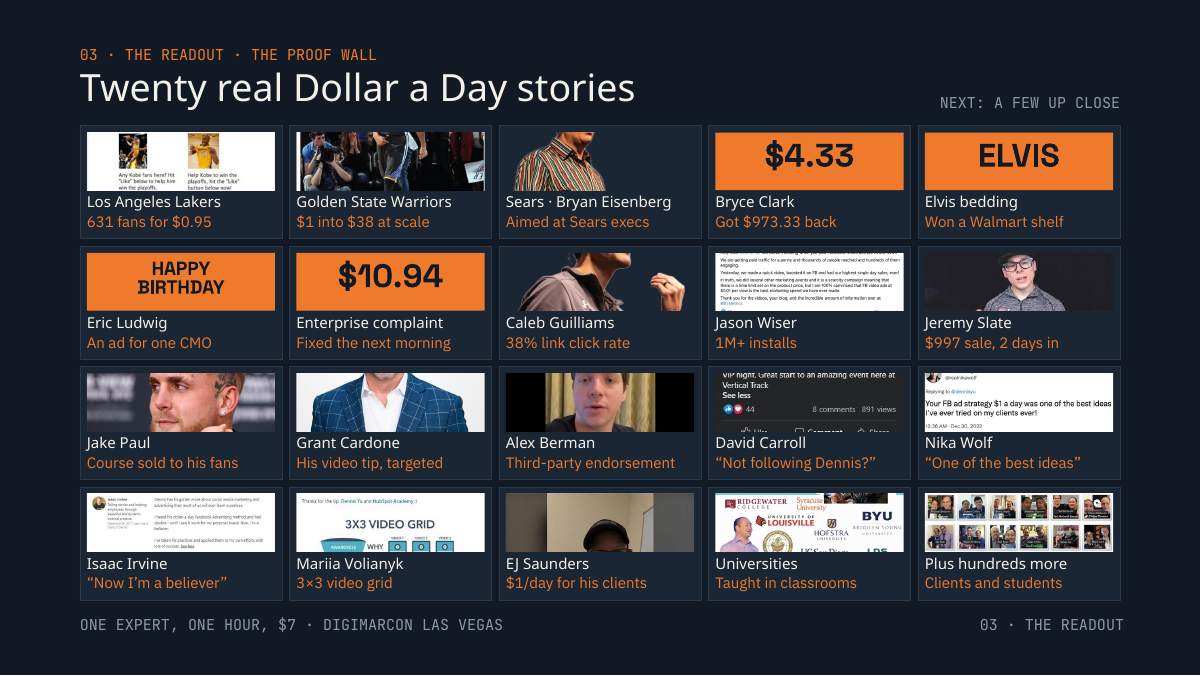
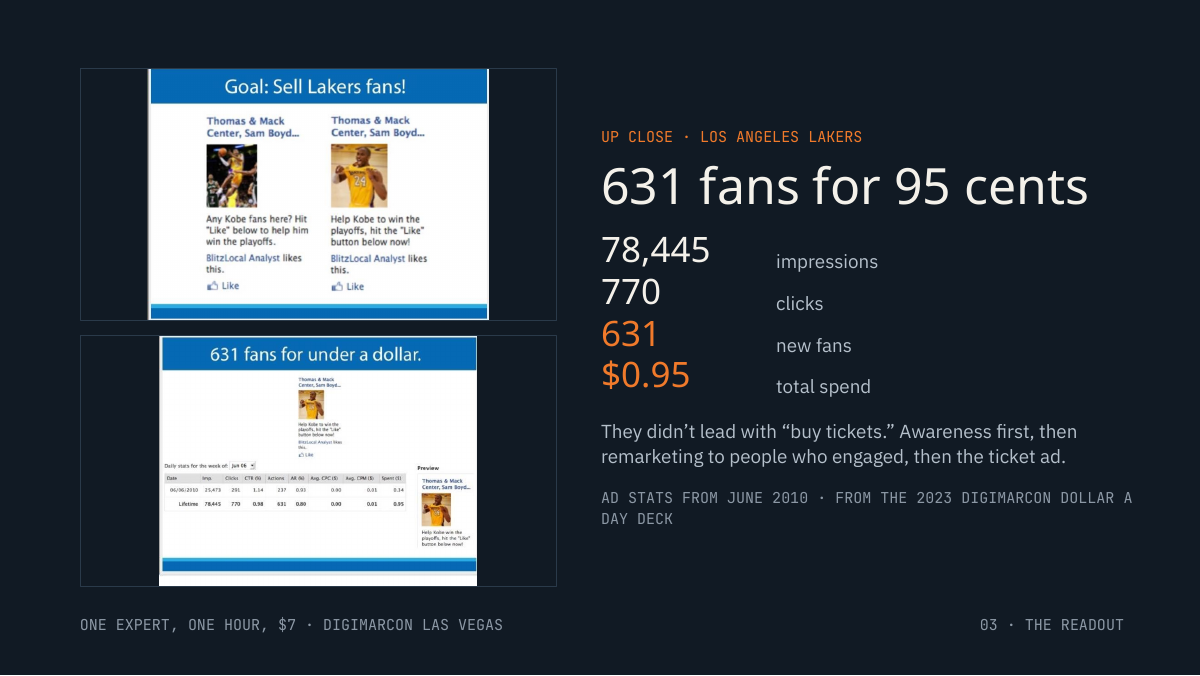
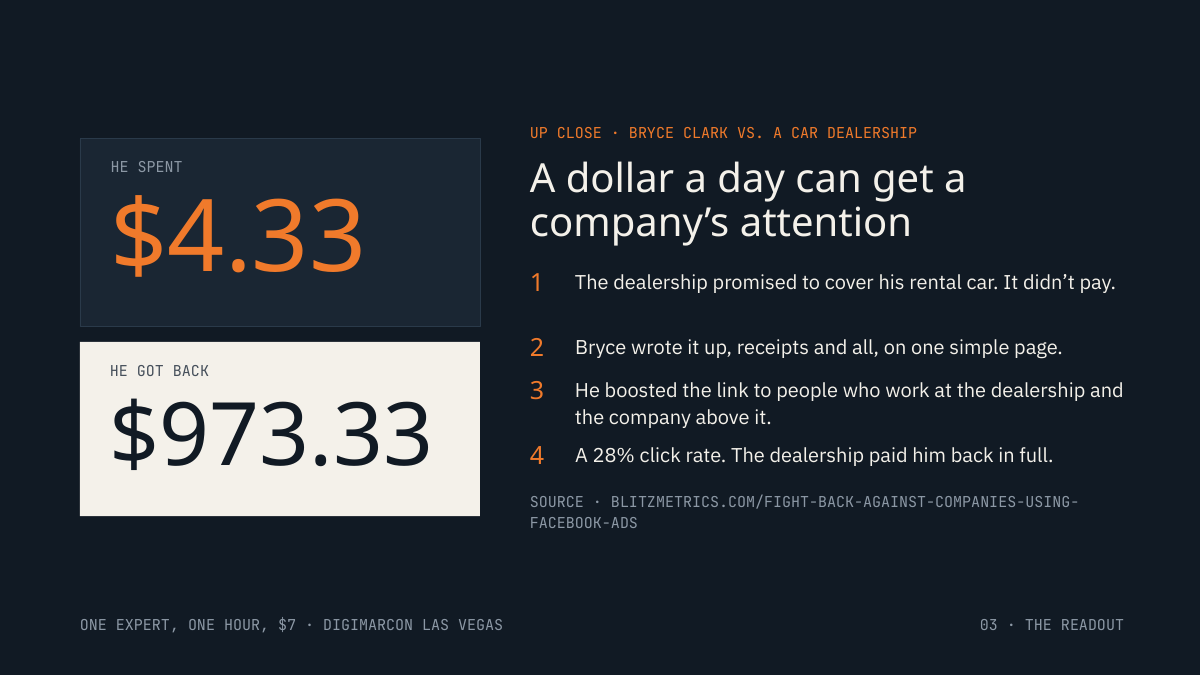
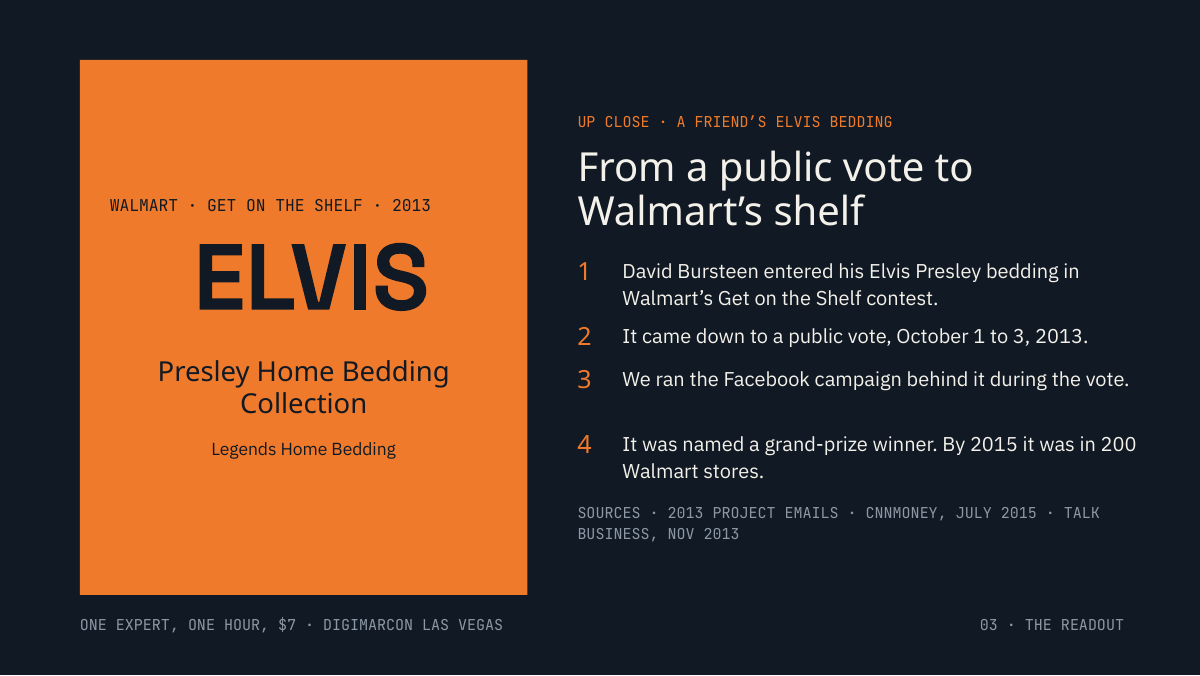
Here's the proof wall. Twenty real Dollar a Day stories, and every one of them is a real person or a real brand. The Lakers got 631 fans for ninety-five cents. The Warriors turned a dollar into thirty-eight with retargeting. Bryan Eisenberg's mom got Sears executives to pay attention. Bryce Clark spent four dollars and thirty-three cents and got his nine hundred and seventy-three dollars back from a car dealership. A friend's Elvis bedding won a spot on Walmart's shelf.
Slide 34 of 57
631 fans for 95 cents
Up close: the Lakers. Two simple ads with Kobe on them. Any Kobe fans here? Help Kobe win the playoffs, hit Like. 78,445 impressions. 770 clicks. 631 new fans. Total spend: ninety-five cents. And here's the part people miss. They didn't show everyone a Buy Tickets ad. They built the path: awareness first, then remarketing to the people who engaged, and only then the ticket ad. That's the same path you'd build for a roofing company or a law firm.
Slide 35 of 57
$1 in, $38 back
Up close: the Golden State Warriors. One dollar in, thirty-eight dollars back, at scale. How? They didn't buy reach. They retargeted people who had already engaged, fans who watched and reacted, and put a dollar a day behind the posts that proved themselves. Then they scaled what kept returning more than it cost. You don't have an NBA team's audience. You don't need one.
Slide 36 of 57
HE SPENT
Up close: Bryce Clark versus a car dealership. The dealership promised to reimburse Bryce for a rental car. Then it didn't pay. He was out nine hundred and seventy-three dollars and thirty-three cents. So he wrote it up, with the receipts, on one simple page. Then he boosted a post linking to it, aimed at the people who work at that dealership and the company above it. Total spend: four dollars and thirty-three cents. A 28 percent click rate.
Slide 37 of 57
WALMART · GET ON THE SHELF · 2013
Up close: a friend trying to get his Elvis products into Walmart. David Bursteen co-founded Legends Home Bedding, and he had the Elvis Presley Home Bedding Collection. He entered it in Walmart's Get on the Shelf contest, and it came down to a public vote, October 1 to 3, 2013. We ran the Facebook campaign behind it during that vote. It was named one of the grand-prize winners. And by 2015, CNN reported it rolling out to 200 Walmart stores.
Slide 38 of 57
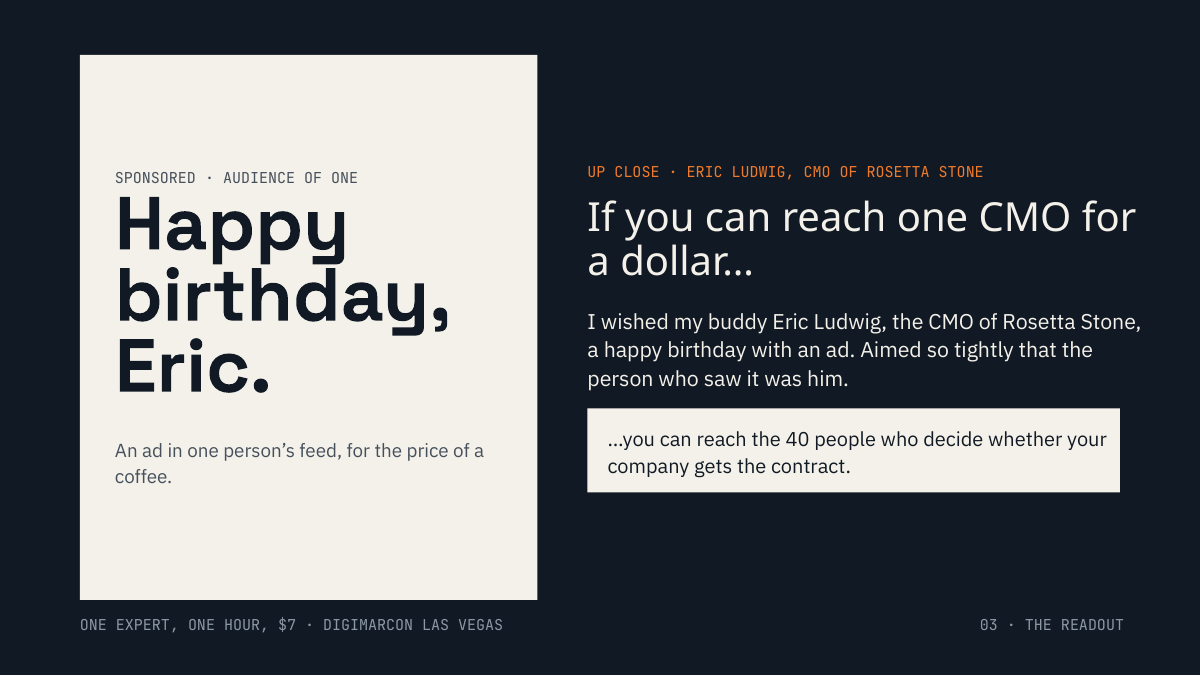
SPONSORED · AUDIENCE OF ONE
Up close: an audience of one. My buddy Eric Ludwig was the CMO of Rosetta Stone. For his birthday, I didn't send a card. I ran an ad. Happy birthday, Eric. Aimed so tightly that the person who saw it in his feed was him. It's a fun story. But here's the business point.
Slide 39 of 57
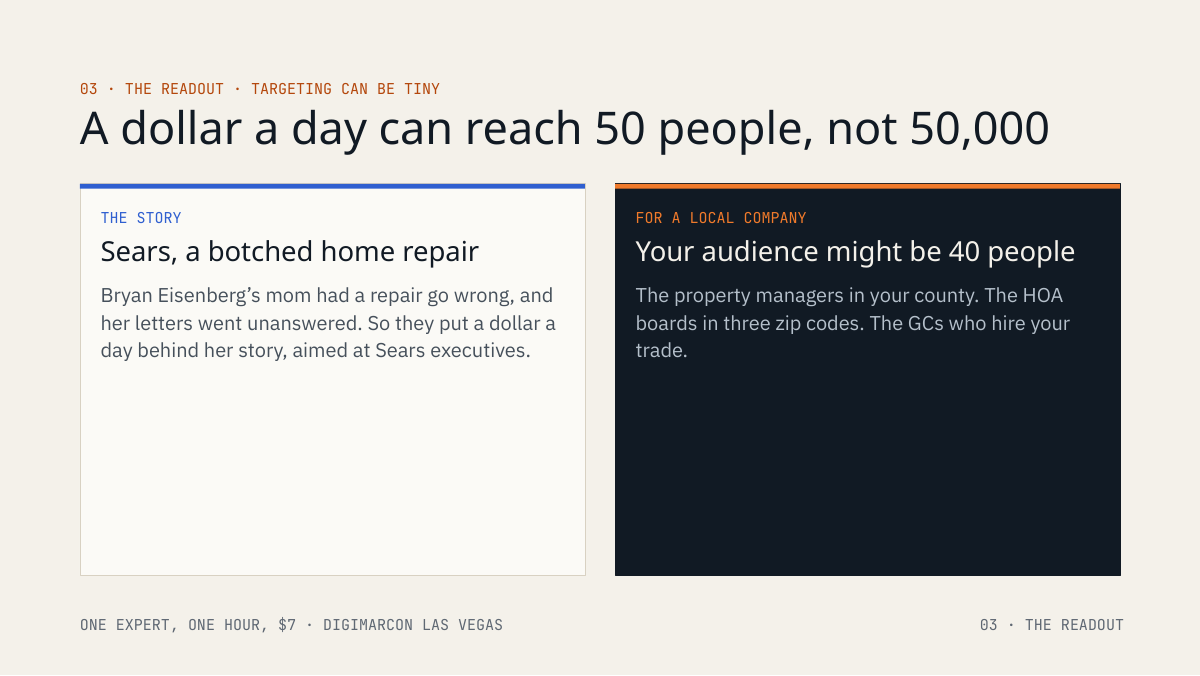
A dollar a day can reach 50 people, not 50,000
Targeting can be tiny. This is one of my favorite stories. Bryan Eisenberg's mom had a botched home repair from Sears, and her letters went nowhere. So they put a dollar a day behind her story, aimed squarely at Sears executives. The people who could fix it were the only people who needed to see it. For a local company, your most valuable audience might be forty people. The property managers in your county. The HOA boards in three zip codes.
Slide 40 of 57
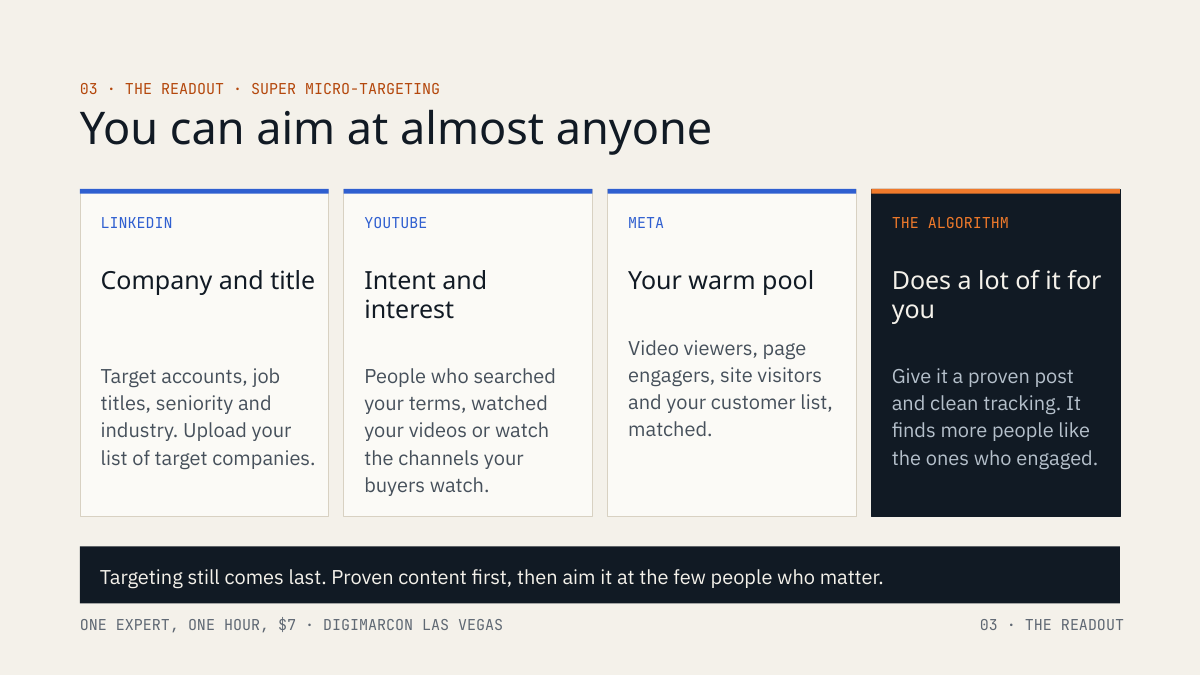
You can aim at almost anyone
So how tiny can targeting get? Super tiny. On LinkedIn you can aim at specific companies, job titles, seniority and industries, or upload your own list of target accounts. That's where 'the 40 people who decide' lives today. On YouTube you can reach people who searched your terms, who watched your videos, or who watch the channels your buyers watch. On Meta, your best audience is the warm pool: video viewers, page engagers, site visitors and your customer list.
Slide 41 of 57
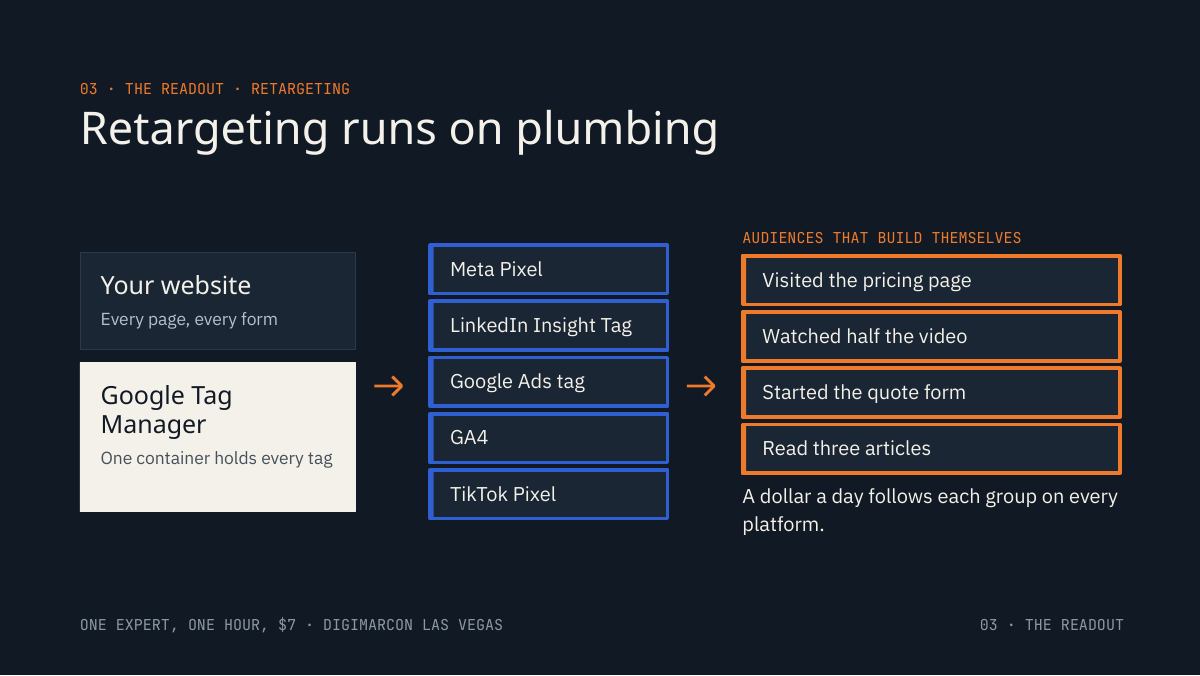
Retargeting runs on plumbing
Retargeting is where Dollar a Day gets incredible. But it runs on plumbing. Put Google Tag Manager on your website. One container. That one container holds every tag: the Meta Pixel, the LinkedIn Insight Tag, the Google Ads tag, GA4, the TikTok Pixel. Set it up once, and every platform can see who visited. Now your audiences build themselves. People who visited the pricing page. People who watched half the video. People who started the quote form and didn't finish.
Slide 42 of 57
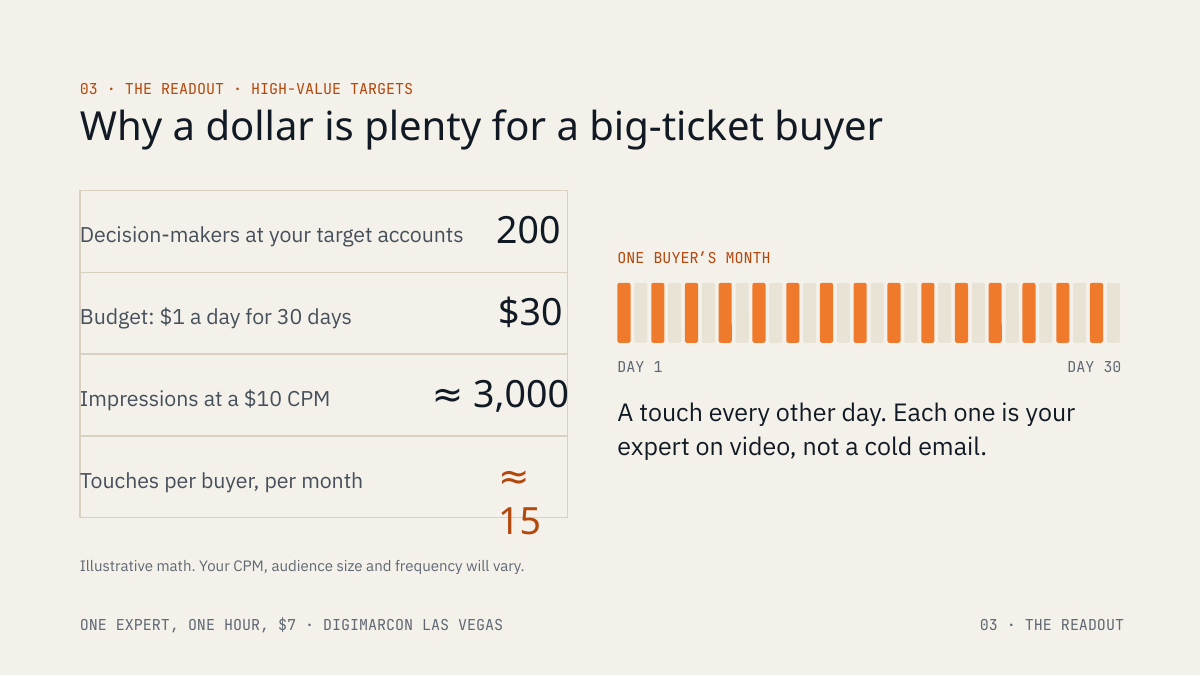
Why a dollar is plenty for a big-ticket buyer
Here's why a dollar a day, which doesn't sound like much, is actually powerful when the buyer is worth a lot. Say there are 200 decision-makers at the accounts you want. A dollar a day for thirty days is thirty dollars. At a ten-dollar CPM, that's about three thousand impressions. Spread across 200 people, that's about fifteen touches each, every month. That's one buyer's month. A touch every other day. And each touch is your expert on video, answering a real question.
Slide 43 of 57
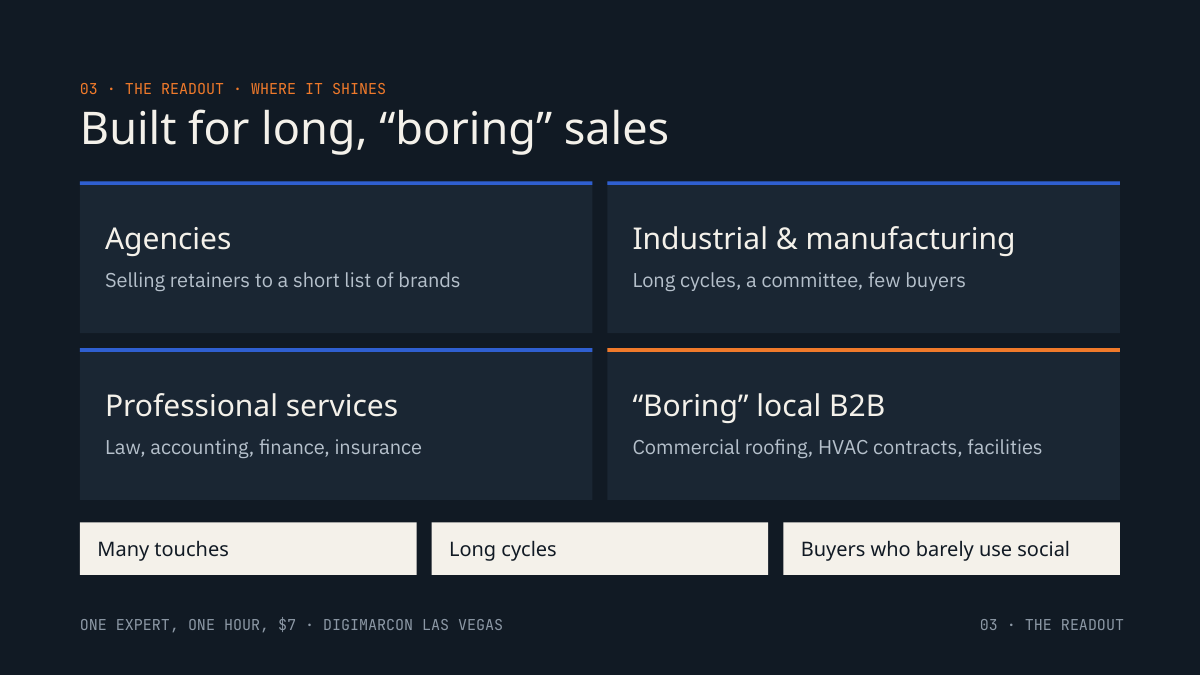
Built for long, “boring” sales
Where does Dollar a Day shine brightest? Not where you'd expect. It's B2B. Agencies selling retainers to a short list of brands. Industrial and manufacturing companies with long cycles and a buying committee. Professional services: law, accounting, finance, insurance. And the so-called boring local B2B: commercial roofing, HVAC service contracts, facilities. These sales need many touches. They take months. And a lot of these buyers are not social media people. They're not posting. But they scroll, and they watch.
Slide 44 of 57
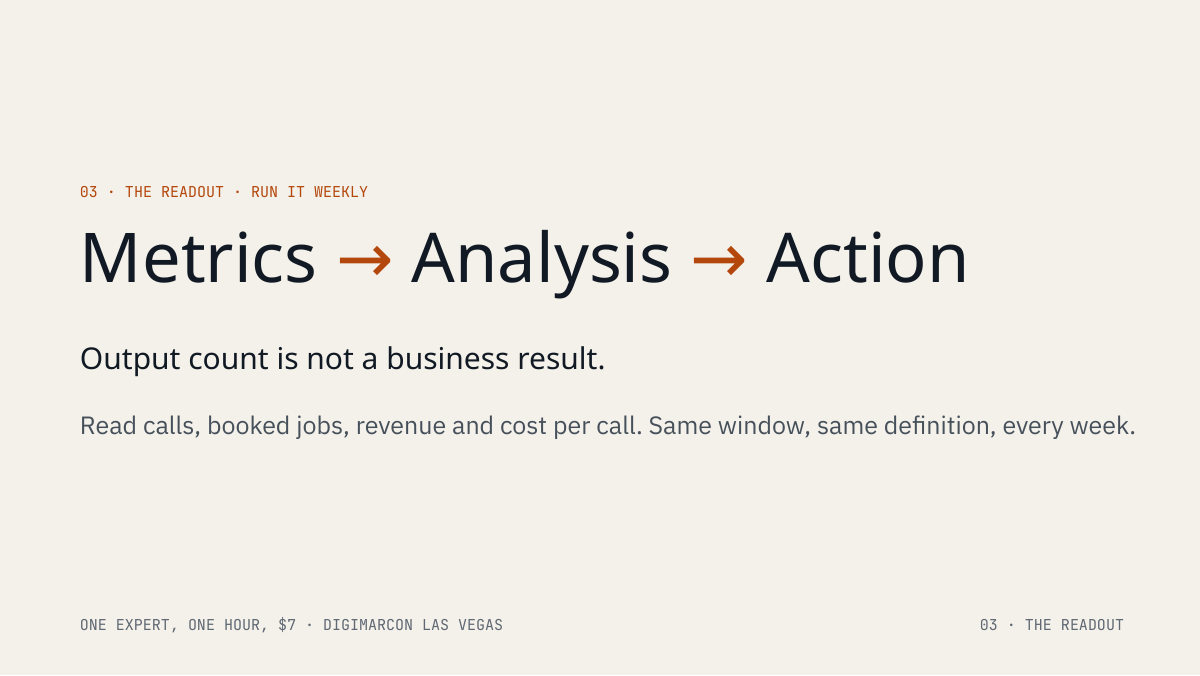
Analysis
Run it weekly. Metrics, analysis, action. And please hear this: output count is not a business result. Nobody's owner ever got excited about 'we posted twenty times.' Read the numbers your owner cares about: calls, booked jobs, revenue, cost per call. Same window, same definition, every week. That's how the readout earns you the next budget.
Slide 45 of 57
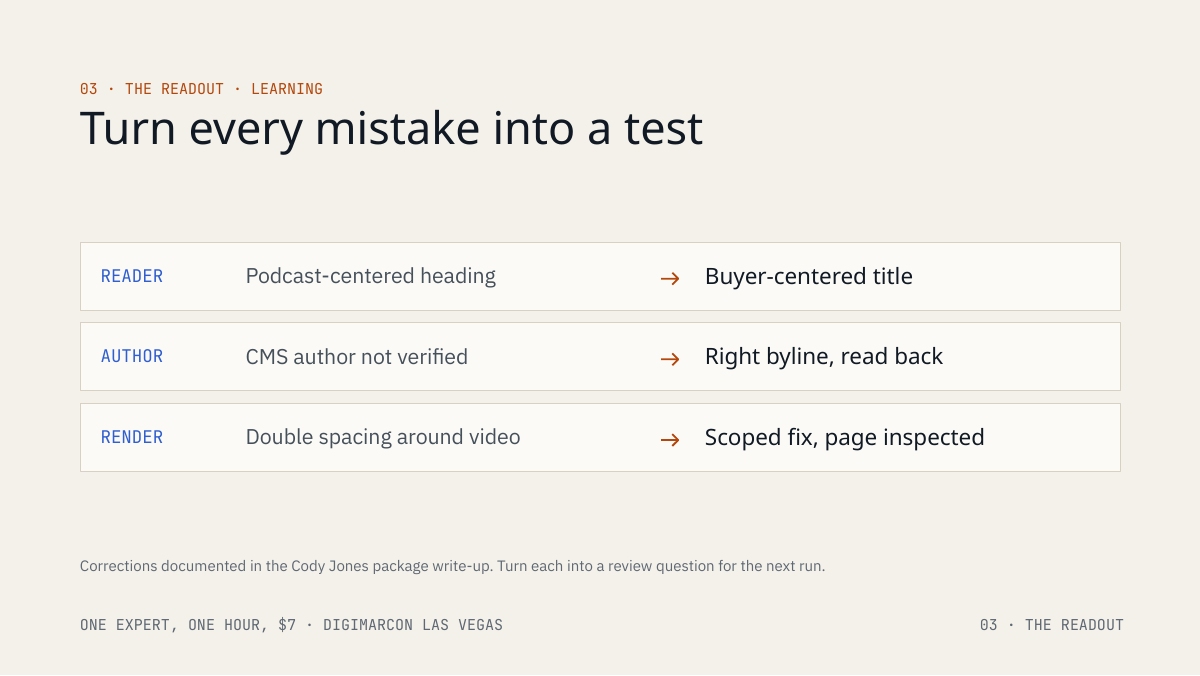
Turn every mistake into a test
Every week something goes wrong. Good. Turn every mistake into a test. These three are real, from the Cody Jones package. Reader: the heading was about the podcast, not the buyer. Now the title is written for the buyer. Author: the byline in the CMS wasn't verified. Now we set the right byline and read it back. Render: there was double spacing around the video. A scoped fix, and then somebody actually inspected the page.
Slide 46 of 57
Agents stage it. A human approves the spend.
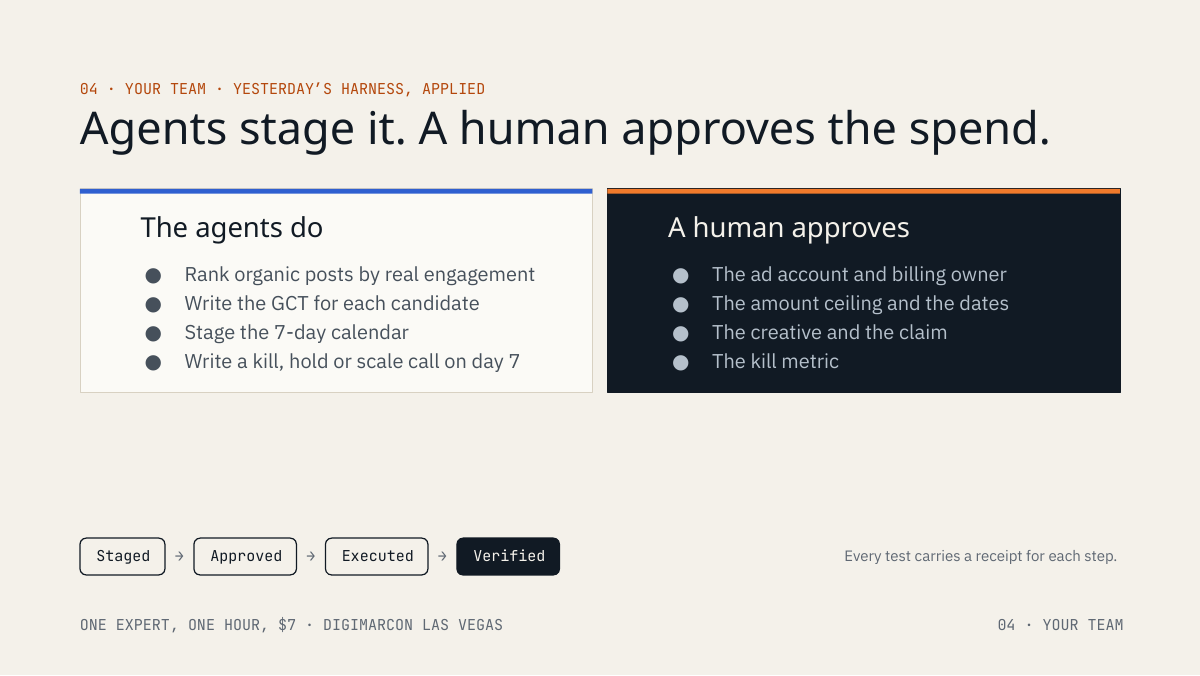
If you were here yesterday, this is the agent harness, put to work on Dollar a Day. The agents do the heavy lifting. They rank your organic posts by real engagement. They write the GCT for each candidate. They stage the seven-day calendar. And on day seven they write a recommendation: kill, hold or scale, with the MAA reasoning. A human approves the money. Which ad account and who owns the billing. The amount ceiling and the dates. The creative and what it claims.
Slide 47 of 57
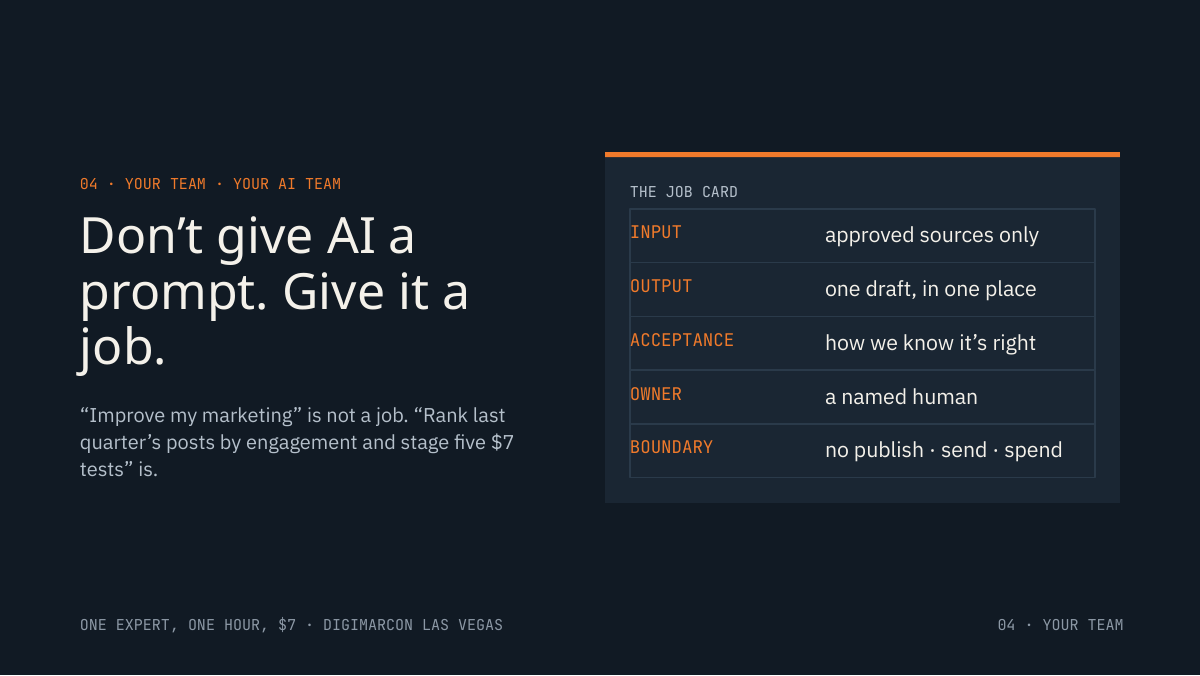
Don’t give AI a prompt. Give it a job.
When you hand Dollar a Day to an agent, don't give it a prompt. Give it a job. 'Improve my marketing' is not a job. 'Rank last quarter's posts by engagement and stage five seven-dollar tests' is a job. Every job gets a card. Input: approved sources only. Output: one draft, in one place. Acceptance: how we'll know it's right. Owner: a named human.
Slide 48 of 57
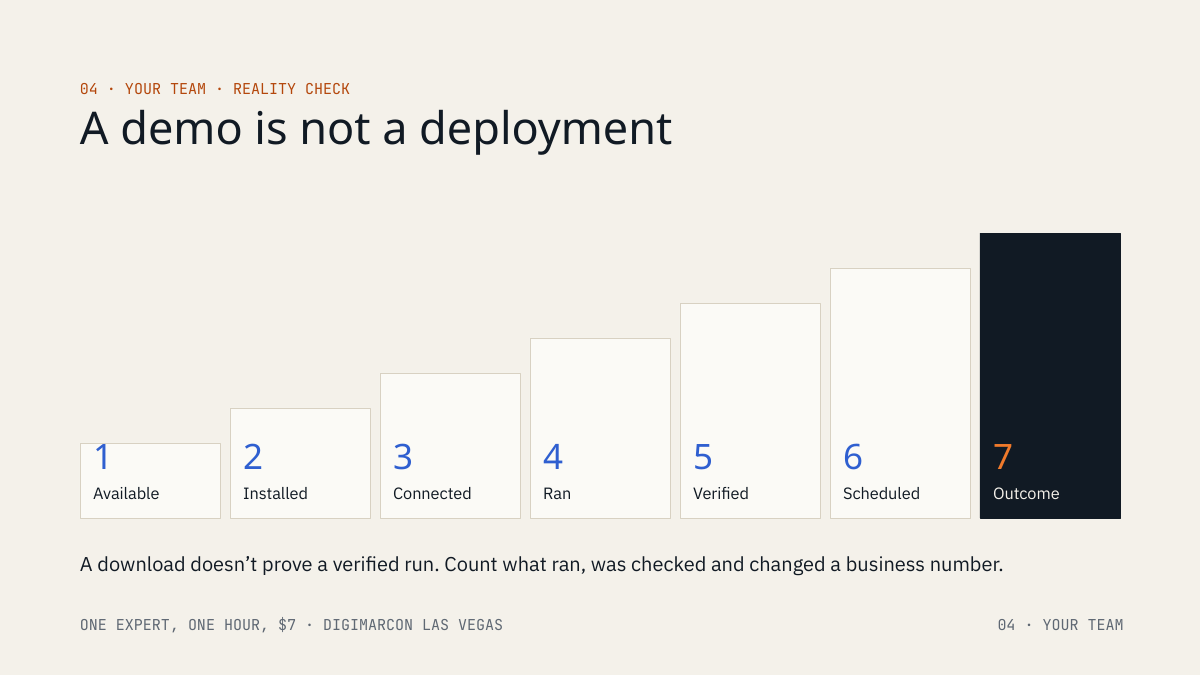
A demo is not a deployment
A reality check, because vendors will show you a lot of demos this week. A demo is not a deployment. There are seven steps. Available. Installed. Connected. It actually ran. Somebody verified the output. It's scheduled to run again. And finally, outcome: it changed a business number. Most AI tools in most companies are stuck at step two. Count what ran, was checked, and changed a number.
Slide 49 of 57
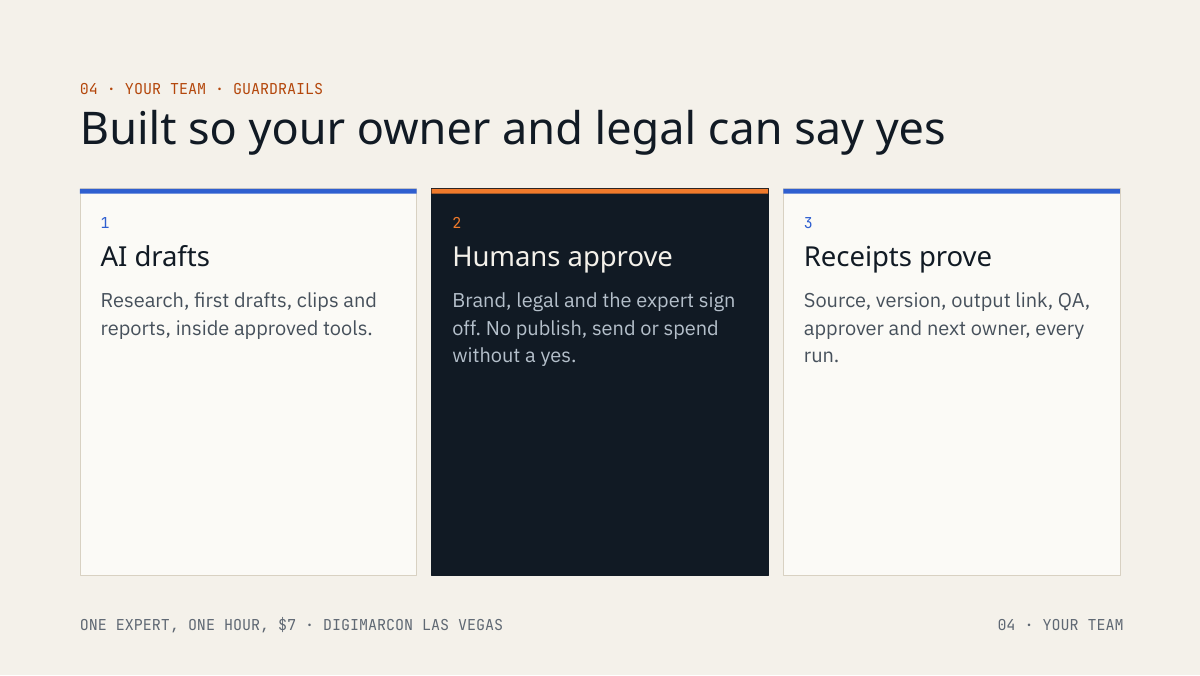
Built so your owner and legal can say yes
Here's the whole guardrail model in three words each. AI drafts: research, first drafts, clips and reports, inside tools you've approved. Humans approve: brand, legal and the expert sign off. Nothing is published, sent or spent without a yes. Receipts prove it: the source, the version, the output link, the QA, who approved it, and who owns the next step. Every single run.
Slide 50 of 57
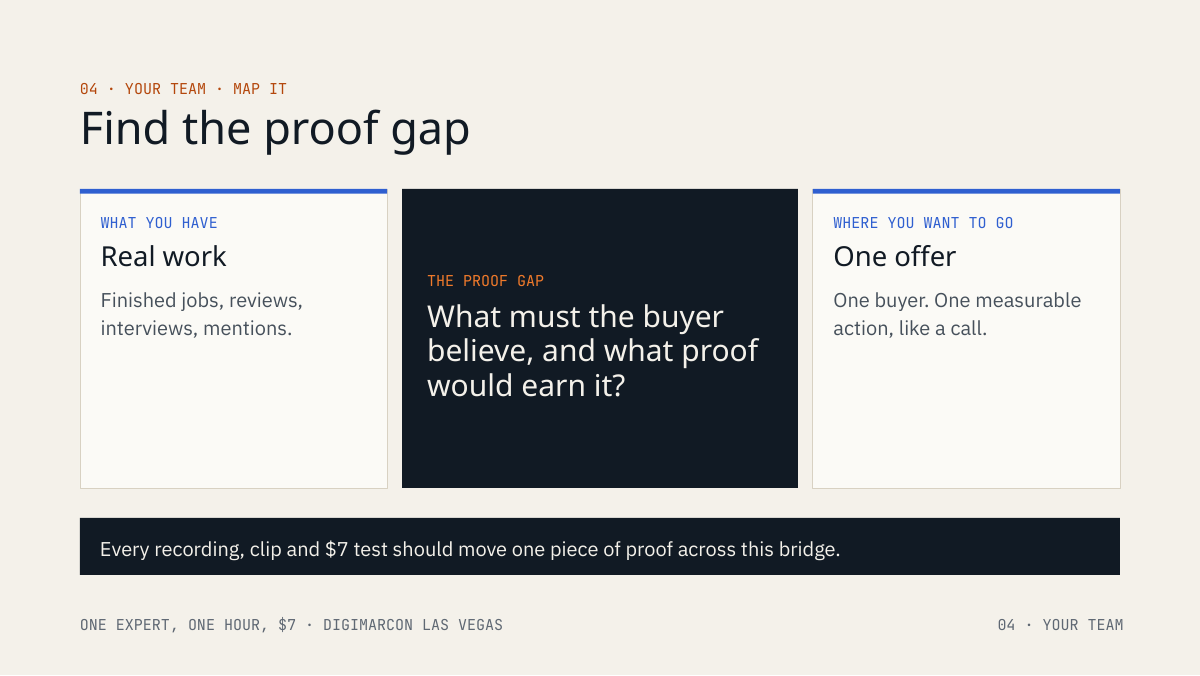
Find the proof gap
Before you multiply anything, map it. Find the proof gap. On one side is what you have: finished jobs, reviews, interviews, mentions. On the other side is where you want to go: one offer, one buyer, one measurable action, like a phone call. The gap is the question: what does the buyer need to believe, and what proof would earn it? Every recording, every clip, every seven-dollar test should move one piece of proof across that bridge.
Slide 51 of 57
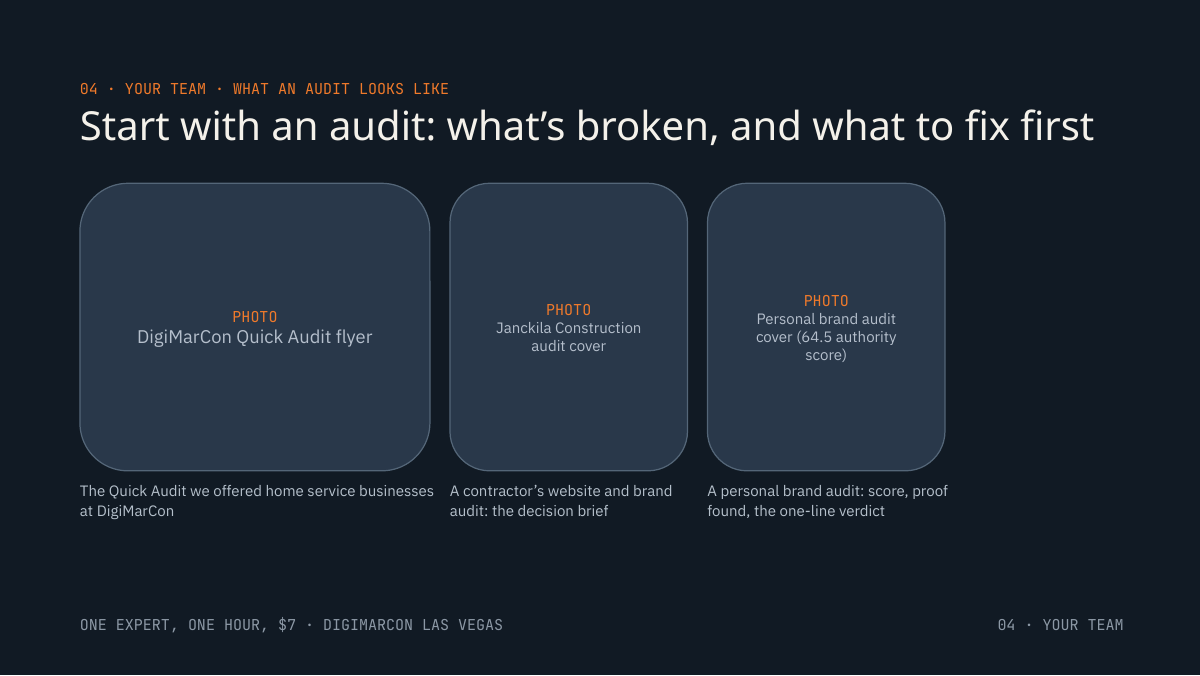
Start with an audit: what’s broken, and what to fix first
This is what the starting point looks like. An audit. This is the Quick Audit we offered home service businesses at DigiMarCon: find what's broken in SEO, the site and social, a one-on-one, and a plain-English action plan your team can follow. Here's a real one: a website and brand audit for a construction company. Page one is a decision brief. The work is credible; explain it more clearly. And it names the first move.
Slide 52 of 57
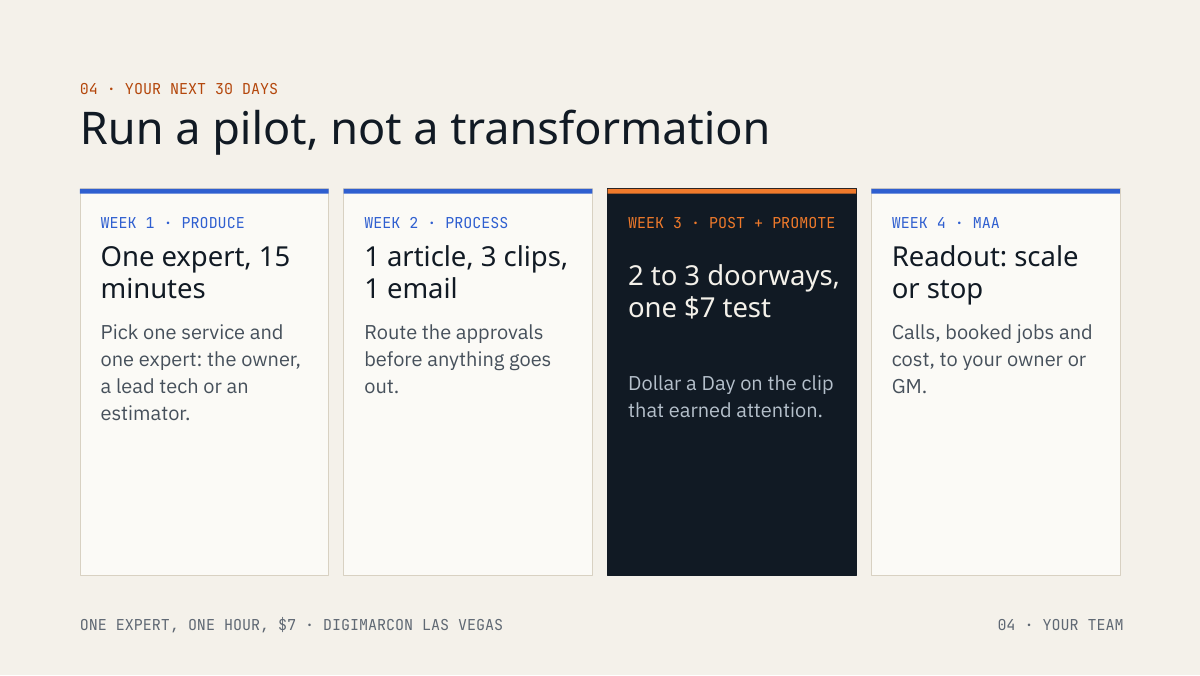
Run a pilot, not a transformation
So what do you do on Monday? Run a pilot, not a transformation. Thirty days. Week one: produce. Pick one service and one expert: your owner, a lead tech or an estimator. Record fifteen minutes. And check the plumbing: pixel, audiences, access. Week two: process. One article, three clips, one email. Route the approvals before anything goes out. Week three: post and promote. Two or three doorways, and one seven-dollar test on the clip that earned the most attention organically.
Slide 53 of 57
Dennis and Alex Makowski
Monday morning. Open your phone. Your camera roll is an untapped asset library. That's Alex Makowski and me. Every real conversation like that belongs in a source library. Start with five recordings, not fifty. Name the people, the topic and the date. Keep the originals. Then rank what you've already posted, and put seven dollars behind the winner.
Slide 54 of 57
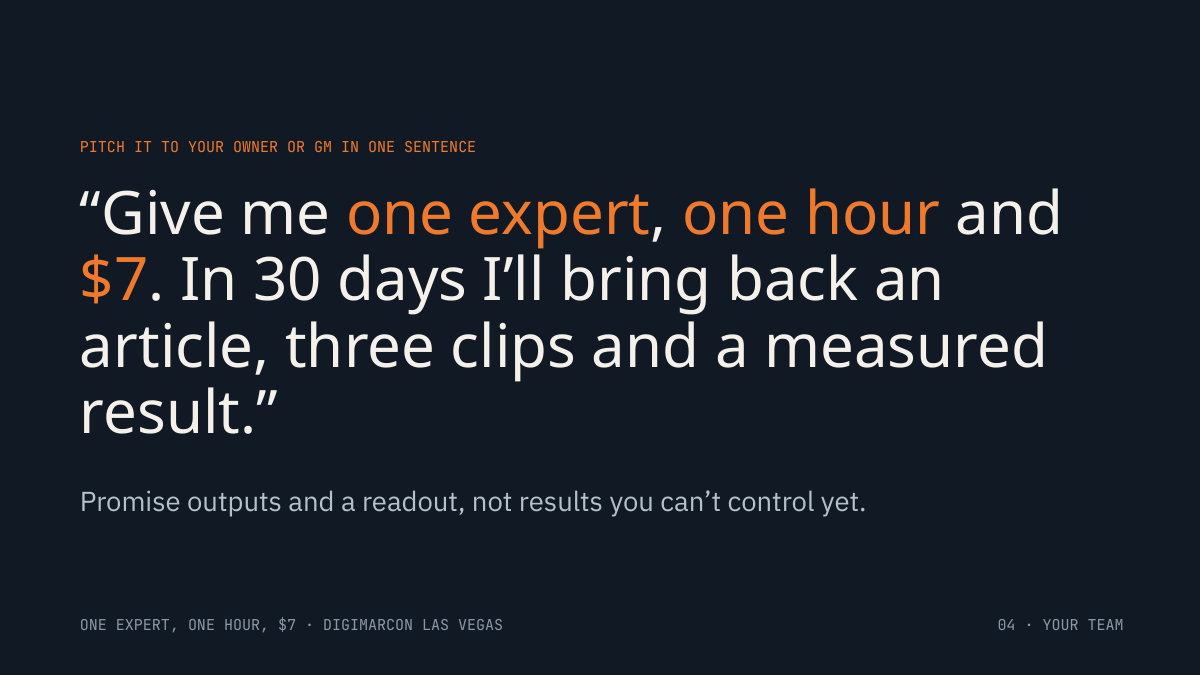
PITCH IT TO YOUR OWNER OR GM IN ONE SENTENCE
And here's how you sell it, in one sentence. Write this down, or take a picture. "Give me one expert, one hour and seven dollars. In thirty days I'll bring back an article, three clips and a measured result." Notice what that promises. Outputs and a readout. Not leads, not revenue, not results you can't control yet. That's why it's easy to say yes to. Your owner can say yes to seven dollars in the hallway.
Slide 55 of 57
THANK YOU, LAS VEGAS
So here's the whole talk in one line: boost what already won. Record one expert. Let the audience vote with organic posts. Then put seven dollars behind the winner, read it on day seven, kill the rest, and scale what earns it. One thing to do before you leave the room: scan this. Everything from today is at dennisyu.com/digimarcon. The slides, the Dollar a Day method, the case studies, and the links from yesterday's agent harness session too.
Slide 56 of 57
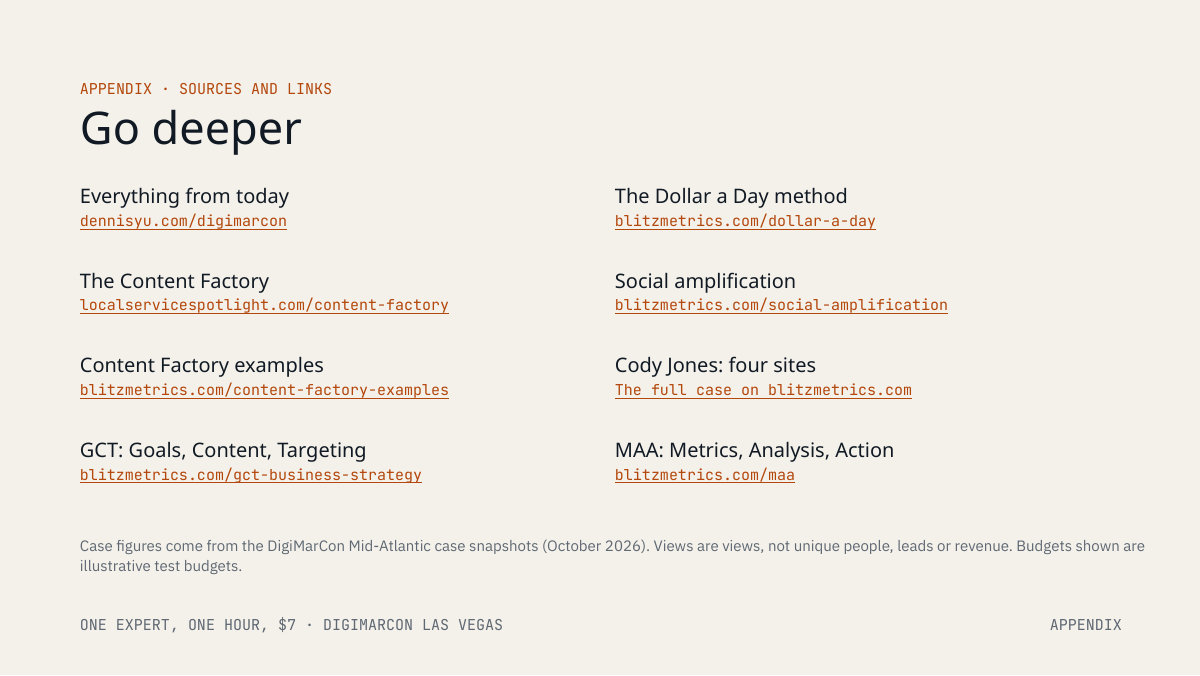
Sources and links
Appendix for anyone who downloads the slides. Every source and link from today, clickable. All of these are also on the event page, dennisyu.com/digimarcon.
Slide 57 of 57
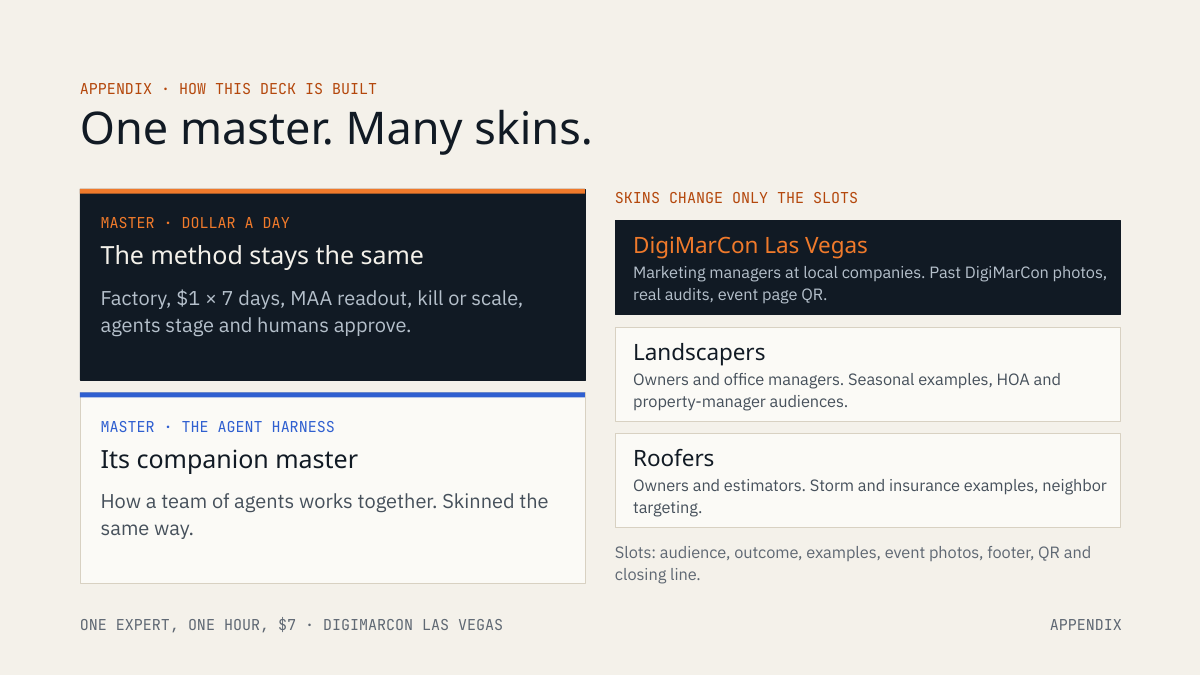
One master. Many skins.
This deck is the DigiMarCon skin of the Dollar a Day master. We keep two masters: Dollar a Day, and its companion, the Agent Harness. The method in a master never changes: the Content Factory, a dollar a day for seven days, the MAA readout, kill or scale, agents stage and humans approve. A skin only changes the slots: who the audience is, what outcome they care about, the examples, the event photos, the footer, the QR code and the closing line.
Dennis Yu · Local Service Spotlight · DigiMarCon World Las Vegas Day 2
Source: Google Slides “One Expert, One Hour, $7 · Dollar a Day · DigiMarCon Las Vegas Day 2 (DigiMarCon skin)” · 57 slides · rendered Nov 6, 2026 (America/Los_Angeles).