
A 25-year content authority who became invisible to AI search — and the one-hour fix that made him legible again. This is a worked example for our agents, and a preview of what AI does to good reputations.
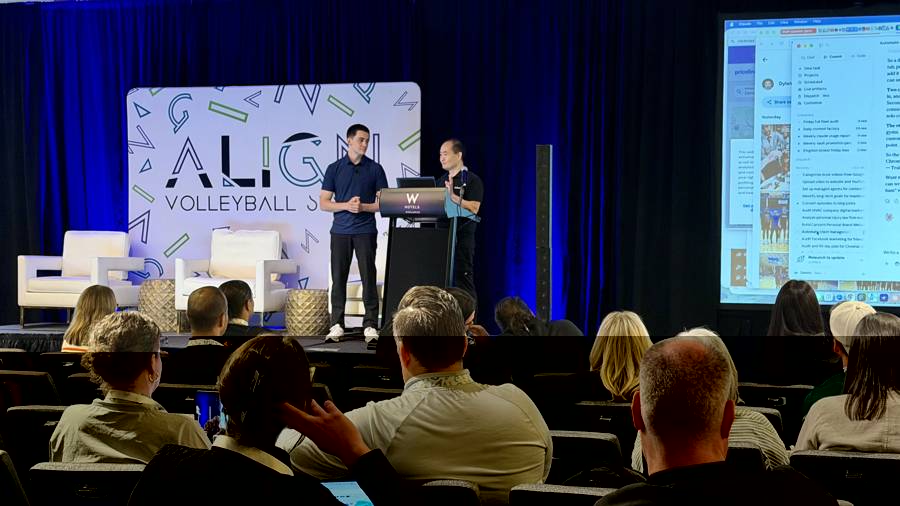
Brian Piper and I are speaking at Digital Day Wichita on AEO and SEO. On the ride over, we ran his name through Google’s Knowledge Graph and our Personal Brand Score tool — and found the most flattering problem a person can have: he has earned an enormous reputation that the machines simply can’t read.
What follows is everything an AI agent did from that single conversation — the research, the disambiguation, the scoring, the diagram, the website, and the economics. We publish these “meta-articles” so our other agents learn the playbook, and so clients can see exactly how the sausage is made.
The first job was to figure out which “Brian Piper” facts are real and most credible, and structure them so a non-technical audience can see it at a glance. In the middle is the real Brian. Around him, six verified achievements, ranked from most credible outward. Below the line: the two different people Google keeps merging him with.
This isn’t a thin-reputation story. It’s three legitimate reputations colliding — and our Brian holding the weakest machine signals even though he holds the strongest human one in his field.
| Brian W. Piper (ours) | Brian J. Piper, PhD | Brian F. Piper | |
|---|---|---|---|
| Field | Content / AEO | Neuroscience | Music |
| Signal | Books, podcast, talks | 120+ papers, Google Scholar | Owns brianpiper.com |
| Effect | Crowded out | Owns the citation graph | Owns the namespace |
The punchline writes itself: the exact-match domain belongs to the musician, the academic authority belongs to the neuroscientist, and our Brian is sandwiched between them — beaten on exactly the structured signals machines trust most. To a search engine or an AI model, structured beats impressive. The whole job is converting his impressive into structured.
We deliberately publish two numbers. One measures the reputation Brian has earned (an 85 — four books, one with Joe Pulizzi the “godfather of content marketing”; Director of Content Strategy at the University of Rochester; six straight years on the Content Marketing World main stage). The other measures how much of it a machine can resolve to one unambiguous person (a 24 — no Knowledge Panel, wrong website, scattered handles, three Brians fighting). The distance between them is the entire opportunity.
Brian’s 61-point gap isn’t a reputation problem — it’s a plumbing problem. Nothing needs to be invented. Everything we’d “build” already exists; it just needs to be made legible to Google and the AI answer engines. That’s the single best setup for an AI assist, because AI multiplies what’s already there.
Dennis asked us to be honest about whether Brian has a real mission or just likes to teach whatever’s hot. The fair read: he’s chased three waves — content marketing, then Web3/NFTs, now AI/AEO — and the crypto chapter dates him. But look closer and the constant is unmistakable:
Discoverability. Getting the right content found, wherever the audience is looking. Search → social → communities → AI.
Stated crisply, his MTP is: help mission-driven organizations — especially universities — get their best work found and trusted in the age of AI, human-first. AEO isn’t a pivot for him; it’s the fourth act of a 25-year discoverability career. There is a clear direction. His brand presentation just buries it. The fix is narrative consolidation, not reinvention — and quietly retiring the $PIPER coin from the front door.
To make the fix concrete, the agent built a reference entity-home site — facts-first, with consolidated Person schema, a complete sameAs list, and a signature “Which Brian Piper?” disambiguation block baked right into the page. It’s staged as a worked example at dennisyu.com/brian-piper.
The honest economics, because that’s the point of the field note.
| Approach | Time | Cost |
|---|---|---|
| A human team (research + design + dev + writing) | ~30 hours over 1–2 weeks | ≈ $4,500 |
| The AI agent (Opus 4.8, max effort) | ~1 hour, same day | ≈ $20 (~400K tokens) |
Roughly 200× cheaper and an order of magnitude faster — and the human still does the part that matters: knowing Brian, making the introductions, standing on the stage. (Token and cost figures are good-faith estimates; the point is the order of magnitude.)
AI is a multiplier, not a generator. It takes what already exists and makes more of it. Brian has 25 years of real, earned substance — so an agent can take his 24 of machine-visibility and lift it toward 88, because there’s a mountain of genuine reputation waiting to be harvested and structured.
For someone with little real substance, the same multiplier does almost nothing — zero times any multiplier is still zero. AI can’t manufacture authority that was never earned; it can only amplify what’s there. So this technology quietly rewards the people who did the work. Brian did the work. That’s why AI doesn’t replace him — it finally lets the world see what he already built.
Method: BlitzMetrics Personal Brand Score (100-point) + Knowledge Graph disambiguation. Prepared by Dennis Yu with an AI agent as a teaching example for the BlitzMetrics agent library. Brian’s canonical home is brianwpiper.com; the dennisyu.com/brian-piper build is a reference example.