Dennis Yu built a system that turns $1/day in ad spend into presold clients. No cold emails. No sales calls. No outbound grind.
The proof: one agency using his framework grew from 60 clients to 400 with $6M ARR. The Golden State Warriors engagement turned $1M in Year 1 spend into $38M in Ticketmaster revenue. A marketer went from 12 to 18,000 Twitter followers for $70.

The system has six interlocking parts: the 3×3 Video Grid sequences strangers into buyers through nine one-minute videos.
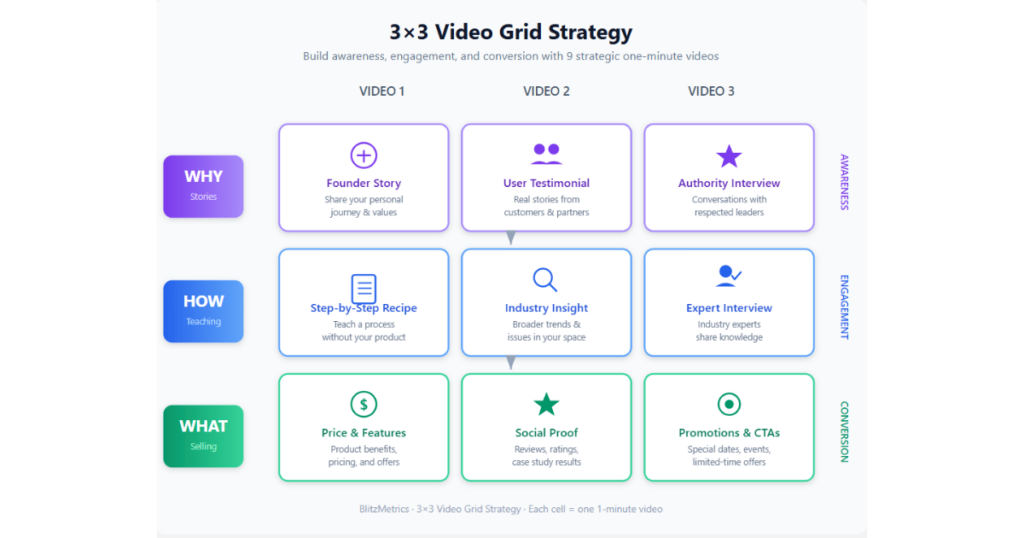
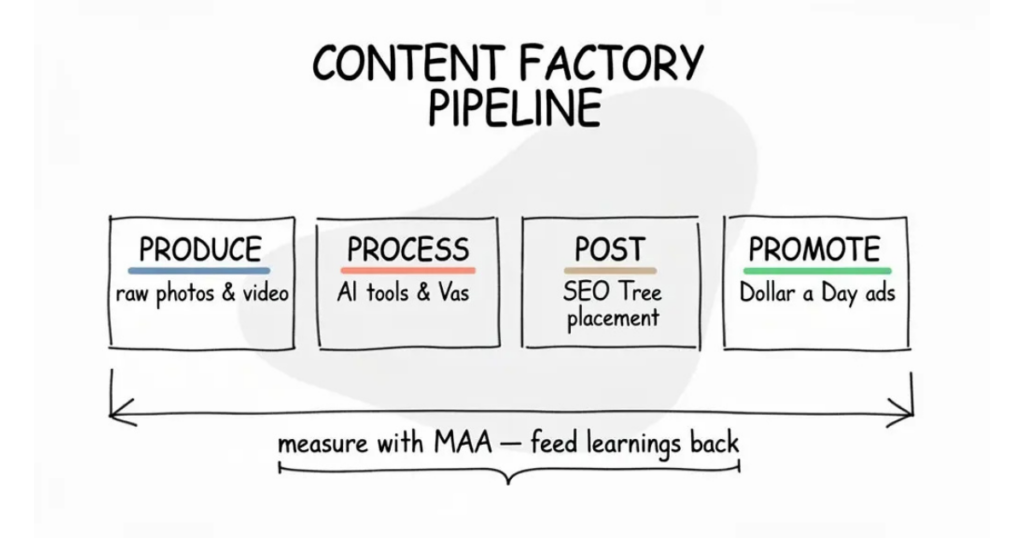
Dollar-a-Day tests content for $7/week and kills 90% of it, letting the algorithm pick winners. The Content Factory turns two hours of smartphone recordings into hundreds of content pieces monthly.
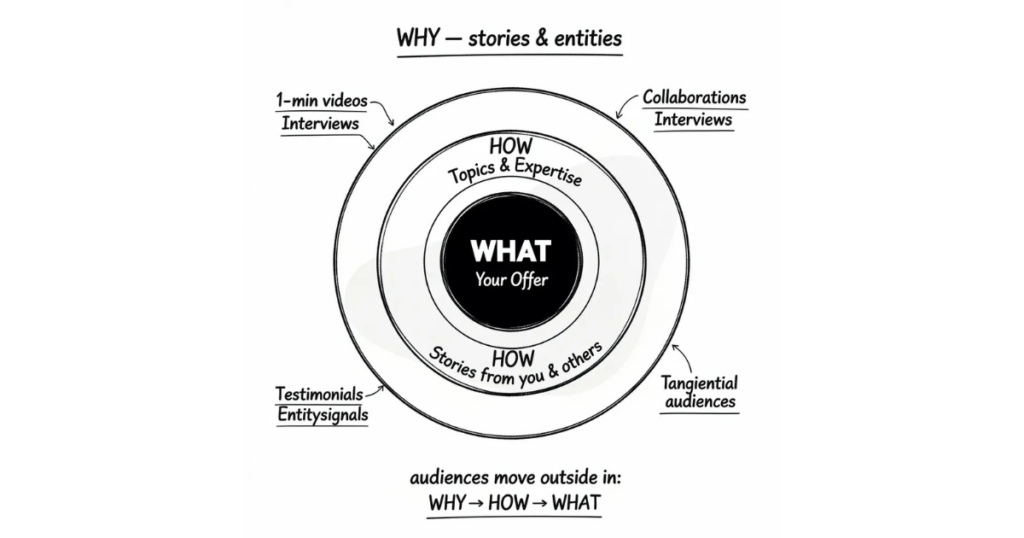
The Topic Wheel maps exactly what to create.
The LIGHTHOUSE Strategy borrows credibility from one respected figure to unlock an entire market.


And the Positive Mentions Tracker turns every endorsement into fuel for paid amplification.
Each piece feeds the others. Content creates mentions. Mentions fuel ads. Ads build audiences. Audiences move through the funnel. The funnel produces clients who become case studies. Case studies become content. The whole thing compounds like interest, getting cheaper and more effective over time.
Here’s how every component works, and how to implement the full system.
The 9 Triangles are the operating system behind everything
Dennis organizes his entire business philosophy into nine three-point frameworks arranged in a mega-triangle with three tiers: WHY (mission), HOW (marketing), and WHAT (business operations). The design principle is deliberate: three-point frameworks prevent analysis paralysis. Most projects fail not from bad strategy but from failure to move.
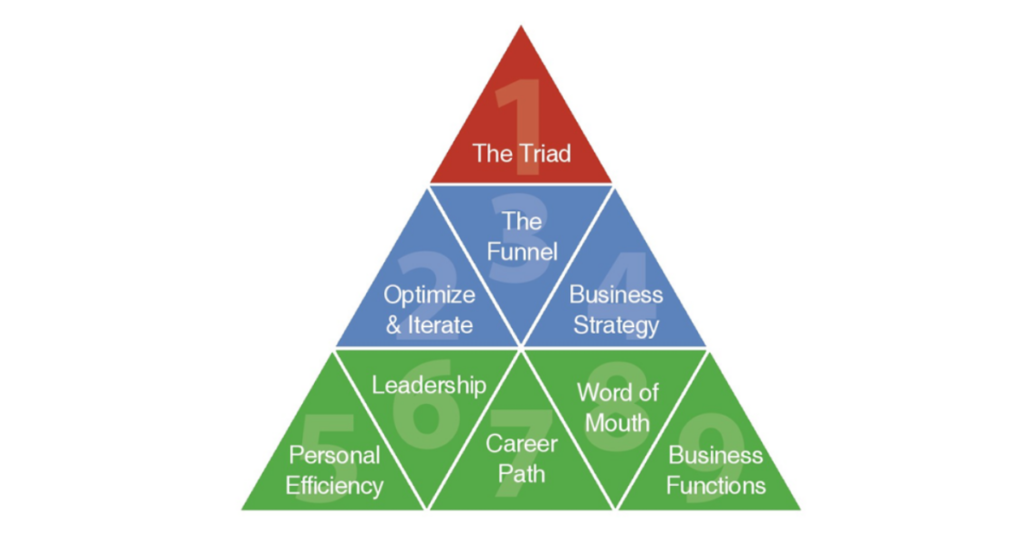
Tier 1, The Mission Triangle (WHY): The ABP triad connects Analysts/Specialists (young adults needing experience), Businesses (needing marketing help), and Partners (schools, conferences aggregating either students or businesses). BlitzMetrics positions itself at the intersection, matching trained talent to business needs through standardized certifications and checklists.
Tier 2, Three Marketing Triangles (HOW): These drive the actual client acquisition engine.
ACC (Awareness → Consideration → Conversion) maps to the buyer’s journey and directly mirrors the WHY→HOW→WHAT content sequencing. This is the funnel architecture.
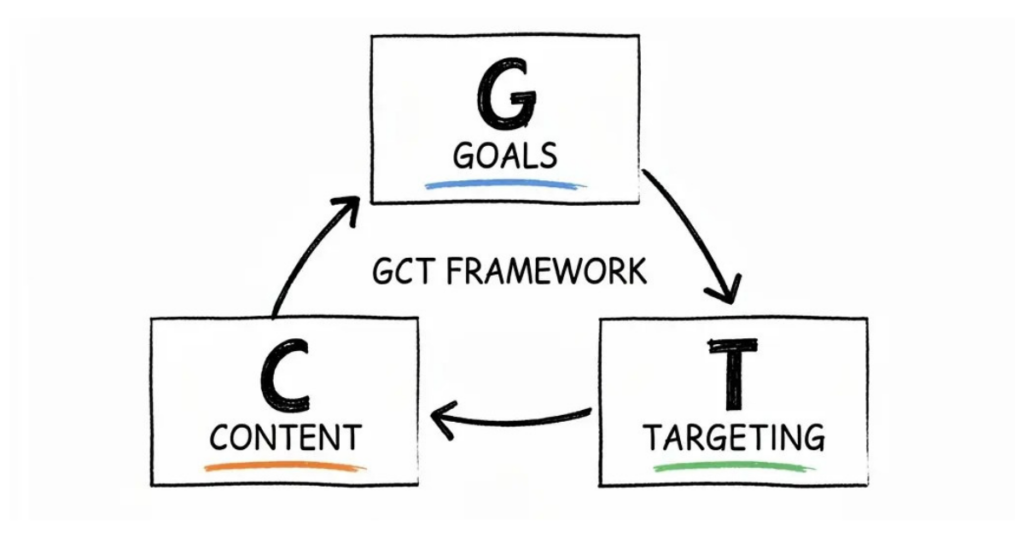
GCT (Goals, Content, Targeting) is the strategic heart. Goals define measurable outcomes. Content supports those goals. Targeting determines who sees it. Dennis insists GCT applies identically across every channel, whether Facebook, LinkedIn, YouTube, email, or Google, because strategy is channel-independent.
MAA (Metrics, Analysis, Action) is the optimization loop. Metrics measure health. Analysis explains changes. Action determines the next move. Applied weekly, this triangle prevents campaigns from drifting.
Tier 3, Five Business Triangles (WHAT): These cover execution. DDD (Do, Delegate, Delete) for personal efficiency. CID (Communicate, Iterate, Delegate) for team leadership. LDT (Learn, Do, Teach) as the career development engine. CCS (Content, Checklists, Software) for systematizing word-of-mouth. MOF (Marketing, Operations, Finance) as the three irreducible business functions.
The critical insight is how these triangles pair. GCT maps to MAA, where goals become metrics, content feeds analysis, and targeting drives action. LDT maps to ABP, where specialists learn, businesses need the doing, and partners enable teaching. These pairings create feedback loops where execution in one triangle automatically strengthens the paired triangle.
The 3×3 Formula turns content into a conversion machine
The 3×3 Formula creates a grid of nine one-minute videos, three rows (WHY, HOW, WHAT) by three columns (three videos per row), that maps directly to the ACC funnel. This is where Dennis’s philosophy becomes tactically concrete.
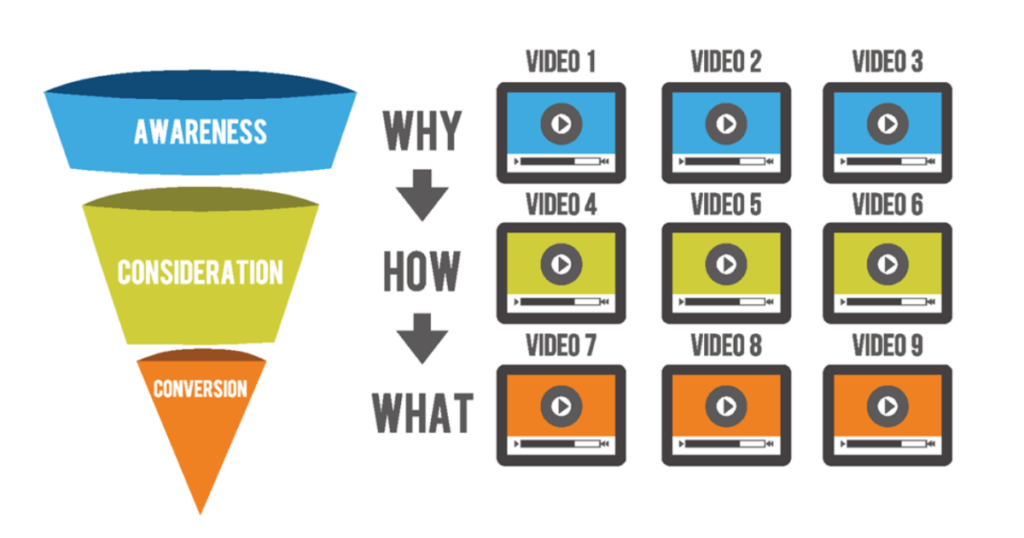
Row 1, WHY videos, build emotional connection. These are origin stories, personal struggles, and founding moments. A rehab center owner talks about the injury that drove them into physical therapy. A SaaS founder describes the frustration that sparked the product. The content here never mentions features or pricing. Dennis draws on Simon Sinek’s principle but operationalizes it: “People buy your WHY. They don’t buy what you sell.” Boston Consulting Group research found authenticity was the primary quality attracting consumers to brands, and authenticity lives in the WHY layer.
Row 2, HOW videos, demonstrate expertise. Tips, tutorials, industry insights, all educational, no selling. “How-to” searches on YouTube grow 70% year over year, making this the engagement engine. A SaaS company might share “3 mistakes companies make with onboarding workflows” without ever mentioning their software.
Row 3, WHAT videos, earn the right to sell, but only after WHY and HOW have done their work. Product demos, offers, pricing, testimonials. Without the first two rows warming the audience, WHAT content gets ignored.
The dual-grid strategy is where personal and company branding merge. Dennis recommends creating two parallel 3×3 grids, one for the founder’s personal brand (posted on personal social profiles) and one for the company brand (posted on business pages). When someone sees that the founder’s personal mission aligns with the company’s mission, trust multiplies. The personal brand is the top of the funnel; the company brand is where transactions happen. The bridge between them is engagement content.
Remarketing creates the evergreen funnel. When someone watches 75% of a WHY video, they get served HOW videos. When they watch 75% of a HOW video, they graduate to WHAT videos. Each video creates a custom audience for the next stage. This automated sequencing runs indefinitely. Dennis compares it to a musician collecting royalties decades after recording. 80% of sales happen between the fifth and twelfth contact, and the 3×3 system delivers those contacts automatically.
Dollar-a-Day is the amplification engine that makes small budgets powerful
The Dollar-a-Day strategy, Dennis’s most famous contribution, is not an advertising tactic. It is a content testing and amplification system. The philosophy: amplify what is already working rather than launching campaigns from scratch and hoping.
The mechanics follow a disciplined three-phase cycle. Phase 1 (7-day test): Boost each piece of content for $1/day for seven days. By week’s end, you’re spending roughly $7/day across seven posts. Phase 2 (Kill and scale): Approximately 90% of posts underperform. Kill them. The winners get $30 more for 30 additional days. Phase 3 (Evergreen): Posts surviving both phases become “Greatest Hits” that run continuously, sometimes for years.
The key benchmarks Dennis uses: a 10% click-through rate signals content-targeting alignment is working. Target roughly $0.02 per video view, $3 per lead, and $10 per conversion. If you’re not hitting these, the content or targeting is broken, not the budget. The system is designed so the algorithm identifies winners, not humans, because “we are always wrong as humans” about what will resonate.
What makes Dollar-a-Day strategically different from typical ad spend is its purpose: the primary goal is not immediate conversions but building custom audiences for remarketing. A $1/day WHY video boost generates 10-second video viewer audiences. Those audiences become the targeting pool for HOW videos. HOW video viewers become the pool for WHAT conversion ads. Dennis reports that 500 people watching a video for 10 seconds each costs less than driving a single website click through traditional advertising.
The “Media Inception” variant deserves special attention for SaaS and agency applications. Dennis targets employees at specific companies, journalists at CNN, editors at TechCrunch, decision-makers at target accounts, with $1/day boosts of co-created authority content. At $0.007 cost per engagement and engagement rates exceeding 40%, this creates the perception of ubiquitous presence for under $30/month. One case study showed a marketer growing from 12 to 18,000 Twitter followers spending just $70 on boosted conference footage.
The Content Factory systematizes production so the flywheel runs without you
The Content Factory is a four-stage industrial process: Produce → Process → Post → Promote. Dennis deliberately chose manufacturing language because he treats content creation as a factory operation, not a creative exercise.
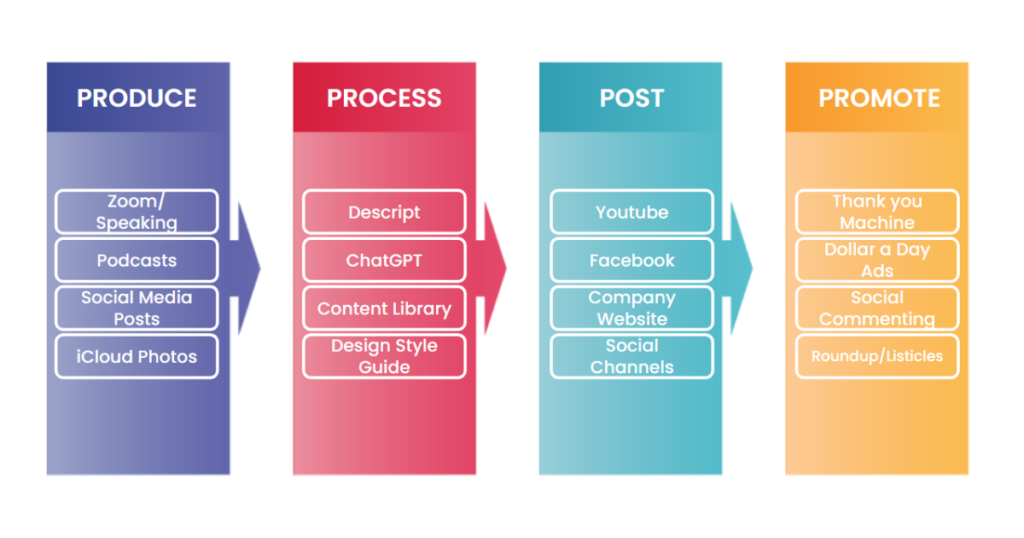
Produce is the bottleneck and the only stage requiring the expert. The founder or subject-matter expert records raw one-minute videos on a smartphone. No special lights, no graphics, no editing. Sound quality matters more than video quality. Dennis himself spends roughly two hours per week recording, generating enough raw material for hundreds of derivative pieces monthly.
Process transforms raw footage using AI tools (Descript for transcription and editing, ChatGPT for blog post generation) into multiple content formats. A single one-minute video yields a transcribed blog post, social media clips for each platform, email content, potential book chapters, and podcast-ready audio. The processing stage adds Google’s EEAT signals (Experience, Expertise, Authoritativeness, Trustworthiness) for SEO value.
Post distributes processed content across every channel. Google Business Profile, YouTube, Facebook, LinkedIn, Twitter, the company blog, email lists. Content is made platform-independent from the start. Dennis notes it takes ten times longer to upload, edit, coordinate, QA, post, and cross-post than to create the raw content, which is why this stage is delegated to virtual assistants at roughly $500/month.
Promote applies Dollar-a-Day amplification to test which pieces become evergreen winners. Two bookend stages complete the extended six-phase version: Plumbing (Phase 0) installs all tracking infrastructure like Google Tag Manager, GA4, Meta pixel, and schema markup. Perform (Phase 5) applies the MAA optimization loop.
The factory runs on three defined roles. Workers execute specific allocated tasks (VAs, account managers). Managers coordinate workflows and prevent bottlenecks. Architects make strategic decisions about what content gets produced. Only proven experts with repeatable success should be producing content; the other 99% of the organization processes, posts, and promotes.
The Topic Wheel organizes content for strategic authority building
The Topic Wheel is the content strategy map, a visual framework of three concentric rings that determines what gets created, with whom, and why.
The center ring (WHAT) is the product or service you sell. For a SaaS company, this is the software itself. This is the smallest ring because you earn the right to sell only after the outer rings have engaged people.
The middle ring (HOW) contains six micro-topics where you want to establish expertise. Dennis recommends three personal topics and three professional topics. These become your content pillars, each backed by a definitive article or hub page. For each topic, identify three people: one you already know and two you’d like to know. These become collaboration targets.
The outer ring (WHY) holds stories, case studies, conference appearances, customer testimonials, and collaborations with authority figures. Audiences discover you from the outside in. They connect with a story first, explore your expertise second, and discover your offer last.
The Topic Wheel connects to an SEO Tree architecture: the WHAT (center) becomes the trunk of your website’s content structure, HOW topics become branches (hub pages), and WHY stories become leaves linking back to branches. Roots are invisible infrastructure like citations, Wikidata entries, and schema markup that feed authority signals to Google’s Knowledge Graph.
The strategic power of the Topic Wheel is in gap analysis: if one of your six core topics lacks sufficient content, that’s where your next recording sessions focus. Dennis reports that publishing 100 pieces organized by Topic Wheel over a few months typically yields about 10 winners that become the foundation for paid amplification.
Authority is engineered through association, not self-promotion
This is perhaps the deepest philosophical layer of Dennis’s system, and the one most critical for SaaS companies and agencies trying to acquire clients. Authority is what others say about you, not what you say about yourself. Dennis distinguishes sharply between perceived authority (people believe you’re the best) and actual authority (you genuinely are the best), and insists you must build perceived authority first because without it, even world-class expertise gets scrolled past.

The mechanism is authority transfer through strategic association. When you co-create content with a respected figure, their audience’s trust transfers to you. Dennis calls this “inception,” named after the film, because the goal is planting an idea so deeply that people think it originated organically. “I’m merely arbitraging the fact that this person has expertise to the people who need to hear that, and because it comes through me as a conduit, that authority transfers through me. I use advertising as the conduit.”
The tactical execution follows a specific pattern. Interview an industry-respected figure for 15 minutes via Zoom. Produce one-minute video clips from the conversation. Boost those clips via Dollar-a-Day targeting the figure’s followers and adjacent industry audiences. The co-created content simultaneously serves the figure (they get free distribution), their audience (they get valuable content), and you (you get authority transfer). BlitzMetrics scores every appearance on a 30-point scale: WHO is saying it (speaker credibility, 0 to 10), WHERE it’s being said (platform authority, 0 to 10), and WHAT is being said (content depth, 0 to 10). Scores of 25 to 30 get amplified heavily; below 15 gets deprioritized.
The Positive Mentions Tracker operationalizes this into a system. Maintain a Google Sheet logging every endorsement, testimonial, shoutout, interview, and article mention with date, URL, type (WHY/HOW/WHAT), Topic Wheel category, and authority score. This sheet becomes the raw material for content repurposing, where each mention gets amplified through the Content Factory pipeline.
The psychology is rooted in how humans actually make decisions. In an information-overloaded world, people use authority as a cognitive shortcut. They can’t evaluate whether a SaaS product is genuinely superior, so they evaluate whether the founder seems credible. Credibility is assessed through association, social proof, and frequency of exposure, not through feature comparisons. Dollar-a-Day engineering of those signals at $30/month per audience segment creates the perception of ubiquitous industry presence at a fraction of traditional marketing costs.
The LIGHTHOUSE strategy is the fastest path to agency and SaaS growth
The LIGHTHOUSE Client strategy is Dennis’s number one recommendation for agencies and SaaS companies seeking rapid growth. The concept: instead of grinding through cold outreach to an entire market, partner with the single most respected figure in your target niche. Their credibility becomes yours instantly.

The implementation follows a scored selection process. Rate existing clients on three dimensions (ease of delivery, revenue potential, competitive differentiation) on a 1 to 5 scale each. The highest-scoring client type reveals your niche. Then identify the industry’s most-followed, most-trusted figure, the person everyone in the niche already listens to.
Dennis’s case studies are striking. Dr. Glenn Vo is the best-known dentist among dentists for marketing, with 24,000 dentists following him. Rather than selling dental marketing agency services directly, Dennis partnered with Dr. Glenn Vo. Every dentist who trusted Dr. Vo extended that trust to BlitzMetrics.

Tom Ferry has 400,000+ real estate agents following him. A real estate marketing agency partnering with Tom gets instant access to that entire audience.

The Golden State Warriors engagement ran 5.5 years, spending approximately $1 million in Year 1 while driving $38 million in provable Ticketmaster revenue. That single LIGHTHOUSE client caused other NBA teams to reach out as inbound leads.
For SaaS companies specifically, Dennis advises against demo-pitching: “Think about the story of you as a founder. Talk about how you’re solving problems, everything except ‘Hey, we have a really cool software product, sign up for a demo.'” The SaaS version of LIGHTHOUSE involves finding the most respected practitioner in the vertical your software serves, co-creating content demonstrating how they solve problems (with your tool as a natural part of their workflow), and amplifying that content to the practitioner’s audience via Dollar-a-Day.
The economic logic is powerful. A-list clients should come presold, with no sales calls, determined to pay whatever you cost. So many people should want to hire you that you refer most clients out, earning referral commissions. One agency owner using the LIGHTHOUSE approach grew from 50 to 60 clients to 300 to 400 clients with $6M ARR by niching into a single vertical and letting the LIGHTHOUSE attract the entire market.
How every piece connects into a single self-reinforcing system
The deeper reason Dennis’s approach works is that no component operates in isolation. The Topic Wheel determines what content to create and with whom. One-minute videos are the primary content format, optimized for social consumption (Facebook recommends 20 to 90 seconds). The Content Factory systematizes production, processing, distribution, and amplification. Dollar-a-Day tests and amplifies the best content at minimal cost. The 3×3 Video Grid sequences content through WHY→HOW→WHAT with remarketing. Positive Mentions fuel authority signals that strengthen Google Knowledge Panels and entity SEO. The Lighthouse Strategy provides the initial credibility injection that makes everything else work faster.
Each component feeds the others in a compounding loop. Content creation generates positive mentions. Positive mentions fuel Dollar-a-Day campaigns. Dollar-a-Day campaigns build custom audiences for remarketing. Remarketing drives prospects through the 3×3 funnel. The funnel generates clients who produce case studies. Case studies become content for the Topic Wheel. The Topic Wheel identifies gaps for the next round of content creation.
Dennis’s comparison to compound interest is apt. Most marketers treat content as disposable: create, publish, forget. Dennis treats winning content as an appreciating asset, continuously amplified for years. The $1/day spend compounds because each piece of evergreen content continues generating audiences, building authority signals, and driving conversions long after creation. The entire system becomes more effective and cheaper per client acquired over time.
Applying this to NaiL: the strategic implications
For a SaaS company like NaiL, the Dennis Yu framework suggests a specific sequence. First, establish digital plumbing: tracking, pixels, schema markup, analytics. Second, identify the six Topic Wheel subjects where NaiL’s founders should establish expertise, and identify the LIGHTHOUSE figure in NaiL’s target market. Third, create the dual 3×3 video grids, nine one-minute videos for the founder’s personal brand and nine for NaiL’s company brand, organized by WHY/HOW/WHAT. Fourth, launch the Content Factory pipeline: film raw videos, process into multi-format content, distribute across all channels, and promote winners via Dollar-a-Day. Fifth, systematically collect and organize positive mentions, co-create content with authority figures, and amplify those endorsements targeting the exact audience segments NaiL wants to reach.
The philosophical shift required is fundamental: stop trying to sell the software and start engineering perceived authority in the space the software serves. When NaiL’s founder is perceived as the most knowledgeable, trustworthy voice in their vertical, through strategic association, transparent teaching, and precisely targeted $1/day amplification, clients arrive presold. The sales conversation shifts from “let me show you a demo” to “when can we start?” That shift, from outbound friction to inbound magnetism, is the entire point of Dennis’s interconnected system.