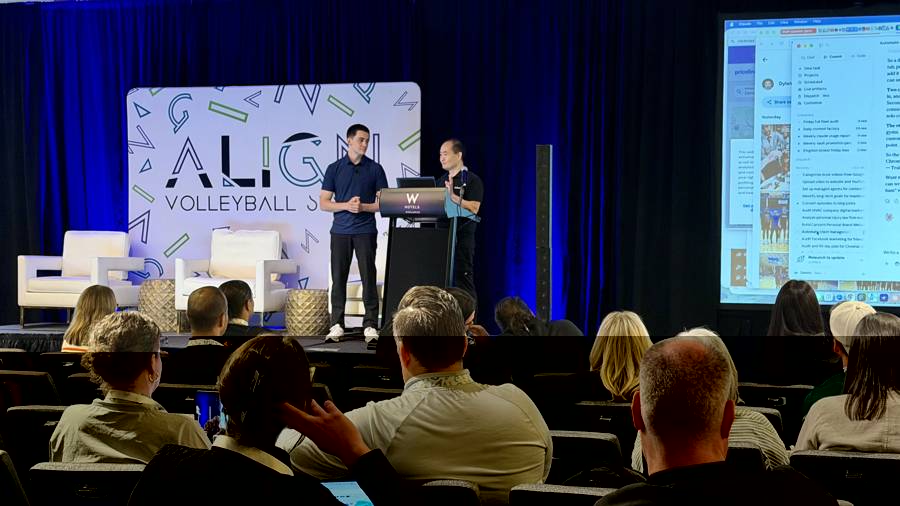

This is what’s on my screen right now— 70+ tabs open across multiple browsers, with 20+ AI agents working on marketing tasks simultaneously. Let me walk you through how this setup works and why it matters for the future of digital marketing.
The Multi-Agent Browser Setup
The top row is Chrome with 70+ tabs open, where 10 agents are working on marketing tasks as documented in our Task Library of 1,000 tasks (20 of them being common). Each agent might have 2-8 tabs open to complete their task. The solid colors and underlines are tab groups.
As they complete tasks according to our SOPs, they write a detailed article of what they’ve done, allowing our SOPs to self-optimize— a beautiful recursive optimization.
Managing Claude, Perplexity, and Multiple AI Platforms
In the bottom right, you can see my Claude usage, which is maxed out on their 20X plan, even with the double usage bonus outside of the “core hours” of 8 am to 2 pm. When I’m nearing the 5-hour session limit, I switch over to my $200/month Perplexity account and use the Opus 4.6 tokens from there, which don’t pull from my $200/month Claude account.
The second row is my Perplexity browser, which is Chromium, much like ChatGPT’s Atlas browser. I am using my favorite Chrome plug-ins such as Ahrefs, Boomerang, and even Claude in Chrome. But mainly, I’m using the Perplexity agents, which can do even more work than Claude because of the 35,000 monthly credit bonus on top of the 10,000 standard.
In the application tray, you’ll see I have 4 browsers open (ChatGPT Atlas is behind other tabs). Because this is a stacked MacBook Pro with 128 GB of RAM, I can run 120 tabs for my 20+ agents to work non-stop, without ever having to use dreaded swap.
Computer-Use Agents Are About to Go Mainstream
Over the next month or so, you’ll see every major AI company roll out some form of “computer” usage, where the agents can do whatever you do on your computer, accelerated by Open Claw’s viral popularity.
We anticipated this years ago, so we’ve recorded thousands of Zoom calls, working sessions, Basecamp (project management) tasks, client reports, Google Analytics data, and other system data to feed into the machine as it gets smarter.
Even my Google Photos has every person, location, object, and activity tagged by Google’s AI. If you’re online, you already know all the platforms have been doing this for years, much like Facebook’s shadow profile system.
AI Is the Amplifier of Talent
Imagine you’re a professional musician— maybe an actor in ancient Greece. Because of how amphitheaters are designed, your voice could reach 2,500 people without amplification.
But now with technology, you can project to an audience of millions— in large stadiums and across the planet simultaneously.
The amplification of volume and distribution allow the most talented performers to multiply their audience and income by 1,000X— which is what AI does.
At the same time, average performers are unemployed, since people can stream anyone on the planet for nearly free.
Steve Jobs said a computer is the bicycle of the mind. AI is your rocket ship.
Why Most Software Companies Should Be Worried
I’m multiplying my talent through these workers— who are only as good as my skill and ability to get them to march in unison.
I look at how I used to do digital marketing as an agency owner and am embarrassed at the clunkiness and incompetence— which most agencies still get away with today.
The CEO of a well-known software vendor boasted their AI software could build smarter internal links than any AI platform or what our team could achieve. So I paid his invoice and waited. Two weeks later, they declared success. I had Claude poke holes in it— to find the work was sloppy and needed our repair.
Any of the LLMs could have done a better job than the low 5 figures we paid this company for the thing they specialize in— and increasingly, this will be the case with all SaaS over the next 18 months.
VC and PE companies already see cratering valuations of software companies because AI is eating software— even with the older, prouder software companies claiming that software is eating the world.
Listen to Practitioners, Not Promoters
I hope you will have healthy skepticism for the eye-popping claims and sky-is-falling proclamations that are becoming increasingly louder.
Listen only to practitioners you actually know— people who have achieved what you desire and openly share what’s working and not, without an agenda (to collect your money).
All the content we produce has been real, since we knew the day was coming— it’s now here.
Originally posted on Facebook.