One file in. A whole personal brand out.
Hand it a data file and a folder of real photos. Out comes a complete, measured personal-brand website — the same engine that built adentrano.com, byte for byte. Then your agents run it.
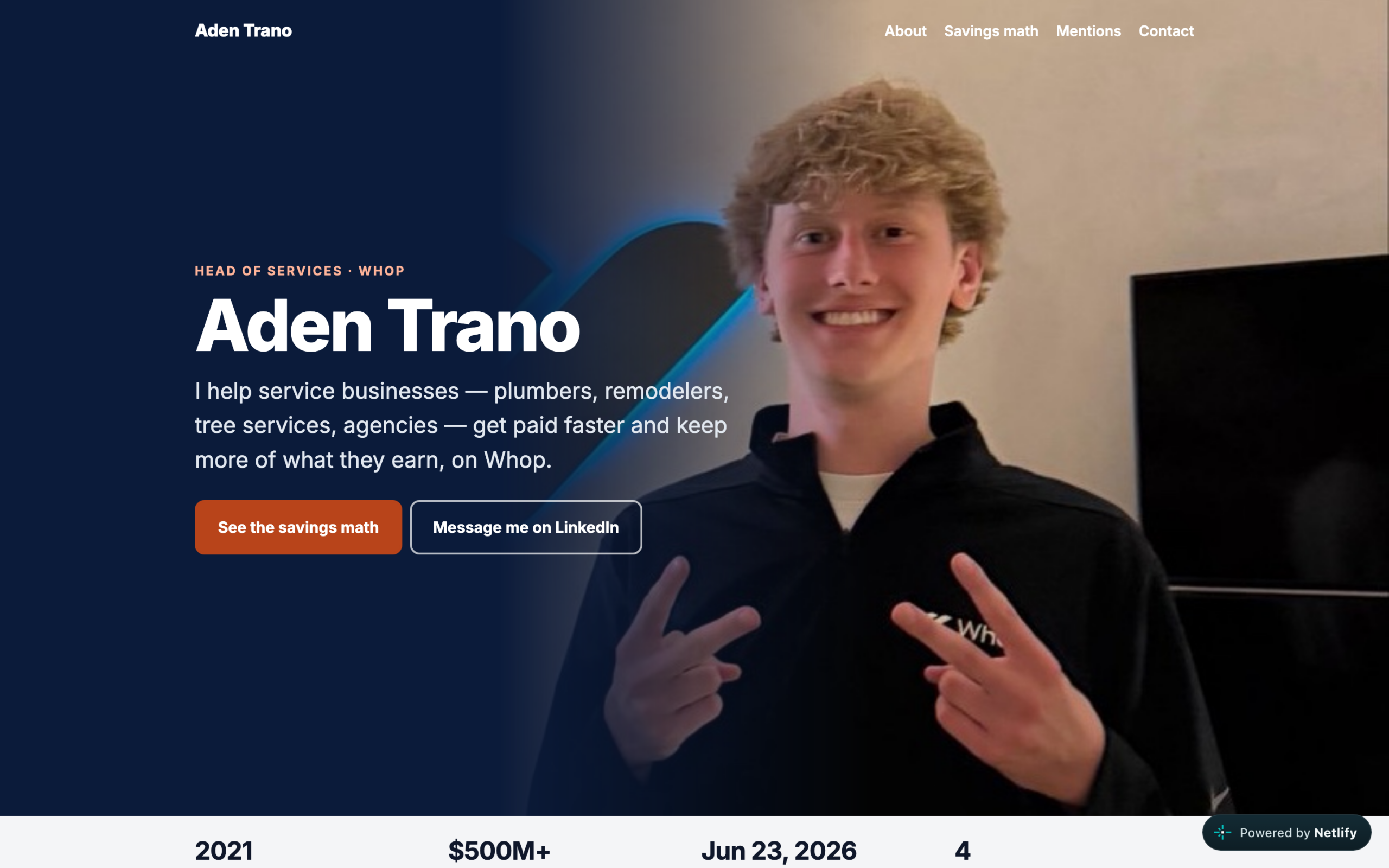
person.json and real photos — no page hand-coded.
I spent three days with Aden Trano, Head of Services at Whop. By the end of the week his site was live at adentrano.com — built by agents, from one file, with every number on it sourced and true. This page is the box that did it, opened up so you can do the same for yourself.
Personal Brand in a Box is a system that turns one data file (person.json) and a folder of real photographs into a complete, facts-first personal-brand website — Home, About, press mentions, contact, an optional cost calculator — structured so Google ranks it and AI assistants quote it, wired to one analytics setup, and deployed on your own domain. It is the productized version of Dennis Yu’s master-and-skin pattern. The build is the free part. The only thing that doesn’t automate is verifying real facts and getting real photos — so that’s the only part left for a human.
How one engine builds anyone’s site
Master and skin. The engine is the master. Each person is a skin — their facts and photos, nothing else. Change the data, rebuild, redeploy.
Everything a visitor and every AI reads lives in the data file. The HTML is generated, never hand-edited. Fix a fact in one line, rebuild, and the correction ships everywhere it appears. That is why a claim can’t quietly rot on one of these sites — and why the box can build the next person as fast as you can gather their facts.
See it in use
Proof beats a pitch. Here is the site this engine built, and the wider method it comes from — running on real people’s own domains.
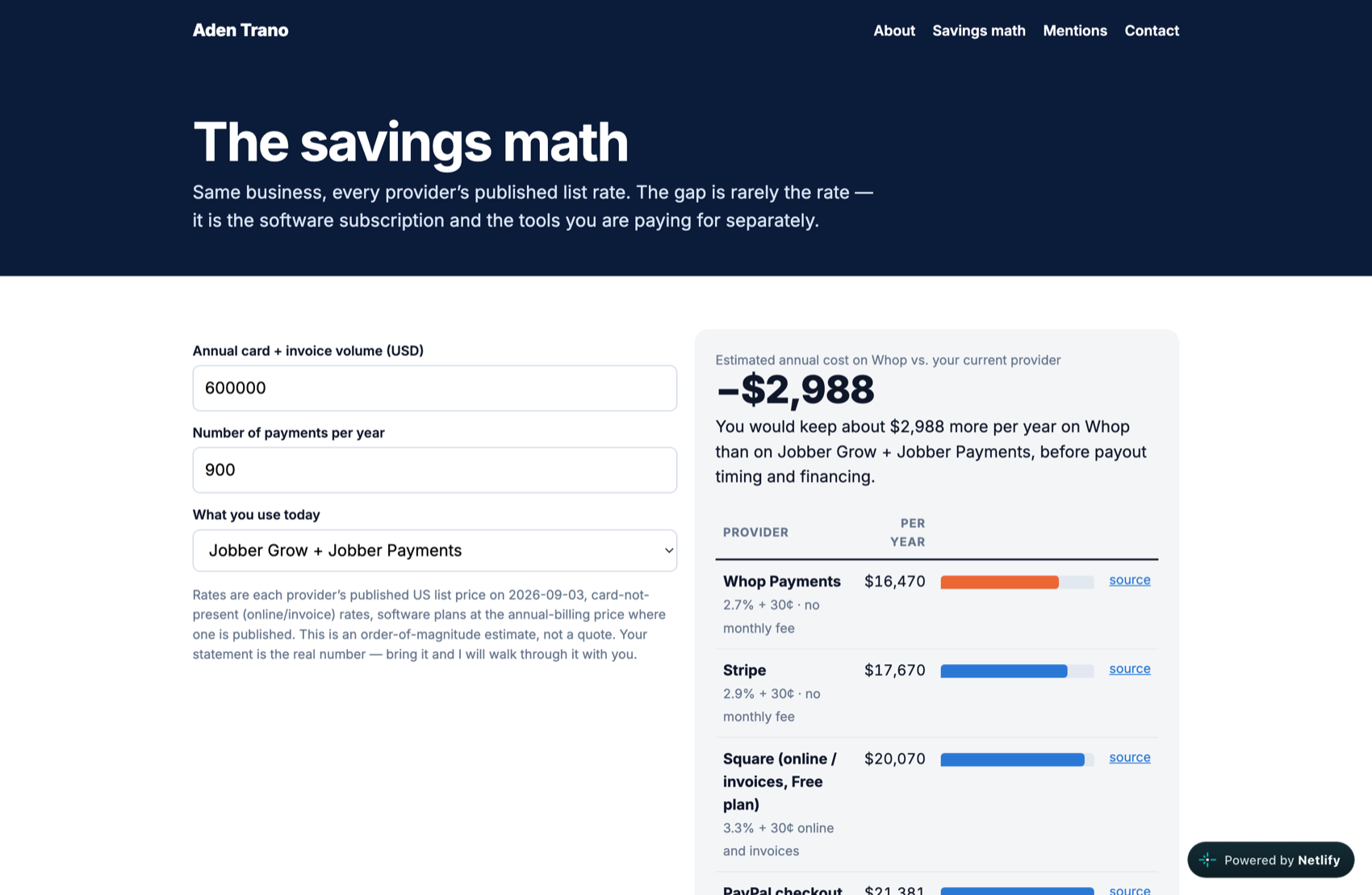

Built with this engine
adentrano.com
Aden Trano’s personal-brand site is the master this box was generalized from. It reproduces byte-for-byte from his data file, carries a working savings calculator, and its financing facts are sourced to Whop’s own posts — corrected the day the numbers needed correcting, in one line.
dennisyu.com/podcast-appearances
My own 236+ podcast appearances live on one canonical page that every episode links back to. Same idea the box automates: one URL owns the topic, everything else orbits it.
George Paladichuk — NaiL A.I.
George’s site shows the niche version: own the definitive page on one tight topic — AI for roofing — and the category cites you by default.
How your agents run it
The site is step one. Keeping it alive is a loop your agents run every week — Dennis Yu’s Content Factory, the four P’s.
That loop is the Content Factory. The box ships wired for it: one Task Library-style page per topic, one analytics setup so you can actually see what worked, and a rulebook (AGENTS.md) your agents read before they touch anything. The strategy underneath it — who you are, what proof to lead with — is the Nine Triangles groundwork every strong personal brand starts from.
What’s in the box
Not a template. A small engine with the boring, important parts already solved.
The data file
One person.json holds every fact, link, and photo reference. Prose fields take real source links. Edit the JSON, never the HTML.
The builder
Renders the JSON into a clean static site — Home, About, Mentions, Contact, Accessibility, 404, and an optional cost calculator. Plain files, any host.
Facts-first, by design
Every claim carries a number, a name, or a source link. If a fact can’t be sourced, it doesn’t ship. That’s what makes people — and AI — trust the page.
Entity plumbing
Schema.org Person, consistent name spelling, a stable #person id and sameAs list — the anchor Google and the LLMs key on.
One clean measurement
One GA4 property fed by one GTM container, four events wired in. A second stray tag corrupts every number downstream, so there’s exactly one.
Tests + a rulebook
A golden-file test pins the output so the template can’t silently drift; AGENTS.md tells any agent the rules that don’t bend.
Put your own agents on it
Any capable coding agent can run this — Claude, Grok, Cursor, Codex. Give yours the kickoff below, then feed it your real facts and real photos. That’s the whole job.
“Personal Brand in a Box” method (dennisyu.com/personal-brand-in-a-box).
1. Read this page and the linked method pages: Content Factory
(blitzmetrics.com/content-factory), the Nine Triangles
(theninetriangles.com), and the live example (adentrano.com).
2. Interview me for real, checkable facts only — role, company, dates,
public numbers, quotes, press. Every fact needs a URL a stranger can open.
If it can’t be sourced, it does not go on the site.
3. Collect real photographs — a headshot, a hero image, one or two candids.
No stock, no AI images.
4. Put every fact into one data file. Build a facts-first site: Home, About,
Mentions, Contact, and (optional) a cost calculator. One GA4 property, one
GTM container. Deploy the static output to my own domain.
5. Then run the weekly loop: one recording -> one canonical article -> clips
that link home -> $1/day behind what already worked.
Never invent a quote, a number, or a logo. Facts first, always.
Want the engine itself — the builder, the schema, and the tests — pointed at your site? That’s what Local Service Spotlight sets up. Start at localservicespotlight.com or email dennis@localservicespotlight.com. Not sure which agent to run it on? Here’s which AI for what.
Questions people ask
The honest ones, answered directly.
Who owns it — the site, the domain, the data?
What do you actually need from me?
Is this just a website template?
Which agents can run it?
AGENTS.md) is written to be cross-model, so the same site can be handed from one agent to another without losing the rules.Can I host it on my own domain and move it later?
How is this different from a Wix or Squarespace site?
Where this fits
Personal Brand in a Box is one piece of a bigger system for showing up as the documented authority in your field.
- The strategy: the Nine Triangles — who you are and what proof you lead with, before any site gets built.
- The playbook: how to build a personal brand — the strategy this engine turns into a site — plus Dennis Yu’s own personal-brand playbook.
- The engine (this page): Personal Brand in a Box — one data file and real photos become a measured, facts-first site.
- The weekly loop: the Content Factory — Produce, Process, Post, Promote — that keeps it alive.
- The library: the Task Library — one page, one URL per task, each one sharper every run.
- The team: Local Service Spotlight sets it up and runs it with you.