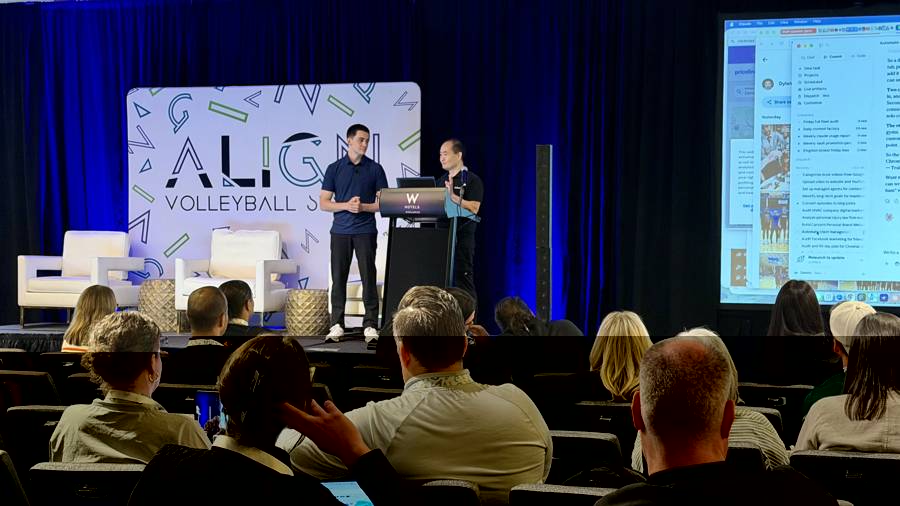

The assignment: build a marketing campaign for a futuristic product, for a Gen Z audience, using AI — in a 30-minute window. Most teams reached for a slide and a stock-looking image. We built a working app you can actually talk to. Here’s exactly how, and the repeatable playbook underneath it.
🛰️ Try the live StarPilot demo →
The brief
The product was fictional but the constraints were real. StarPilot AI: a wearable wrist device, set in 2045, that projects a holographic AI companion to help people manage their “daily missions” — studying, launching a business, leading a team. Our team drew the Gen Z audience. Five judging criteria, ten points each: creativity, effective AI use, marketing strategy, visual quality, and audience alignment. Fifty points total. Thirty minutes on the clock.
The temptation in a sprint like this is to produce more stuff — more captions, more taglines, more slides. That’s the wrong instinct. With a tight clock and a clear rubric, the move is to find the single artifact that scores on the most criteria at once, and build that to a finish.
The goal was never to make marketing content. It was to prove that prompt engineering, audience understanding, and AI tools together can generate a high-quality campaign — fast.
The insight that drove everything
Good campaigns don’t start with the product. They start with a true thing about the person. So before we wrote a single word of copy, we named the audience’s core emotion.
For Gen Z, it isn’t laziness — that’s the lazy read. It’s the feeling of being behind. When your phone hands you everyone else’s highlight reel all day, other people’s wins quietly become your deadlines. So we didn’t sell features. We sold relief and agency: a co-pilot that turns “I have so much to do” into an actual plan, with no hustle-culture guilt attached.
That gave us the campaign in one line — “Permission to Launch” — and a tagline that puts the person in the driver’s seat: You’re the mission. We’re the co-pilot. The beauty of the StarPilot concept is that the product metaphor (personal mission control) is the emotional promise (you’re in control now). When those two things are the same thing, the marketing writes itself.
Why we built the app instead of a slide
Look at the rubric again: creativity, effective AI use, visual quality. A working, interactive product demo scores on all three simultaneously. A bullet-point slide scores on none of them well. So we built StarPilot Mission Control — a live console where you type a real problem (“final in three days,” “I’m broke and overwhelmed,” “I want to start a side hustle but I’m scared”) and the holographic co-pilot responds in real time with a structured mission plan.
It isn’t a mockup with fake screenshots. It actually works. And that’s the whole point of an AI hackathon: don’t describe what AI could do — show it doing it.
The part that matters for your own AI work
The demo feels “intelligent” because the responses are structured, not freeform. Every answer follows the same engineered shape:
- Acknowledge the person’s actual situation in their voice — warm, never preachy.
- Mission plan: three to five specific, genuinely useful steps. Not “study hard” but “mark each topic green / yellow / red and spend 80% of your time on yellow.”
- Telemetry: a quick read on the estimated window, difficulty, and “fuel” needed — turning a vague task into something measurable.
- Co-pilot note: one honest line of encouragement that addresses the emotion under the task.
That four-part frame is a prompt-engineering pattern you can lift directly. The reason most AI output feels generic is that people ask for a blob of text. The reason ours felt like a product is that we defined the shape of a good answer first, then made the model fill it. Decide what “done” looks like before you generate, every time.
The repeatable playbook
1. Name the emotion before the product. Find the one true feeling your audience has, and build the promise around relieving it.
2. Reverse-engineer the rubric. Identify the single artifact that scores on the most criteria, and build that to a finish instead of spreading thin.
3. Engineer the shape of the answer. Structured outputs (acknowledge → plan → data → encouragement) turn generic AI text into something that feels like a product.
4. Show, don’t describe. A working demo beats a deck. In an AI sprint, the proof is the pitch.
5. Write in the audience’s voice, not the brand’s. Self-aware and specific beats polished and corporate — especially for Gen Z.
Speed is a strategy, not a compromise
The thing that surprised the room wasn’t that AI made us faster. It’s where the speed came from. The 30-minute limit forced clarity: one insight, one artifact, one finished thing. Teams that tried to do everything at once produced less, not more. The marginal cost of an extra deliverable with AI is near zero — which means the scarce resource isn’t production, it’s judgment. Knowing what to build is now worth far more than the building itself.
That’s the lesson worth carrying out of any hackathon and into real client work: AI removes the excuse to ship something incomplete. When generation is cheap, “good enough” stops being a constraint and starts being a choice. So make the better choice. Ship the finished thing.
StarPilot AI is fictional. The playbook isn’t. Whether you’re a student learning to wield these tools, an agency owner trying to do more with a small team, or a marketer staring down a deadline — the same four moves apply. Name the feeling. Reverse-engineer the goal. Shape the output. Ship the working thing.
Run a mission with StarPilot AI →
Permission to launch: granted.