This page is a worked example (a leaf). The canonical for how we audit is How we audit.
Show me the work loop.
“Claude worked for four hours” is not the same as “I worked for four hours.” Here is the evidence-first audit that separates agent runtime, human orchestration, and verified output.
AI makes work faster. It does not make accountability optional.
When someone says they were “using AI all day,” that statement can describe two completely different days.
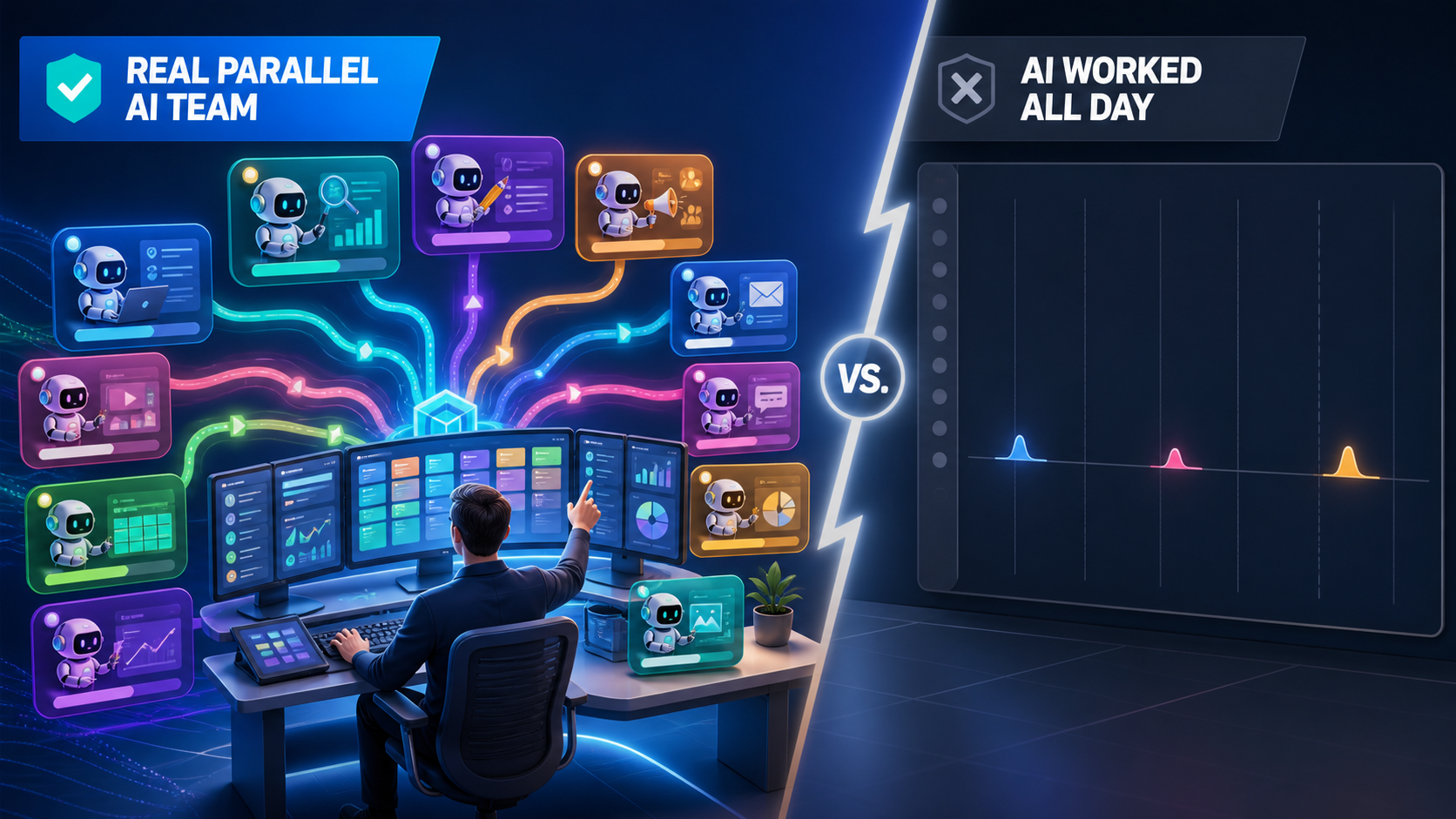
On one day, the person opened several well-scoped projects, supplied real context, reviewed the answers, caught errors, reprompted, verified the work in the actual systems, and launched the next jobs while other agents ran. On the other day, the person typed three short prompts, disappeared while Claude generated, copied the outputs into an end-of-day report, and counted the machine’s waiting time as human working time.
The status update can look similar. The transcript does not.
First, stop mixing up the three clocks
Human orchestration
Prompting, adding context, deciding, reviewing, correcting, verifying, and handing off. This is the person’s observable work.
Agent runtime
The time Claude or another agent spends generating or executing. Useful capacity, but not automatically human labor.
Verified output
The finished artifact, system change, test result, decision, or published deliverable that another person can inspect.
If five agents run for 40 minutes in parallel, that is 200 agent-minutes—but only a 40-minute wall-clock window. If the operator spends six minutes starting them and comes back two hours later, you cannot honestly report two hours of human work. You report six observed minutes of orchestration, the available agent runtime, the review work when it happens, and the resulting outputs.
“AI all day”
threads + timestamps
turns + gaps + overlap
verified outcomes
What a real AI workday looks like
A strong operator keeps the runway full. While one agent researches, another drafts, another tests, and another waits for access, the operator reviews the completed work and starts the next useful job. The goal is not to maximize message count. The goal is to maintain a healthy loop of Communicate → Iterate → Delegate, with visible MAA cycles: Metrics → Analysis → Action.
The important signal is the loop: launch → review → correct → verify → launch. Three isolated blips do not become an eight-hour day because a browser tab stayed open.
The measurements that remove the wiggle room
| Metric | Exact definition | Why it matters |
|---|---|---|
| Threads opened | Distinct work conversations whose first human message falls inside the audit window. | Shows new jobs launched. |
| Threads active | Distinct conversations with at least one human work turn inside the window. | Shows the breadth of orchestration. |
| Human turns | Messages sent by the operator. “Thanks,” “continue,” and accidental duplicates are counted separately as low-substance turns. | Prevents acknowledgments from looking like deep iteration. |
| Context supplied | Files, links, examples, constraints, source facts, acceptance criteria, and decisions supplied by the human. | Good output usually begins with good ingredients. |
| Review cycles | A human response that evaluates an agent result and gives a correction, decision, test result, or next instruction. | Distinguishes orchestration from one-shot prompting. |
| Response latency | Agent completion timestamp to the operator’s next substantive turn in that thread. Report median, 90th percentile, and longest gap. | Shows whether completed agents were left idle. |
| Idle gaps | Within the declared work window, gaps of 15+, 30+, and 60+ minutes with no observable work turn in any in-scope thread or verified system action. | Shows coverage without pretending to read someone’s mind. |
| Concurrency | Overlapping agent execution intervals when start and completion timestamps exist. Count the union for wall-clock time; never add parallel intervals and call the sum “hours worked.” | Separates real parallelism from inflated time. |
| Verified outcomes | Deliverables with inspectable URLs, files, commits, records, tests, screenshots, or system logs. | Connects conversation activity to actual results. |
| MAA cycles | A linked set of metric/evidence, causal analysis (“because”), and next action. | Measures iteration—not volume. |
Every statement gets an evidence label
The report must never blur a fact, a calculation, and a story. Put one of these labels next to every important claim.
Observed
Directly present in a timestamped transcript, artifact, test, or system record.
Derived
Calculated from observed evidence, with the formula and assumptions shown.
Claimed
Reported by the worker but not independently supported by the available evidence.
Unavailable
Cannot be determined from what the auditor can access. No guessing and no invented precision.
This matters because Claude can now search past chats on paid plans, but that search uses retrieval. Searches outside projects and searches inside each individual project have different boundaries. That is excellent for a fast daily review, but it is not the same as a guaranteed exhaustive database query. Anthropic also offers account data exports that include conversation data and chat history. Use the search-based version daily; use the export-based version for a stronger forensic check. See Anthropic’s documentation on chat search and memory and exporting Claude data.
A fair scorecard: grade the operating system, not keystrokes
Set role-specific output targets before the workday. Do not invent a universal quota after seeing the result. Then score five dimensions out of 100:
Important: a high message count can still be bad work, and a short thread can produce an excellent result. The transcript metrics diagnose the operating pattern; verified outputs determine whether the pattern created value.
Copy and paste this into Claude at the end of each day
Replace the bracketed fields. The prompt tells Claude to be an auditor, not a flattering assistant, and to state exactly what it could and could not verify.
You are an evidence auditor, not my coach and not my advocate.

Audit my AI-assisted work for this exact window:
- Start: [YYYY-MM-DD HH:MM]
- End: [YYYY-MM-DD HH:MM]
- Time zone: [TIME ZONE]
- Declared work schedule/breaks: [SCHEDULE]
- In-scope Claude projects/workspaces: [LIST EVERY PROJECT]
- Role and agreed output targets for the day: [TARGETS]

EVIDENCE COLLECTION RULES
1. Use Claude's past-chat search tool now. Do not rely on memory or on this chat alone.
2. Search standalone chats, then search EACH named project separately. List every scope you actually searched.
3. Build a candidate inventory first. Then cite or link every conversation used in the report.
4. If chat search cannot guarantee a complete inventory, say "SEARCH-BASED AUDIT — NOT EXHAUSTIVE" at the top. Do not hide this limitation.
5. If I attached an exported conversations file, use it as the authoritative inventory and say "EXPORT-BASED AUDIT." State the export's coverage and any missing fields.
6. Exclude personal/incognito conversations and anything outside the agreed company scope. List exclusions by category, not by private content.
7. Do not accept my end-of-day summary as proof. Reconcile it against transcripts and inspectable artifacts.
8. Never equate agent runtime, browser-open time, upload/build time, or parallel-agent minutes with human working time.
9. Never add overlapping agent intervals and present the total as wall-clock or human hours. Show both agent-minutes and the union of elapsed wall-clock intervals when exact timestamps exist.
10. If exact timestamps, completion times, token usage, tool calls, or links are unavailable, label the metric UNAVAILABLE. Do not estimate it silently.

DEFINITIONS
- New thread: first human work message occurred inside the audit window.
- Active thread: at least one human work turn occurred inside the window.
- Human turn: one message from me. Mark acknowledgments such as “thanks,” “continue,” or duplicated messages as low-substance.
- Substantive turn: adds context, constraints, evidence, a decision, critique, test result, correction, or a concrete next action.
- Review cycle: I evaluate an agent result and then approve, correct, test, redirect, or extend it.
- Response latency: agent completion to my next substantive turn in that thread. Use only exact timestamps.
- Idle gap: during my declared schedule, 15+, 30+, or 60+ minutes with no observable work turn in ANY in-scope thread and no cited verified system action. An idle gap is a gap in evidence, not proof of misconduct.
- Verified outcome: a file, URL, commit, published item, record change, test result, screenshot, or other artifact another person can inspect.
- MAA cycle: Metrics/evidence → Analysis containing a causal explanation → specific Action.

REQUIRED REPORT
A. AUDIT HEADER
- Audit type: SEARCH-BASED or EXPORT-BASED
- Exact window and time zone
- Scopes searched
- Scopes not searchable or not supplied
- Evidence completeness: High / Medium / Low, with one-sentence reason

B. EXECUTIVE VERDICT — MAXIMUM 8 BULLETS
- What the evidence supports
- What it does not support
- Whether activity was sustained, clustered, sparse, or indeterminable
- Biggest bottleneck
- Strongest operating behavior
- Most important next-day correction
- Confidence level

C. THREAD LEDGER — ONE ROW PER THREAD
Columns:
1) direct link/citation
2) project/scope
3) first and last in-window timestamp
4) new or continuing
5) human turns
6) substantive turns
7) context supplied (files, links, examples, constraints)
8) review cycles
9) agent/tool/sub-agent actions, if observable
10) agent runtime, only if exact
11) verified outcome and proof link
12) status: accepted / needs rework / blocked / no outcome shown

D. CHRONOLOGICAL TIMELINE
- Show every substantive human turn and verified system action in time order.
- Group genuine parallel work visually.
- Mark 15+, 30+, and 60+ evidence gaps during the declared schedule.
- Separate human actions from agent-running intervals.

E. METRICS DASHBOARD
- New threads
- Active threads
- Total human turns
- Substantive human turns
- Low-substance turns
- Review cycles
- Files/links/examples/constraints supplied
- Median, p90, and longest response latency, if exact
- Count and total span of 15+, 30+, and 60+ evidence gaps
- Peak and average concurrent running agents, if exact
- Agent-minutes and union wall-clock agent time, if exact
- Verified outcomes
- Accepted outcomes
- MAA cycles
- Rework or failed-verification count

F. PROMPTING QUALITY RUBRIC — SCORE 0–5 WITH QUOTED EVIDENCE
- Clear goal
- Relevant context
- Constraints and scope
- Acceptance criteria / definition of done
- Effective delegation and parallelization
- Critical review instead of blind acceptance
- Verification in the real system
- Next-action clarity
For each score, quote no more than two short excerpts and link the source thread.

G. CLAIMS RECONCILIATION
Create a table comparing every material claim in my end-of-day update with transcript/artifact evidence.
Label each claim:
- OBSERVED — directly supported
- DERIVED — calculated from observed evidence; show formula
- CLAIMED — stated but not independently supported
- CONTRADICTED — conflicts with stronger evidence
- UNAVAILABLE — cannot be determined

H. 100-POINT SCORE
- Evidence integrity: 30
- Prompt quality: 20
- Iteration/review: 20
- Flow/responsiveness/concurrency: 15
- Verified output against PRE-AGREED targets: 15
Show the arithmetic. Do not reward raw message volume by itself.

I. BOTTLENECK DIAGNOSIS USING MAA
Give the top three bottlenecks. For each:
- Metric/evidence
- Analysis: why it likely happened
- Action: a specific change for tomorrow
- Verification: how tomorrow's audit will prove whether it improved

J. RANDOM-SPOT-CHECK PACK
Select three threads using a stated deterministic rule (for example, sort direct links and take first/middle/last). For each, provide the direct link, promised output, best human prompt, weakest human prompt, final artifact, and whether the artifact was independently verified.

FINAL AUDITOR RULES
- Be neutral, specific, and skeptical.
- Do not flatter me.
- Do not infer private activity from missing work evidence.
- Do not call evidence gaps “hours worked.”
- Do not call agent runtime “human labor.”
- Do not turn a few examples into an exhaustive claim.
- End with exactly: “What the evidence proves,” “What remains unverified,” and “Tomorrow’s three actions.”
Red flags the report should surface automatically
Use this to coach before you use it to judge
The purpose is to find the bottleneck: fear of AI, weak prompts, poor review habits, failure to run work in parallel, missing access, slow verification, or simply not enough iterations. A good audit gives the person a way to improve tomorrow.
But accountability without evidence becomes an argument. That is why I have long said I’ve heard the excuses, why I refuse to let “busy” replace communication, and why the lack of iteration is the hidden reason campaigns—and people—get stuck.
“Don’t make me chase you” should not mean “send me a longer story.” It should mean: show me the thread ledger, show me the timestamps, show me the MAA cycles, and show me the finished work.
The standard is simple
Don’t tell me the AI was open. Show me the loop.
Launch useful work. Supply ingredients. Review quickly. Correct what is wrong. Verify in the real system. Publish the evidence. Then do another iteration.
Apply this standard consistently, protect private activity, and agree on role-specific targets in advance. The result is a work audit that is hard to game—and useful enough to make a good operator better.