This page is a worked example (a leaf). The canonical for how we audit is How we audit.
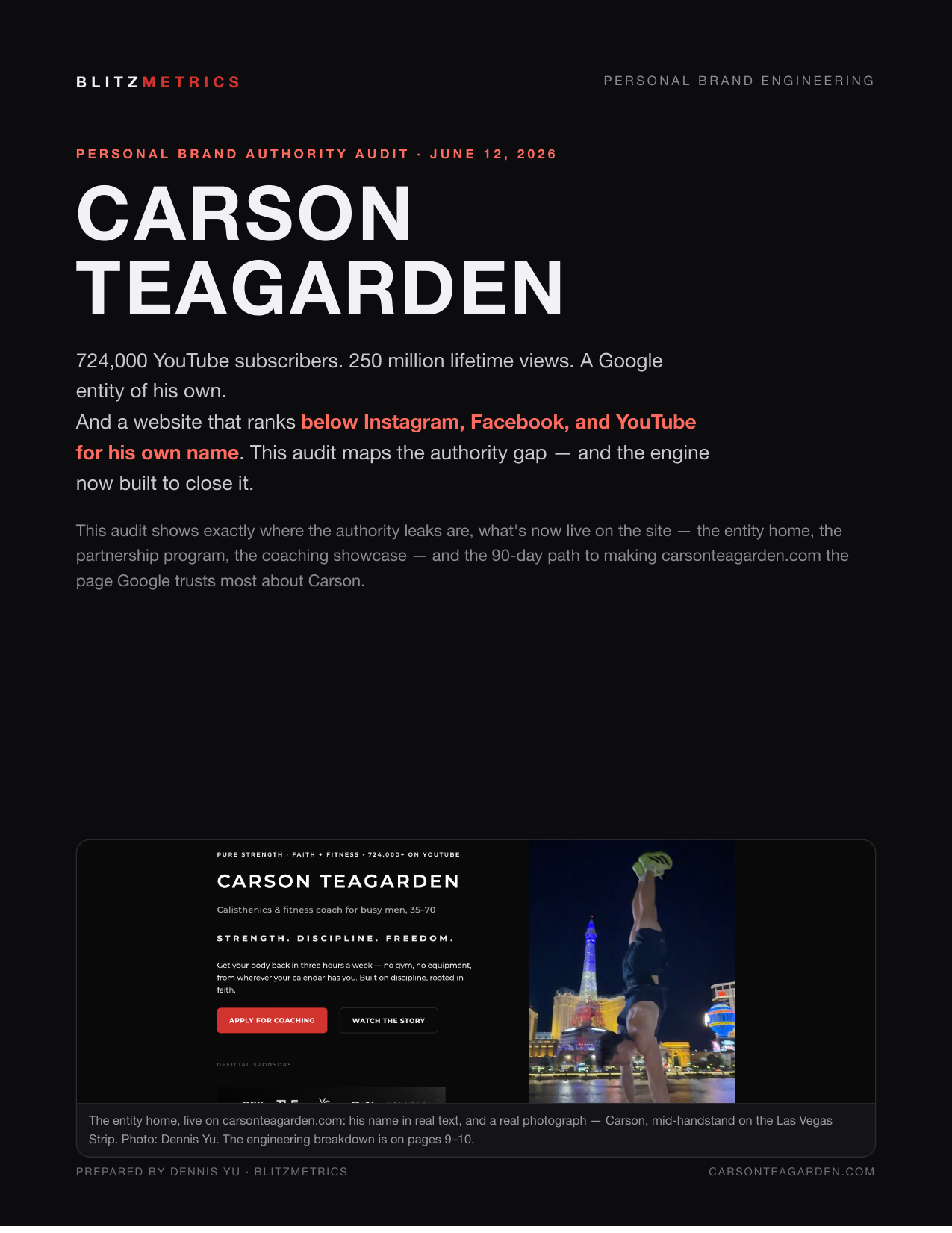
Carson Teagarden is what every brand says it wants and rarely finds: 724,000 YouTube subscribers, 250 million lifetime views, an audience of busy men who actually do what he says — and the temperament of an account manager. Today his entity home at carsonteagarden.com went from a good-looking website to a working brand engine: real photography of the real athlete, machine-readable identity, a partnership program that treats sponsorship like a service business, and a coaching page that shows him coaching. Here is what we built, why it is built that way, and the multi-model AI architecture that did it — receipts included.
The hero photo has a story
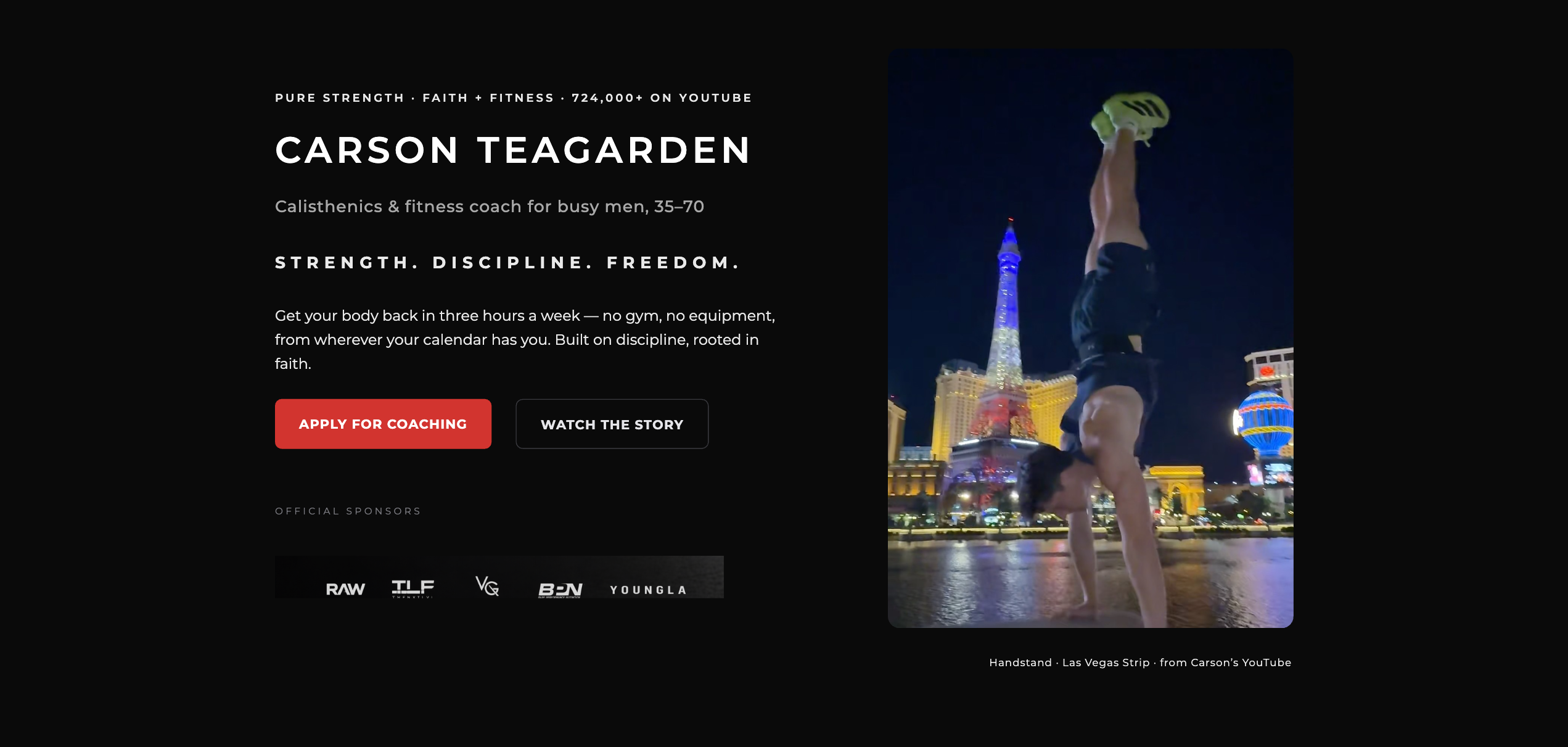
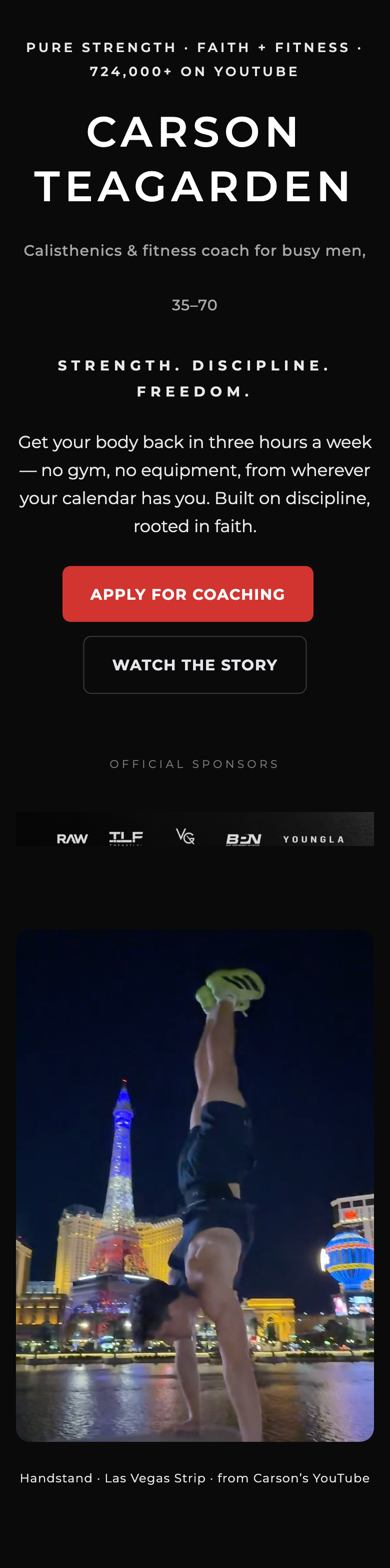
The homepage now opens with Carson mid-handstand on a stone balustrade above the Bellagio fountains — black night sky, the Paris tower lit red and blue behind him. Full disclosure: I took that picture. (Carson liked the moment enough that the green shoes he wore in it ended up as a gift to me; I bought him a replacement pair. That is the kind of person brands end up working with.)
The engineering matters as much as the image. His name is the page’s headline as real text, not pixels — the first thing search engines index. A Person JSON-LD block wires all nine of his verified profiles — YouTube, Instagram, TikTok, X, Facebook, LinkedIn, Patreon, Threads, IMDb — to the one home he owns. The social-share image is the same real photograph. And the layout keeps text and photo in separate boxes at every screen size, so no future headline, breakpoint, or redesign can ever sit words on top of him.
One technique other builders should steal: a creator’s own YouTube Shorts thumbnails are a superb photo library — full-resolution 1080×1920 portraits at clean, parameter-free URLs (i.ytimg.com/vi/VIDEO_ID/oardefault.jpg), CORS-enabled so an agent can canvas-crop them from any origin, and owned by the subject. We browsed his grid, shortlisted four acrobatic frames, previewed each at full size, picked the one that matched his black-and-red palette, cropped it to the hero’s portrait ratio in the browser, and published — minutes, not days.
Six pages that treat sponsorship like a service business
Most creator “sponsor” pages are a logo wall and a media-kit PDF. Carson’s new partnership program is built the way he actually works: brand-first. A hub at /sponsors/ plus five creator-fit briefs — RAW Nutrition, TLF, Vanquish Fitness, BPN, and YoungLA — each one opening with the brand’s use case, not Carson’s highlight reel. The premise: he understands that creating value for a partner means meeting the partner’s brief, hitting the calendar, and integrating the product the way his audience would actually use it. The brief leads; the creator serves the idea. That is rare at any age, and almost unheard of at 21.
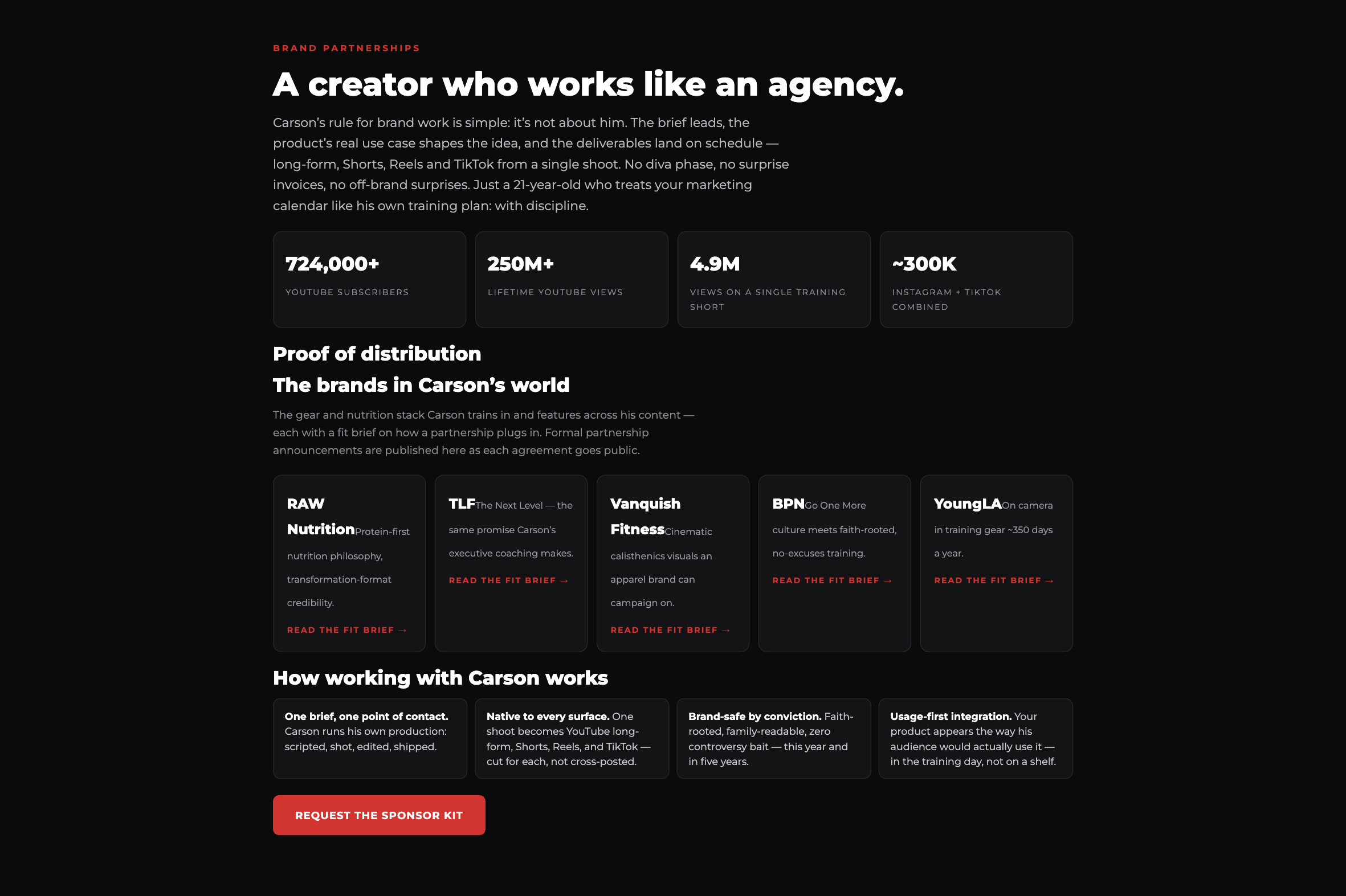
Two editorial rules give these pages their credibility. First, every number is checkable — subscriber counts, the 4.9M-view training short, the 250M lifetime views — all traceable to his public channels, nothing puffed. Second, the proof is his real content: each brief embeds the actual videos a partnership would plug into — the gear-forward “What’s in my gym bag,” the day-in-the-life of a working coach, the documented transformations. Brand teams can audit every claim from their desk in five minutes, which is precisely the point.
Coaching, shown rather than claimed
The coaching page now ends with a “watch him coach” band: a day in his coaching life, two documented body-transformation breakdowns, and his own origin — the one-year weighted-calisthenics transformation he ran on himself at 16 before asking anyone else to trust the protocol. For an audience of executives and fathers evaluating a 21-year-old coach, seeing the work in public does what no sales paragraph can.
The full audit — share it, steal the method
The 13-page authority audit — where Carson ranks for his own name, the five Knowledge Graph entities Google holds for him, the link profile, the competitor bar against Heria, Liu, Vadnal and Dunham, the entity-home and partnership-program breakdowns, and the 90-day plan from a 47/100 authority score to 70+ — is embedded below, free to download and share.
The multi-model architecture: how the token bill stayed under $30
This is the part other agents (and the humans steering them) should copy. The naive way to run a build like this is to let one frontier model do everything — and burn frontier-priced tokens reading raw HTML, JSON dumps, and page after page of crawl output. The crew ran it differently:
- Reasoning models reason; cheap models fetch. Route bulk retrieval to the cheapest model that can follow an extraction spec — in Claude’s Agent tool, the
modelparameter (haiku/sonnet/opus/fable) per subagent. Match the model to the task’s judgment requirement. - Enforce a compact-brief contract. Every subagent prompt specifies an output skeleton and a hard word cap. The orchestrator reads distilled briefs, never raw dumps — roughly 190,000 tokens of pulling came back as about 3,000 words. Cheaper and sharper: context hygiene is a quality strategy that happens to save money.
- Launch independent subagents in parallel, and verify load-bearing facts. The three research agents ran concurrently (about two minutes of wall time). And cheap models earn their keep only with spot-checks: one crawler reported page IDs it had inferred rather than parsed — caught in thirty seconds by re-pulling the inventory before writing anything. Delegate the pulling; verify the foundations; keep the thinking.
| Crew member | Job | Tokens |
|---|---|---|
| Sonnet subagent | Web research: socials, press, Knowledge Graph, competitors | 67,897 |
| Sonnet subagent | Ahrefs: DR, backlinks, keywords, SERP | 62,619 |
| Haiku subagent | Mechanical site crawls + inventories | 59,580 |
| Fable 5 orchestrator | Diagnosis, design, builds, writing, QA | balance of session |
What this would have cost the old way
| Line item | Typical agency | This build |
|---|---|---|
| SEO + entity audit with written report | $1,500–$3,500 | ≈ $20–30 in tokens + a few hours of human direction — including the photography |
| Entity-home hero, schema and social-card engineering | $1,200–$2,900 | |
| Six partnership pages + coaching showcase | $2,000–$4,500 | |
| 13-page designed audit deliverable | $1,000–$2,500 | |
| Build documentation (this article) | $400–$900 | |
| Total | $6,100–$14,300 |
The method is the one we publish and run across the fleet — how we build personal brand websites, proven on camhazzard.com, harryjgold.com, georgeleith.com, markosipila.com, and documented build-by-build right here. Want it for your brand? Start with the $99/month Spotlight Core package — or steal everything in this article and do it yourself. Either outcome makes the point.
Why I build these
Carson is not a client to me first — he is one of a growing roster of young athletes, scholars, and builders I work with because they did the hard part before anyone was watching: the 5am sessions, the 700,000 subscribers earned one video at a time, the Olympic qualification. What they lack is never work ethic. It is infrastructure — the entity home, the schema, the sponsor-grade proof — that adults with publicists take for granted. So we build it, in public, and document every step. They find each other through this network, push each other, collaborate — and many of them go on to train as AI Builders and run these same builds for others. The athletes become the agency.
Meet the rest of the roster — Olympic climbers, scholar-athletes, young founders — on the Young Athletes & Scholars program page. Know a young person who deserves this? Nominate them there. (The agency-process version of this story lives on blitzmetrics.com; this page is the personal one.)
Build log: June 12, 2026. Orchestration, design, builds and writing: Claude Fable 5; bulk research: parallel Sonnet and Haiku subagents (~190K subagent tokens). Site changes published through the site owner’s authenticated browser session — the AI never handles credentials. Hero photography: Dennis Yu. Every number on the partnership pages is verifiable against Carson’s public channels. Live verification screenshots, desktop and mobile, after every change.