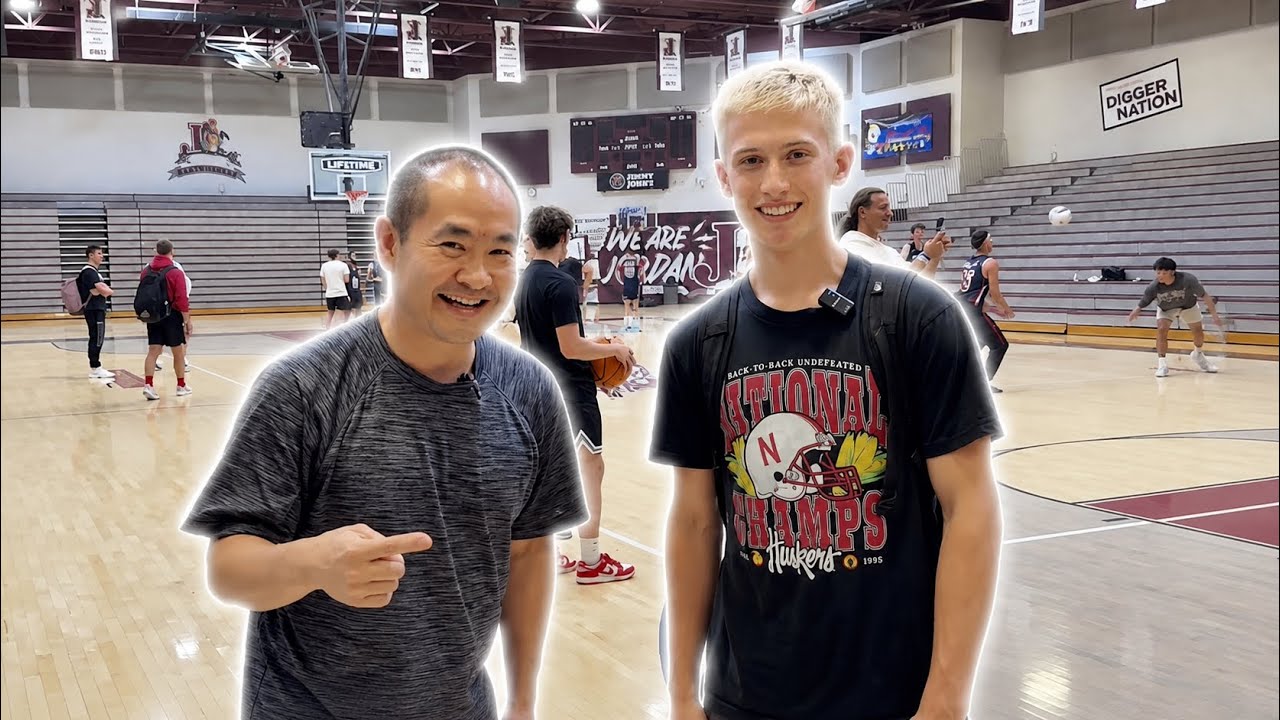
Every creator I meet wants to talk about the output. Views, followers, brand deals, the clip that hit. Almost nobody wants to talk about the input, because the input is boring and repetitive and takes years. Ask a creator with a billion views what produced the billion and you usually get a growth-hacking answer. I asked one, and he gave me a number instead: about a million jumps.
The creator is Nathaniel “Hoopin Nate” Kenney, a 5’7″ dunker out of Omaha with more than a billion views across platforms and about 210,000 people following him on Instagram alone. I interviewed him for two minutes at The Dunk Camp in Utah. Those two minutes contain a better lesson on building a personal brand than most of the marketing conference talks I sat through last year.
The Billion Is the Output. The Million Is the Input.
His father Joe told me about the million jumps before I ever turned the camera on. When I asked Nate to confirm it, he did not perform the number. He said somewhere around there, the way you would confirm your own shoe size. Then I asked what a million jumps taught him.
“That you should never give up. There’s been a lot of hard times in that million jumps, but as long as you persevere, you’re gonna keep making progress.”
Nathaniel “Hoopin Nate” Kenney
Read the middle clause again, because that is the whole thing. A lot of hard times in that million jumps. He started on a Nerf hoop hung on a kitchen cabinet door. He became the best mini hoop dunker alive, then moved to low rims, then to full ten foot rims. Each of those transitions cost him years of failing in a gym with nobody watching.
Business owners tell me their content is not working after six weeks. Athletes tell me their brand is not growing after two months. Nate’s billion views sit on top of roughly a decade of unglamorous repetition. The output is public. The input never is. That asymmetry is why so many people quit right before the thing starts working.
He Corrected Me Before He Answered
I asked him when he realized he was famous. He would not accept the premise of the question.
“I would never consider myself famous, first off. But the first night I got posted by SportsCenter. I remember my brother came into my room screaming ‘Oh, my goodness.'”
Nathaniel “Hoopin Nate” Kenney
He has been on Jimmy Kimmel. He has shot campaigns with Gatorade alongside Michael Jordan and with Google Pixel alongside Giannis. He has appeared on TNT, ESPN, and Fox Sports. He rejects the word famous anyway, and he does it in the first four words of his answer.
I have worked with the Golden State Warriors, Nike, Adidas, Red Bull, and Starbucks. The people inside those organizations who last are almost always the ones who refuse the label. Refusing it is not modesty theater. It keeps you working on the input while everybody else is admiring the output.
The Detail That Actually Connects
The most valuable sentence in the interview has no numbers in it at all. I asked what that first night felt like, and he described a room.
“my entire family sat on my parents’ bed and just watched the video and looked at the comments.”
Nathaniel “Hoopin Nate” Kenney
A brother sprinting down a hallway yelling. A family piled on a bed in Nebraska passing a phone around, reading strangers’ comments out loud. Nobody needs to understand dunking to feel that. Every parent, every sibling, every person who ever had one good night reads that sentence and is instantly inside it.
This is the part creators skip. They lead with the billion because the billion sounds impressive, and the billion is exactly what makes them forgettable, because numbers of that size are abstract. The bed is not abstract. Sponsors, journalists, and recruiters remember the bed. I remembered it on the flight home and I have told the story four times since.
Thirty years of doing this and the pattern has never changed. Specificity is what travels. When we built content for the Warriors, the numbers were already enormous and largely inert. What moved people was the human moment attached to the number.
Golf, Editing, and Why the Off-Topic Answers Matter
I asked what people might not know about him. He said golf and editing. If he were not dunking he would want to play professionally, and his favorite golfer is Scottie Scheffler, for a reason that had nothing to do with rankings.
“He’s got a good faith, and I think he’s a good role model.”
Nathaniel “Hoopin Nate” Kenney
Then he explained why he likes sitting in an edit timeline, which is not something anybody expects from an athlete known for one second of airtime.
“It just allows you to be creative and tell a story in a way that most people might not see it as.”
Nathaniel “Hoopin Nate” Kenney
Those two answers are worth more to his brand than another dunk clip. Golf gives him a second audience and a natural bridge to sponsors who have nothing to do with basketball. Editing tells you he is a storyteller, not a stunt. A brand deciding between him and the next dunker will use exactly those details to choose.
Persistence Only Compounds If It Is Recorded
Here is the uncomfortable part. Nate came out ranked first among all 76 campers on the audit I ran with dunker and host Dylan Haugen, published openly on the Dunk Camp 2026 audit leaderboard. Ranked first, and Google still had a thin and partly wrong understanding of who he is.
The Knowledge Panel confidence score measures one thing: how well Google understands who you are and what you do. Anything above 400 is celebrity tier. Shaq sits near 40,000. A creator with a billion views can still sit near the bottom, because views live on someone else’s platform and vanish from the record. The same structured data that lifts that score is what ChatGPT and Claude read when somebody asks about you.
“You’re understood by your relationships, by the content that you have.”
Dennis Yu
A million jumps produced a billion views. The billion views produced almost no permanent, structured record. That gap is the entire reason I stood in a gym in Utah with a camera and asked a teenager about his parents’ bed.
This Article Is the Method
At the end of our session I offered to interview any camper who wanted it and turn that video into assets across our sites. Two minutes with Nate became six articles, each with a different angle. Nate told it himself in his own SportsCenter night account. Dylan covered the conversation for the dunk community in the Dunk Talk breakdown. Dunker Spotlight took the ranking angle in the numbers are not the story, and the general version for athletes in any sport is a highlight reel is not enough.
The marketing mechanics are broken down in the story behind the numbers, and the full system we taught the room is in the 76 athlete repurposing system.
Nate is known as Hoopin Nate because he started on mini hoops. He is now landing 360 windmills on regulation rims. I told the camera he is Hoopin Nate, but soon Dunking Nate. Whatever the name ends up being, the input never changed. He kept jumping on the days it did not work, and somebody finally wrote it down.