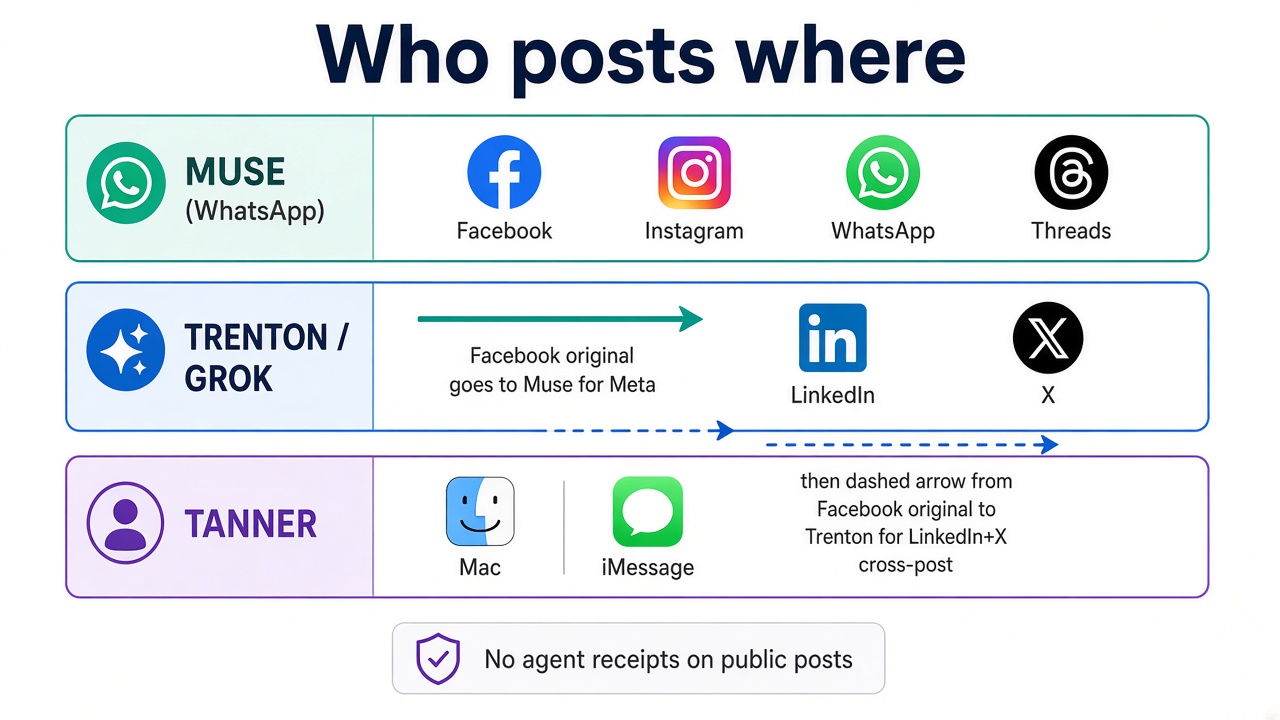
Short version: I chat Meta’s Muse in WhatsApp. Muse owns Facebook, Instagram, WhatsApp, and Threads. My content desk (Trenton) still owns LinkedIn and X. Tanner owns Mac iMessage. If you try to make every agent do every network, you get broken logins and AI sludge. One surface, one owner.
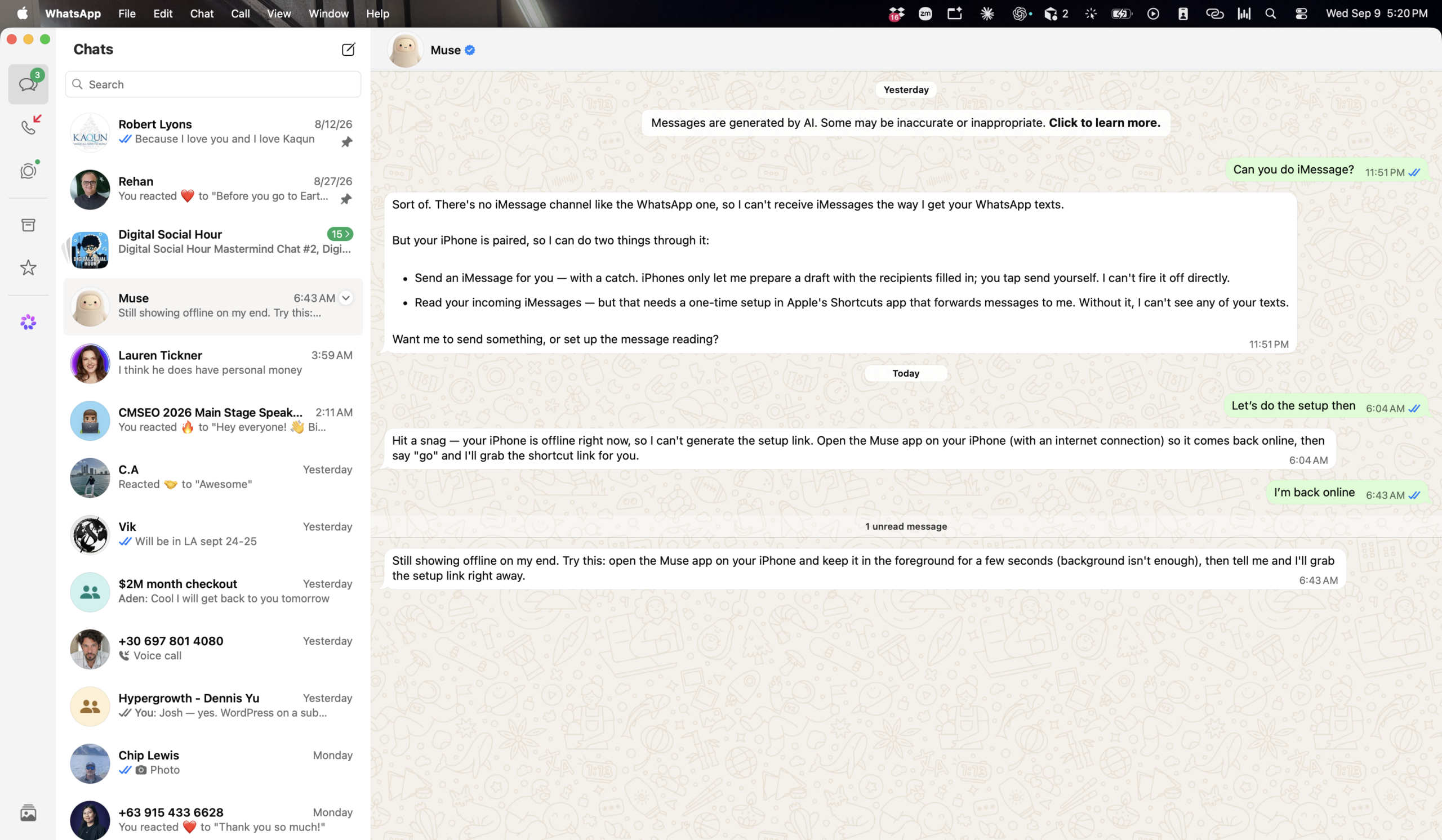
This is my real Muse chat
Not a stock mockup. Tonight on my Mac: WhatsApp Desktop, contact Muse with the verified badge, egg avatar, AI disclaimer at the top. We were mid-setup on whether Muse can help with iMessage (spoiler: WhatsApp is native; iMessage stays a separate Mac rail).
Why Muse gets Meta — and why I’m not pretending otherwise
Meta launched Muse as a personal agent you message like a person — Muse app or WhatsApp — running in a Muse Secure VM with its own browser, a Sentinel gate on outbound actions, and an audit trail. Primary announcement: about.fb, 8 Sep 2026.
That is biased toward Meta properties. Good. I want the agent that already has Facebook and Instagram wiring for Facebook and Instagram. Fighting the platform with a generic browser agent is how we burn evenings on 2FA walls.
The handoff (five boring steps)
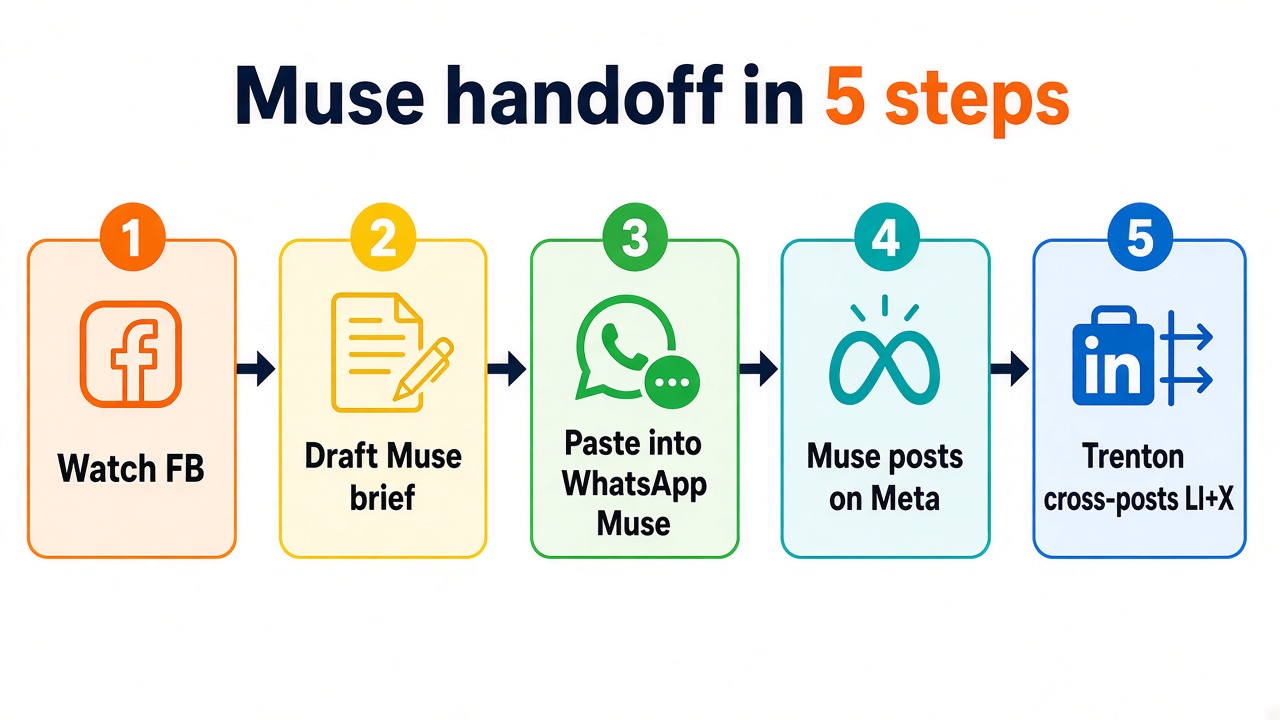
- Watch for Meta-native work (FB/IG/Threads/WA), or a FB original that also needs LinkedIn/X.
- Draft a one-job Muse brief (goal, surface, copy, assets, constraints, done-when).
- Paste into WhatsApp contact Muse and send. We cannot
SendToAgentMuse — it is not a Grok Bot peer. - Muse executes under access I’ve granted, asks before sensitive sends, leaves an audit trail.
- Trenton takes the live Facebook original and mirrors it to LinkedIn + X — same text and image, no “Agent receipt” footer on the public post.
What Meta’s own Muse stack already shows about multi-agent work
I’m not inventing a framework. Meta’s public Muse Spark / Muse Code docs already describe orchestration patterns we borrow:
- Muse Spark Contemplating mode — parallel agents for hard reasoning.
- Muse Spark 1.1 — main agent plans and delegates to parallel subagents; Marketplace computer-use demo (phone video → listing).
- Muse Code session messaging — bounded handoffs between live sessions without merging permissions.
- Hermes Kanban cookbook — durable comments as the audit surface, not back-channel chat.
Consumer Muse is the Meta executor. Muse Spark / Muse Code are the model and coding-agent cousins. Same family, different jobs.
Rules that keep this from becoming AI theater
- No agent receipts on public posts. Job IDs belong in Basecamp, not the Facebook caption.
- One job per Muse brief. No novels.
- Don’t “correct” my intentional copy (yes, meatings was on purpose).
- iMessage ≠ WhatsApp. Tanner owns Mac Messages. Muse owns WhatsApp.
- Don’t invent metrics in the launch-week explainer. Case studies get before/after logs later.
FAQ
Is Muse the same as Muse Spark or Muse Code?
No. Muse = consumer agent in WhatsApp/app. Muse Spark = model family. Muse Code = Meta’s coding agent/CLI.
Can Grok agents message Muse directly?
Not today. Handoff is WhatsApp → contact Muse.
Who posts LinkedIn and X?
Trenton / Grok, from the Facebook original after it’s live.
Where are Meta’s own words?
Muse product · Muse Spark · Muse Spark 1.1 · Session messaging
Dennis Yu — updated 9 Sep 2026. Screenshot and lane split from our live ops the same day Meta shipped Muse.