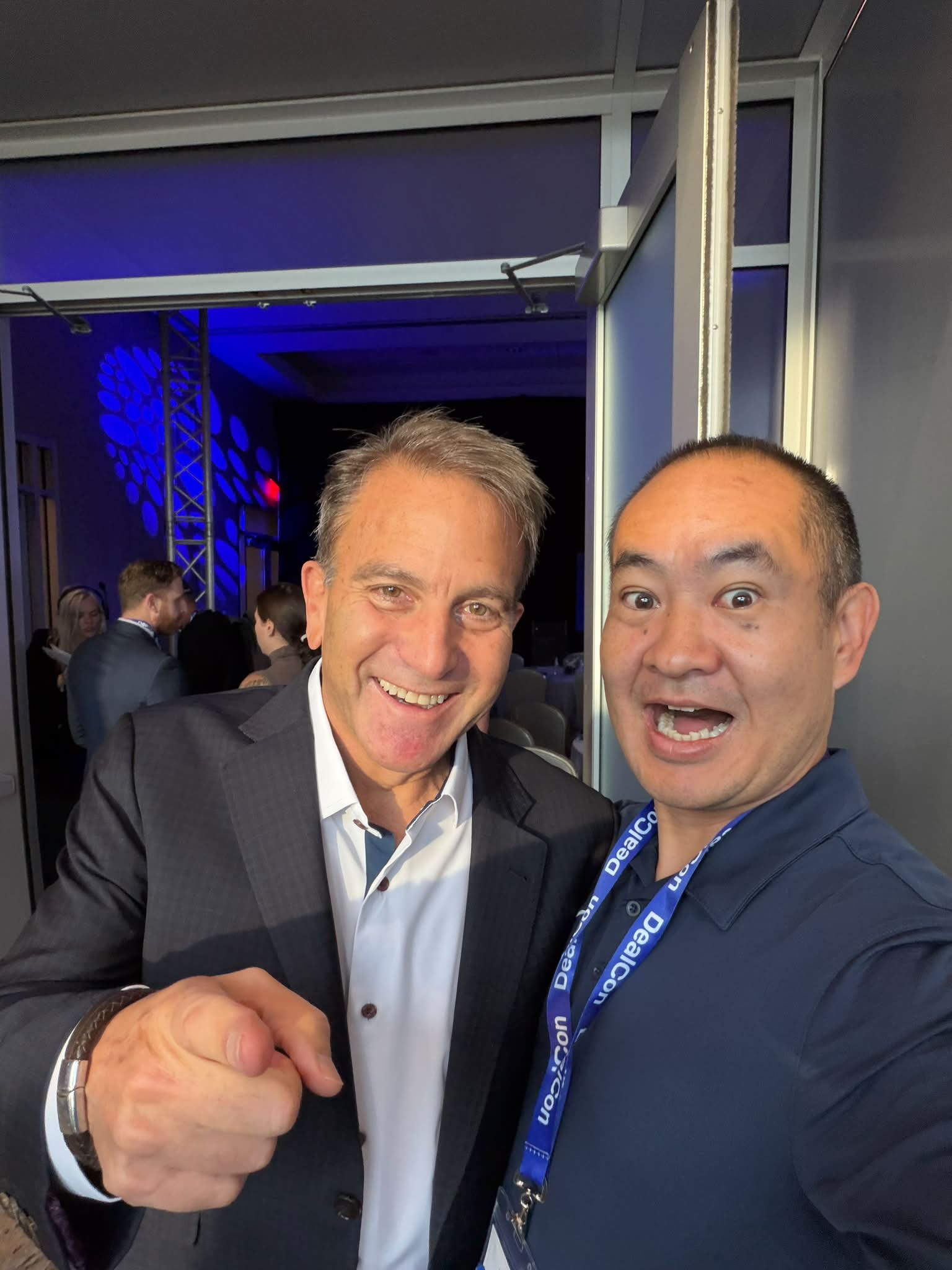
 Tom Shipley — the deal maker of deal makers.
"Meet Tom Shipley, the deal maker of deal makers. He walks the talk more than anyone I know and deeply wants to help other founders achieve their goals via acquisition." — my caption when I posted this photo from DealCon Austin, October 19, 2026 (Instagram · Facebook)
You don't have to be a Wall Street guy to do a deal
Most contractors I know think acquisitions are for other people — private equity firms, lawyers, finance guys in suits. Nobody ever showed them the actual mechanics, in plain English, using businesses like theirs: an HVAC shop doing $3 million a year, a plumbing company with eight trucks, a pest control route business built over 25 years by a founder who is now 63 and tired.
That is exactly what DealCon exists to fix. DealCon calls itself "The #1 CEO M&A Summit for 7–9 Figure Founders" — a private, closed-room summit hosted by Tom Shipley (Co-Founder) and Matt Bodnar (Co-Host, and Founding Partner of Eidolon Capital), built around the acquisition playbook behind 16 acquisitions and more than $2 billion in lifetime brand sales.
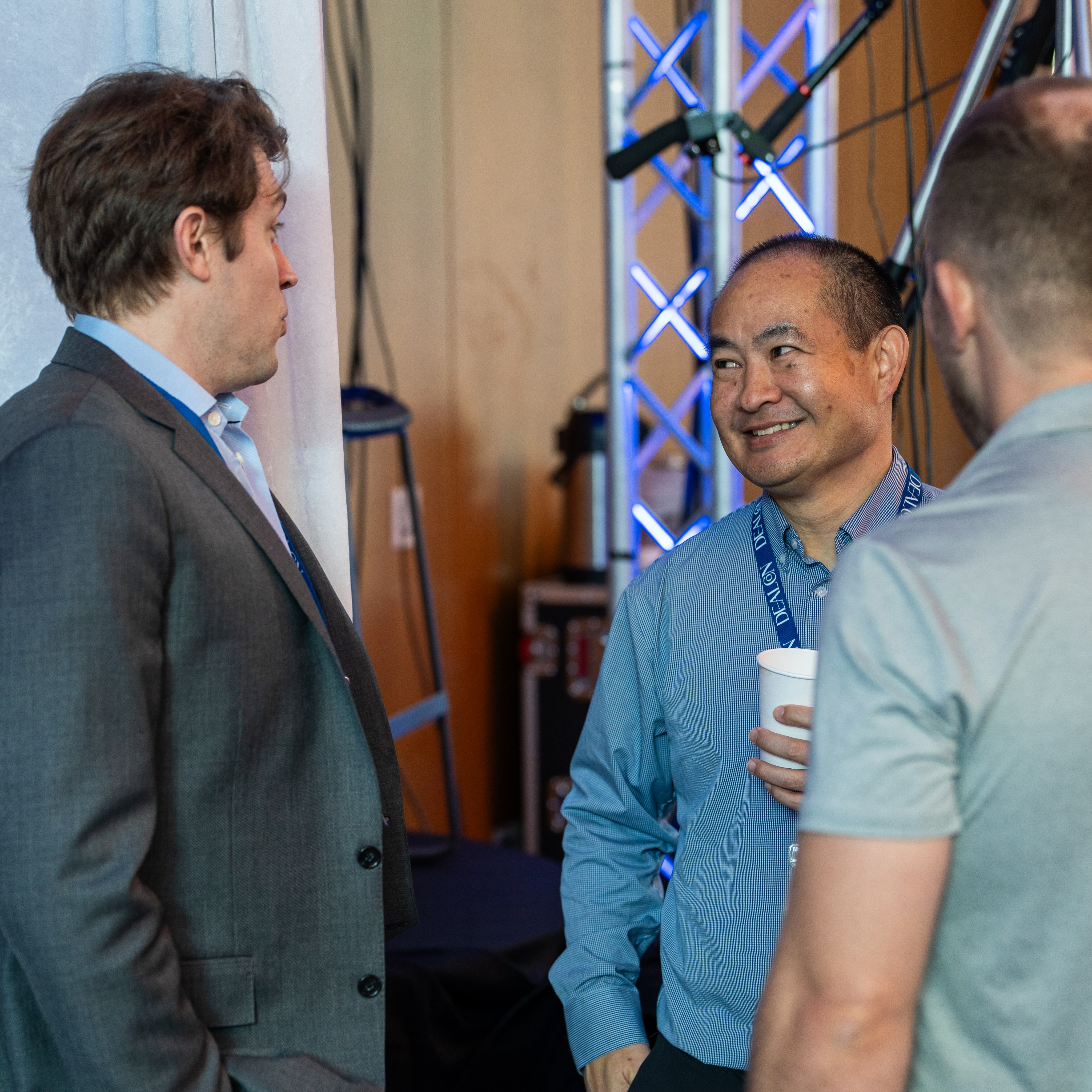 The most powerful conversations happen off the stage. Coffee with Matt Bodnar.
I didn't meet these people on a stage. I met them at dinners, in hallways, on a boat — and at Matt Bodnar's house, where we ate insects and talked deals for hours. That's the room this article is about.
I've been to DealCon again and again — Nashville, Miami, and Austin. I've spoken there, recorded podcasts in the hallways, eaten dinner with the speakers, stayed at Matt's house, and given my testimonial sitting in a boat. This article is everything I wish someone had handed me before my first one:
- Why the next ten years are the biggest wealth-transfer window in the history of the trades (the "silver tsunami")
- Why most owners who try to sell end up closing for zero — and how not to be one of them
- How a roll-up actually makes money (the multiple-arbitrage math, with real numbers)
- How deals get financed out of the business's own earnings — seller notes, earnouts, rollover equity, and SBA loans, including the 2025 rule change that killed a lot of bad advice
- The people who teach this — Tom, Matt, Erik Huberman, Robyn Siers, Billy Batt — with photos and videos to prove these are real relationships, not stage handshakes
Whether you want to sell your shop for what it's actually worth, or buy your competitors and build a platform, this is the playbook.
What actually happens at DealCon
DealCon is not a pitch-fest. Tom describes the room this way: about 70% of attendees are making their first acquisition, 10% have closed one deal, 10% are serial acquirers running $50M–$300M platforms, and 10% are there to sell. Home services is one of the named industries in the room.
The three days follow a simple spine (from the official agenda):
- Day 1 — Deal flow. How to find off-market deals — the ones that never hit a broker listing.
- Day 2 — "Buy it without writing the big check." Seller notes, earn-outs, equity swaps. DealCon's own teaching: the average deal in its network closes with less than 10% cash down.
- Day 3 — Aggregator Panel + tracks. An Exit Track, a Rollup Track, and an AI Track, plus live deal reviews — a real owner presents a real deal on stage and Tom and Matt break it down in front of the room. The flavour of it: Tom's live deal review post from Austin.
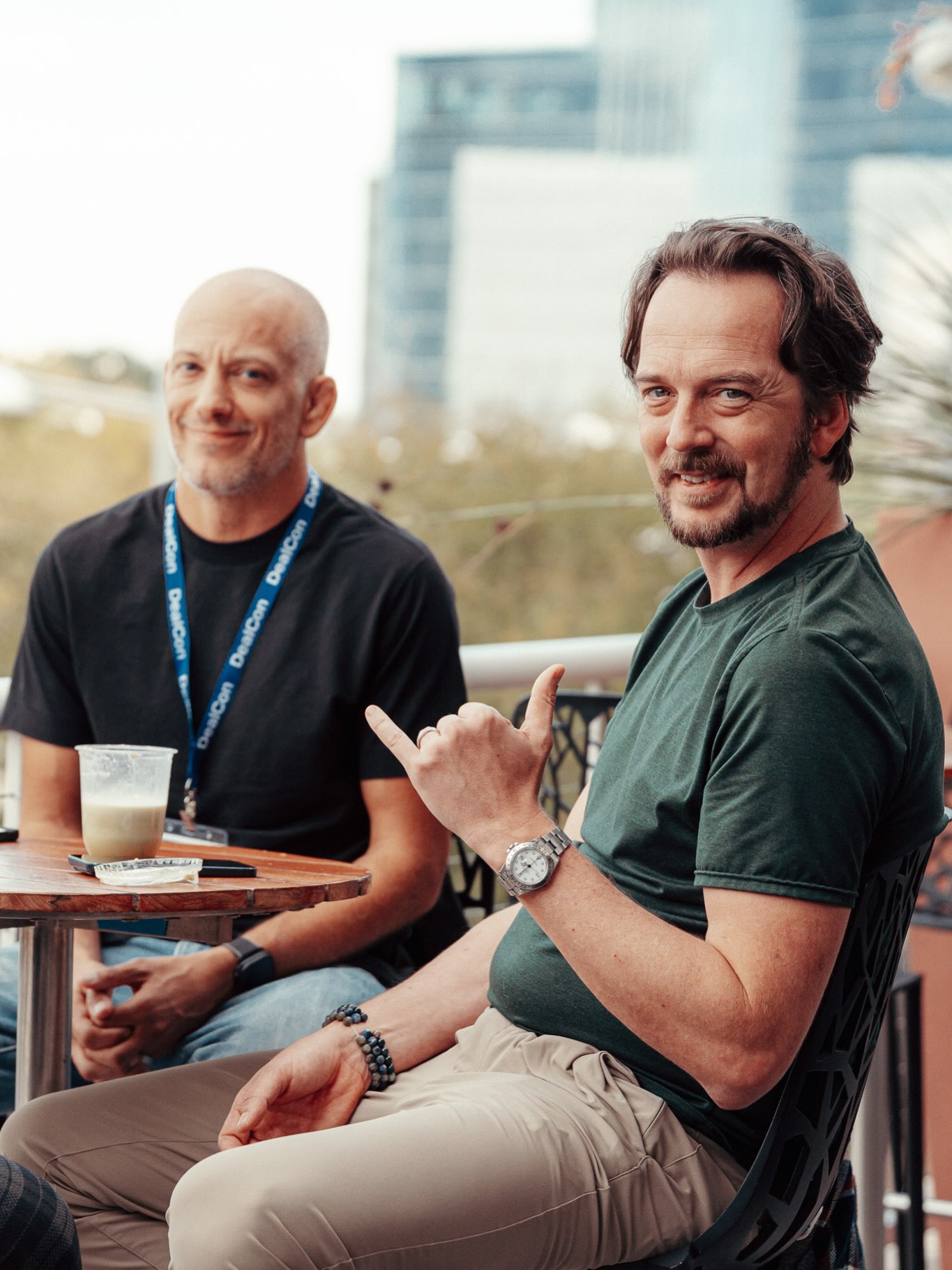 Day 1. The conversations start before the sessions do.
And then the part nobody puts on the agenda: the dinners. Tom posted after Austin that on the Tuesday night, "the restaurant had to ask more than 100 of us to leave at 11. The next morning, at 8:30, on the final day of DealCon Austin, the room was still full." (Facebook · Instagram) Deals start at the tables, not the podium.
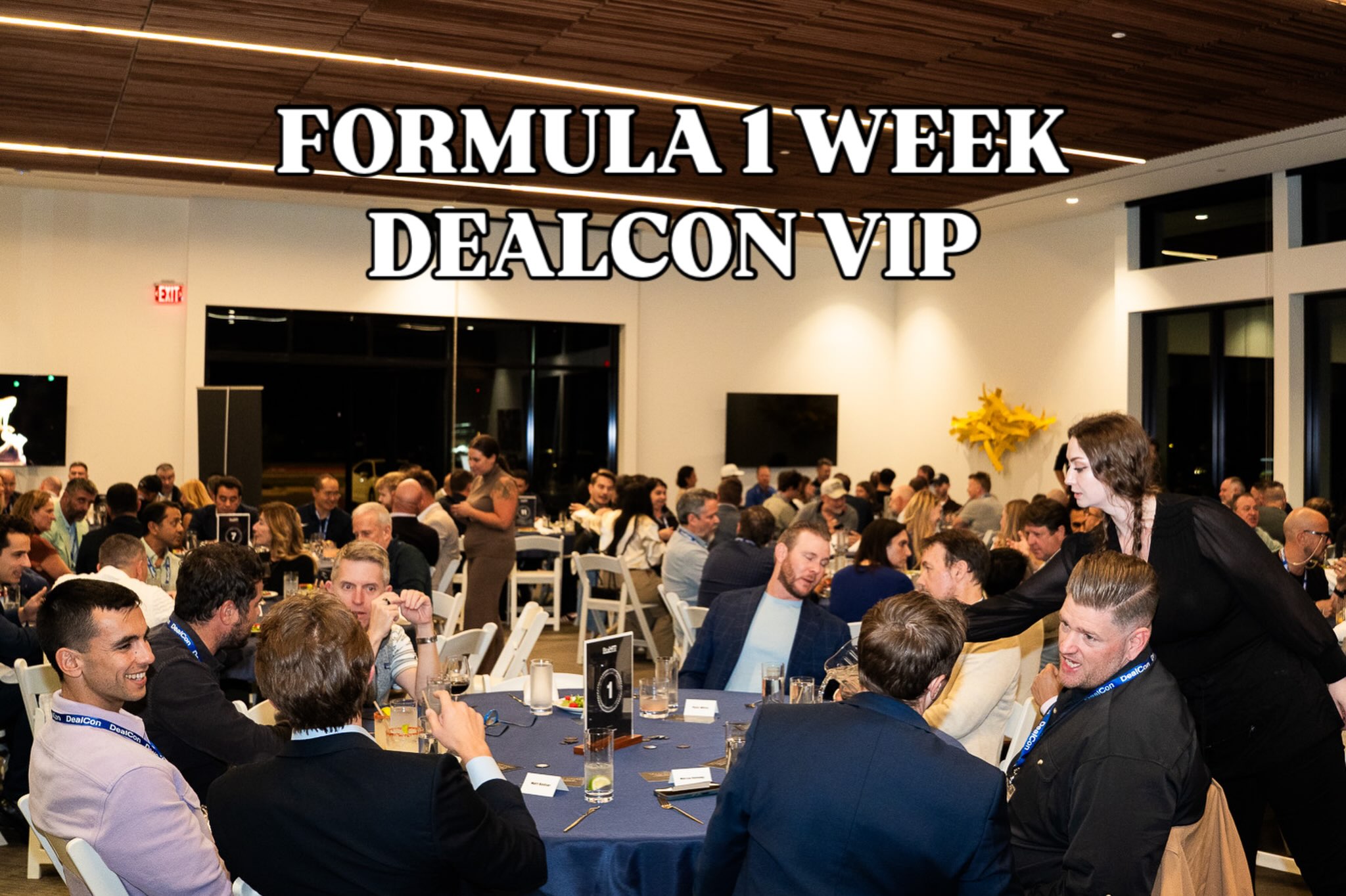 VIP night, trackside at Circuit of the Americas, Formula 1 week.
 Day 2 ended the right way — a private reception dinner at Haywire.
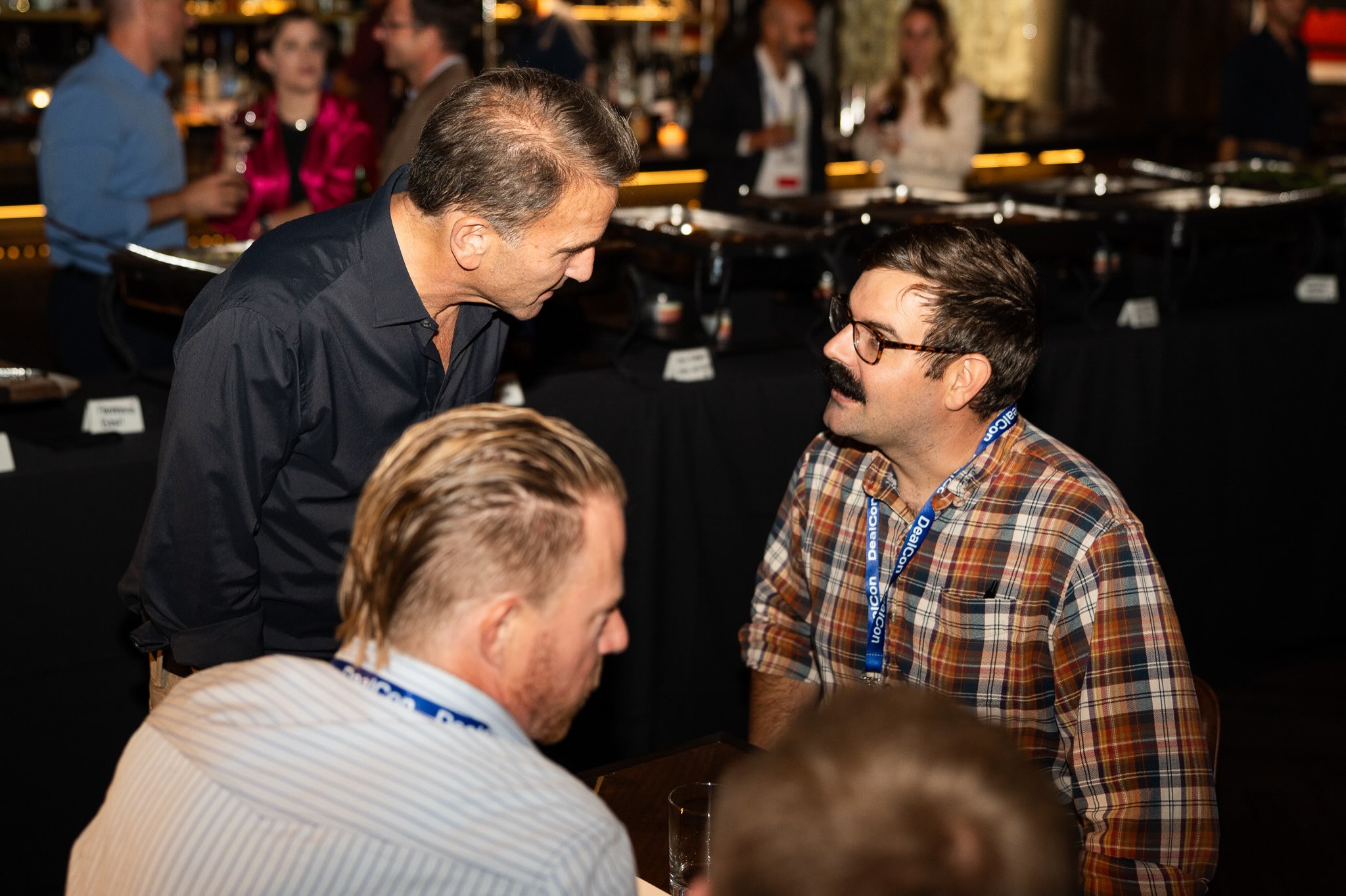 DealCon after hours at Haywire. This is where the real conversations happen.
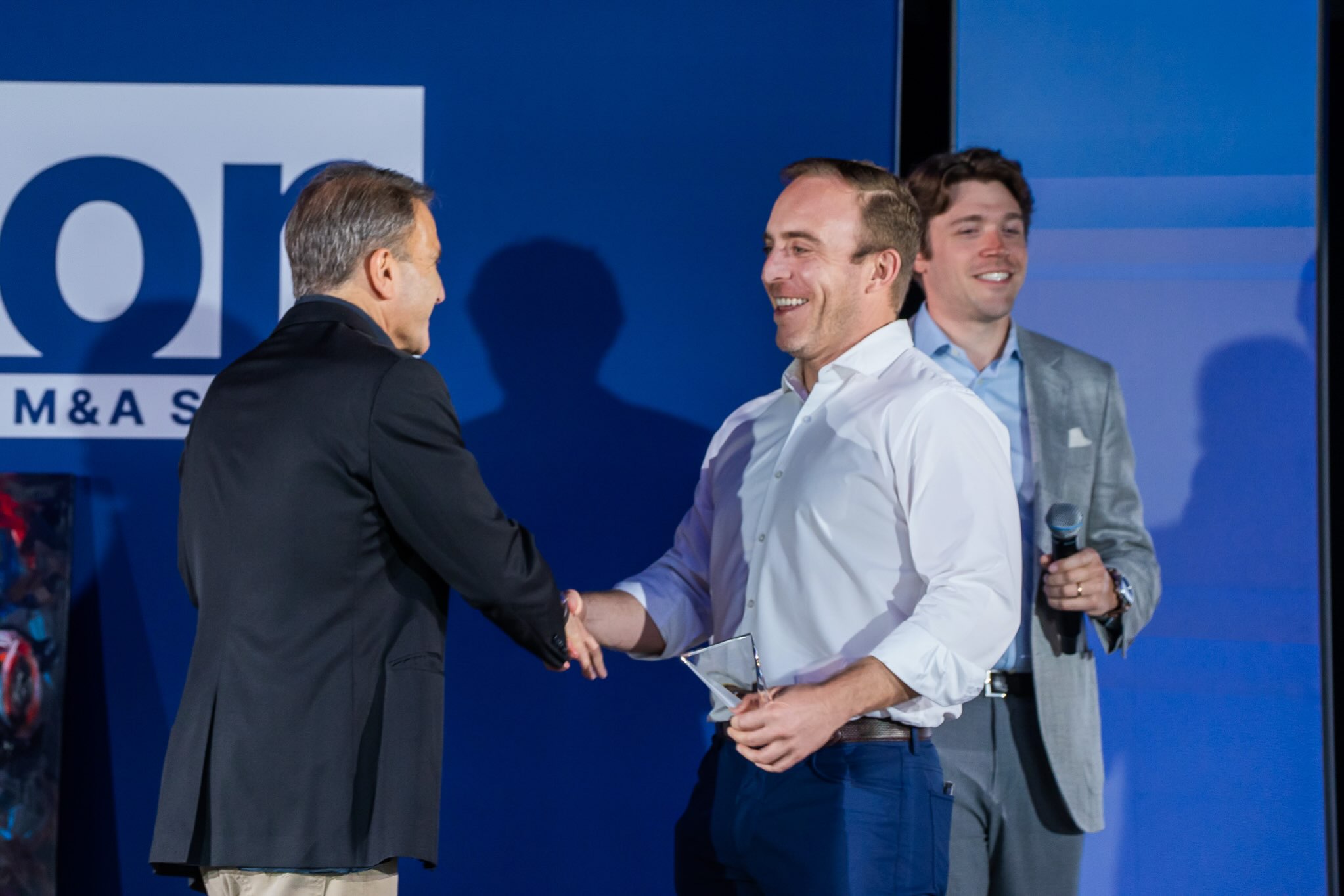 We stopped the sessions to celebrate the people who actually closed deals.
My own testimonial, recorded for Tom's team, put it this way: "DealCon compressed what would have taken 30 conferences into two or three days." I found business partners and deal flow there, and left knowing I could consult for equity, structure creative deals, and think like an acquirer. (Watch it on Instagram · Facebook)
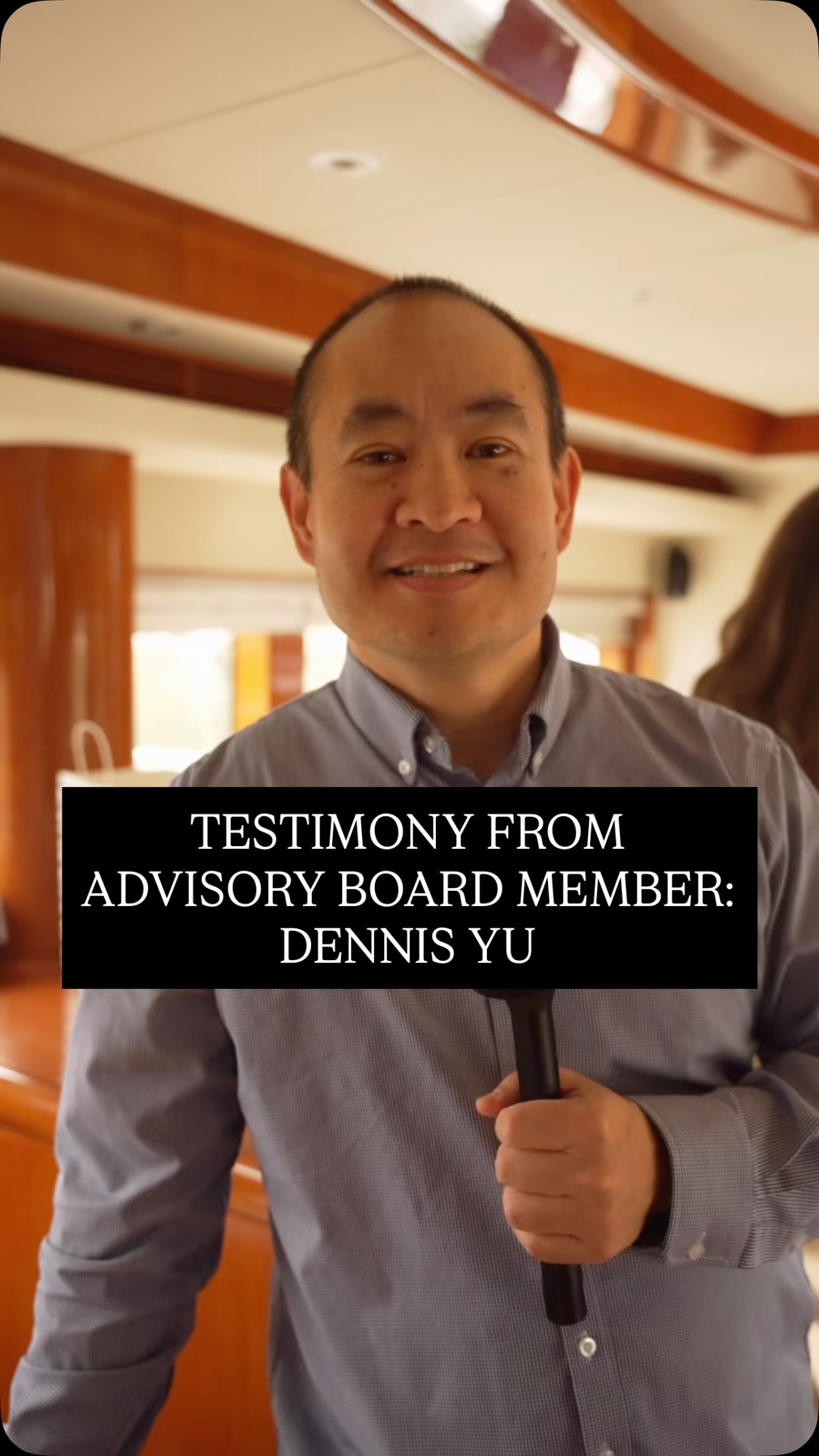 They filmed my DealCon testimonial on a boat. I meant every word.
My DealCon timeline — Nashville, Miami, Austin
| When | Where | What happened |
|---|---|---|
| September 2024 | Nashville | Between sessions at the M&A conference in Nashville, I sat down with Matt Bodnar and host Peter Lang and recorded the conversation below — why Matt says "M&A is the solution to everything." Years earlier, I had stayed at Matt's house in Nashville. |
| February 2025 | Nashville | Another DealCon edition in Nashville — Robyn Siers was already on the speaker/leader roster there. |
| September 8–10, 2025 | Austin — Austin Proper Hotel | 100 founders, $1M–$100M revenue, sold out. Jay Abraham headlined; Erik Huberman was among the past speakers in Matt's save-the-date. |
| February 9–11, 2026 | Miami | 125 seats. I spoke there — Tom announced me on February 7 — and Tom and I filmed our selfie reel on the floor, geotagged Miami: "If you want to buy a company in the next 6 months, come to Austin in October for DealCon, hosted by Tom Shipley." (Instagram reel · speaker announcement) Also the trip where I was out on a boat with Billy Batt and other folks from the room — the deals are the excuse; the friendships are the compounding asset. |
| October 19–21, 2026 | Austin | I gave the Advisory Board talk Tom set for me — "Authority Is the Asset: How Search, AI, and Reputation Drive Deal Flow and Valuation" — and the photo at the top of this article is from that week. Tom's photo dump says it best: "This is what happens when 7-9 figure entrepreneurs get in one room to acquire, scale, and exit at an outsized level." (Tom's photo dump) |
| March 31 – April 2, 2027 | Miami — Brickell Arch Hotel | Next. 150 vetted founders. I'm speaking. Come find me. Welcome reception March 30. Tickets on dealconlive.com — $2,497 early-bird General Admission at publish time, refundable through February 1, 2027. |
Tom set my Austin session himself. He didn't have to — that's who he is in this room: a host, not a guru.
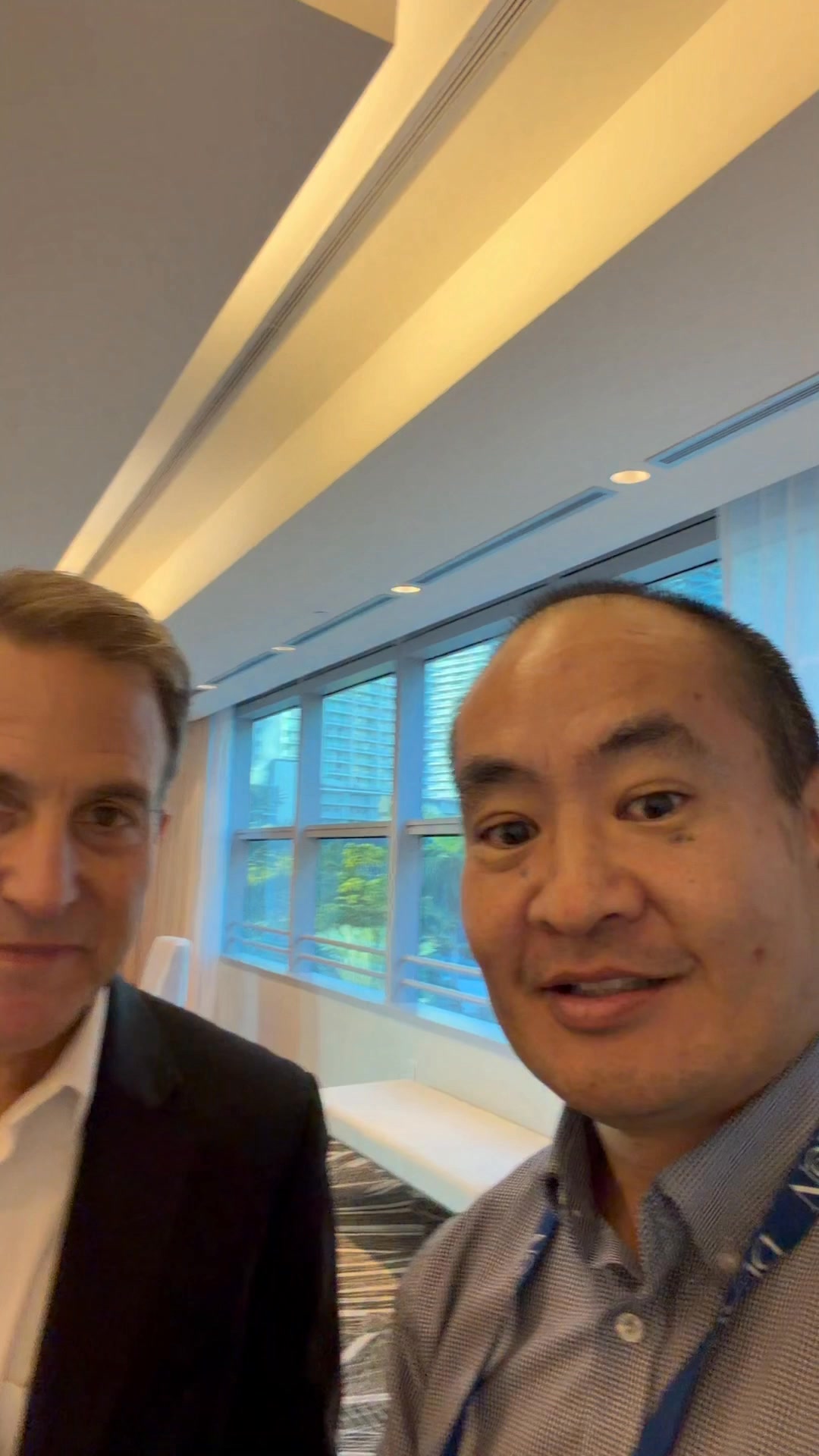 Miami, February 2026. Tom and I, telling every founder in the room: go buy a company.
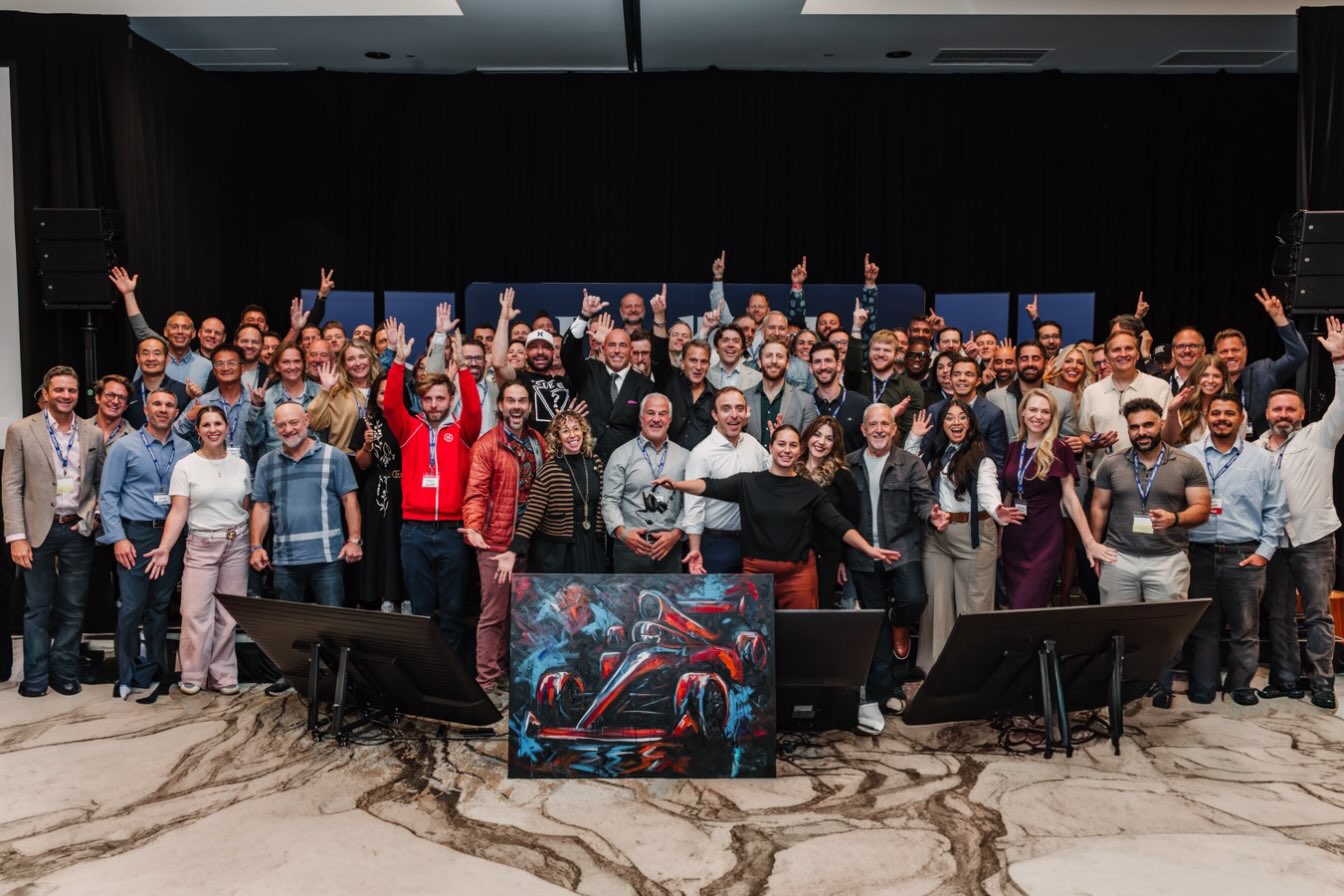 The whole room on stage for the closing photo — DealCon Austin, October 2026.
The growth tells the story: the earliest DealCons were 12, then 25, then 40 CEOs in a room. Austin 2025: 100 founders. Miami 2026: 125 seats. Miami 2027: 150.
The silver tsunami: the numbers behind the next decade of deals
Baby boomer owners are retiring, and their businesses have to go somewhere. Here is the wave, from the sources (not conference hype):
- ~12 million small businesses, representing nearly $10 trillion in assets, are expected to change hands over the next decade. — JPMorganChase, Powering 10 Million Small Businesses
- 2.9 million U.S. businesses have owners over 55. They employ ~32.1 million workers, pay ~$1.3 trillion in annual payroll, and generate ~$6.5 trillion in revenue. — Project Equity, via Harvard Business School
- 73% of privately held companies plan to transition within 10 years — a $14 trillion transfer opportunity. — Exit Planning Institute
- More than half of all privately held businesses in America have owners over 55. — U.S. Census Bureau, via HBS
Home services sits right in the middle of this: founder-led, no-succession-plan, "my kids don't want the business" shops built over 30 years — good crews, loyal customers, recurring contracts, and an owner who is the business. Which brings us to the brutal part.
The default exit is zero
Most owners assume that when they're ready, they'll sell. The data says otherwise:
- "70% of the companies put on the market do not sell, and 50% of exits will be involuntary." — Exit Planning Institute, on its own blog
- Only about 20% to 30% of businesses that go to market actually sell. — HBS, citing EPI
- DealCon's own site puts it in daily terms: roughly 1,800 American businesses close their doors every day — about 900 of them owned by retiring owners, because only 1 in 4 ever finds a buyer. (DealCon, citing BLS, EPI, and BizBuySell/IBBA data)
- Why? 58% of owners have no written transition plan, and 78% have never assembled a formal transition advisory team. — EPI 2023 National State of Owner Readiness Survey
Read that again. The most common "exit" in America is not a lowball offer. It is no offer. The owner turns off the lights, the trucks get sold for scrap value, the phone number — with 20 years of customers calling it — stops being answered, and decades of built value settle at zero. That is the problem DealCon, Tom, and Matt are actually solving — and it is fixable, from both sides of the table.
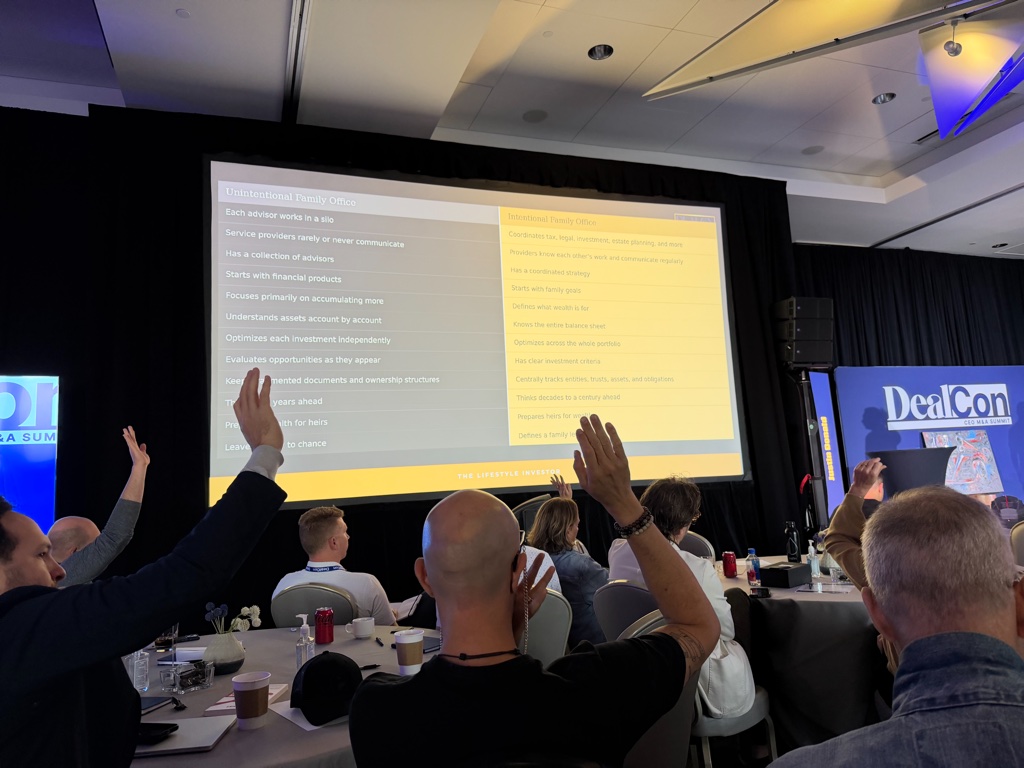 Full room, hands up. DealCon Austin, Day 2.
Path 1 — You're the seller: sell for a premium instead of closing for nothing
If you own the shop, your job in the 2–3 years before you sell is to make the business transferable — worth something to someone who isn't you.
What buyers actually pay for in home services:
- Recurring revenue. Maintenance agreements in HVAC, service contracts in plumbing, route density + retention in pest control. Pest control commands a premium for a reason: Rollins reported ~75% of its business was recurring services.
- A business that runs without you. If every estimate and key relationship runs through your cell phone, a buyer is buying a job, not a business — and they'll price it that way.
- Clean books. Two to three years of financials a lender can underwrite. This is where most deals die quietly.
- Your authority. This was my DealCon talk. A shop that Google, AI search, and the local market already trust — reviews, a real brand, a Knowledge Panel for the owner — is worth more than an identical anonymous shop: the buyer is purchasing trust they'd otherwise have to rebuild. Authority is a line item in your valuation.
What home services businesses actually sell for (broker/advisor syntheses of closed deals — ranges, not a single index):
| Trade | Typical range |
|---|---|
| HVAC (tuck-in / smaller deals) | ~4–7× EBITDA; Western Companies' Feb 2026 report: residential at 6.2× ($500K–$1M EBITDA), 8.4× ($1–$5M), 9.9× ($5–$10M) |
| Plumbing | ~2.4–6.5× EBITDA, top-tier operators higher |
| Pest control (the premium trade) | ~7–10× EBITDA for mid-market tuck-ins, 9–12× larger, 11–15× (premier up to 17×) at platform level |
Sources: CT Acquisitions, Western Companies, Feb 2026, DealSeam.
For context: BizBuySell counted 9,586 businesses sold in 2025 at a median price of $350,000, selling at 94% of asking. The median seller who prepares does fine. The unprepared majority never get to a closing table.
Seller checklist:
- Get a real valuation early — a market number, not your retirement number worked backwards.
- Clean up the books; separate personal expenses.
- Systematise yourself out of daily operations; document how the shop runs.
- Grow recurring contracts — every maintenance agreement is sellable value.
- Build your public proof: reviews, photos, your name attached to expertise. Start now, not the month you list.
- Assemble the team before you need them: an M&A attorney (Robyn Siers's whole practice — see below), a deal CPA, a broker who knows your trade.
- Consider structures beyond "all cash at close": a seller note, an earnout, or rolling equity into the buyer's platform can mean a higher total price — and a second payday at the platform's exit.
Path 2 — You're the buyer: the roll-up, explained like a contractor
A roll-up is simple: buy one solid business as your platform, then bolt on smaller competitors (tuck-ins / add-ons) in the same or adjacent markets, run them on one back office, one brand, one marketing engine — and the combined business becomes worth more than the sum of its parts.
Why? Multiple arbitrage. The single most important concept at DealCon, and Tom and Matt teach it relentlessly:
- A platform business might be bought at 6–10× EBITDA
- Add-ons get bought at 3–6× EBITDA
- The combined platform eventually exits at 10–15× EBITDA
Worked example (from CT Acquisitions' roll-up explainer): buy $1M of EBITDA for 4× — $4M. Inside a platform valued at 10×, that same $1M of profit is worth $10M. The $6M difference is value created by the structure, not by working harder.
This is not theory in the trades. Private equity has rebuilt home services around it: Apex Service Partners reached a reported $1.3B in revenue, Wrench Group crossed a reported $3B, and add-on deals were more than 41% of all HVAC M&A in the first half of 2026 (Capstone Partners, via Carta) — the highest share in four years.
Nor do you have to be Blackstone to play a smaller, saner version. A local operator who buys two or three retiring competitors, merges the routes, keeps the crews, and answers all the phones under one brand is doing a roll-up. DealCon is full of them.
Watch: me, Matt Bodnar, and Tom Shipley together on buying and selling companies
"But I don't have the money" — how deals finance themselves
This is the objection DealCon's Day 2 exists to kill. You rarely need the full price in cash — you need a credible down payment, a lender who understands the trade, and a structure where the business's own cash flow services the debt (lenders typically test around 1.25× debt coverage). The pieces:
1. Seller financing (the seller note). The seller lends you part of the price — typically 10–25% in sub-$10M deals — paid over time out of the business's earnings. The seller gets a higher total price and income over time; you get a seller who wants the transition to succeed. Tom's network data puts seller notes at ~49% of the average DealCon deal structure.
2. Earnouts. Part of the price (typically 15–25%) is paid later, if the business performs — for example, contingent on retaining 90% of recurring billing through month 24. Earnouts bridge the gap when buyer and seller disagree about the future. Matt's firm, Eidolon Capital, is known for exactly this flexibility — equity rolls and earnouts where rigid buyers walk away.
3. Rollover equity. The seller takes part of the price as ownership in your platform instead of cash, and stays invested in the bigger outcome — including the multiple-arbitrage second payday at the platform's exit.
4. SBA 7(a) loans. The first-time buyer's workhorse: loans up to $5M for acquisitions. But get the current rules, not the 2023 internet version. Under SBA SOP 50 10 8 (in force since June 1, 2025), a complete change of ownership requires a real 10% cash injection; a seller note counts toward it only on full standby (no payments) for the life of the loan; and earnouts are prohibited in SBA-financed deals — the price must be fixed at closing. Anyone telling you "almost nothing down with an SBA loan" is quoting a dead playbook. On a $1.5M deal, plan on at least $150,000 of verifiable cash.
5. The typical stack, all-in, for a sub-$10M deal: senior debt 50–70% · seller note 10–25% · buyer equity 10–25%, with mezzanine sometimes filling the middle. DealCon's official teaching — average deal under 10% cash down, built from seller notes, earn-outs, and equity swaps — is the aggressive end of that stack, in private (non-SBA) deals with motivated sellers. It's a structure you negotiate, not a guarantee you assume.
The honest one-liner: you don't need to be rich to buy a business. You need to be credible, prepared, and in the room where motivated sellers and deal-structurers actually are.
The people who taught me this
Tom Shipley — the deal maker of deal makers
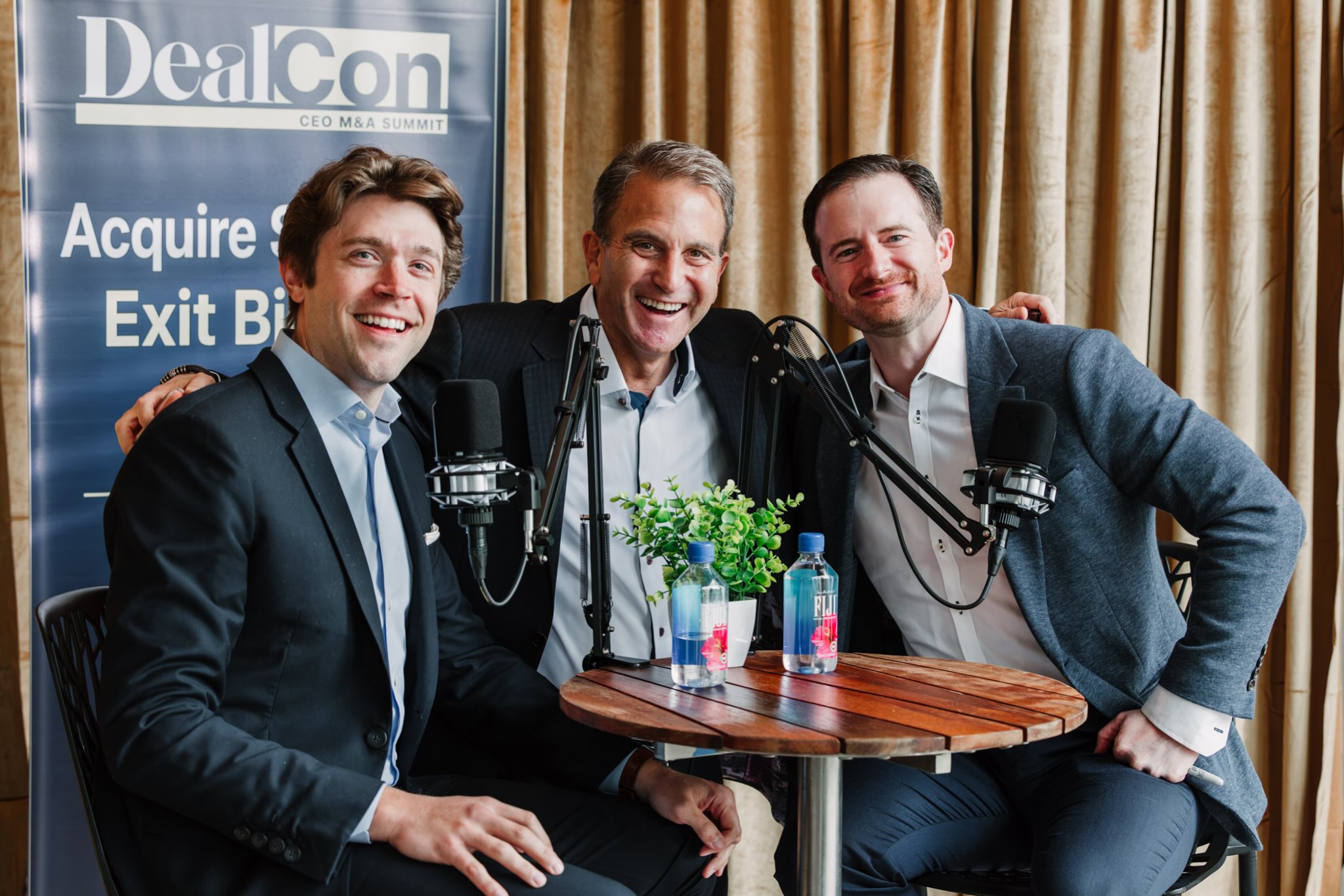 Tom and Matt at the podcast table in Austin. These two built the room.
Tom's DealCon bio, in short: IDF special forces (Unit 669); co-founded Atlantic Coast Brands, where — in his canonical telling — "we ran out of money, and then one $15M acquisition took us from $331K to $100M in three years." Brands including Hydroxatone ($1B lifetime sales) and Keranique ($630M); $2B+ in lifetime brand sales; a PE exit in 2021; $100M raised for Foundry; 16 acquisitions and exits. His philosophy is "Add a Zero" — stop asking how to grow 10% and ask what acquisition gets you 10×.
He also walks the talk personally. Tom set my session himself, thanked me for the Advisory Board session and for the podcast I recorded at DealCon in the same email thread, and his team announced me as a speaker for Miami.
 Tom Shipley, closing out DealCon Austin.
Go deeper with Tom: - The Lifestyle Investor #269 — Tom Shipley: Scaling Through Acquisitions — his flagship talk, full video:
- Beyond A Million #218 — Tom Shipley on Building Bigger Exits Through Acquisitions & Rollups — the most roll-up-specific interview I found: the AVA roll-up, multiple expansion, and what DealCon is, in his own words - Deal Playbook with Tom Shipley — his podcast, co-hosted with Matt. Start with "Why Most Businesses Fail to Sell — And How to Beat the Odds" (Sept 13, 2024): valuation, seller financing, rollover equity. And yes — they had me on too: Episode #5, "How to Build an Agency Without Sales Calls with Dennis Yu" (Sept 13, 2024). (Episode index)Matt Bodnar — the smartest M&A player I know
I wrote this about Matt in June 2026, and I'd write it again today:
"The smartest M&A player who is also helping other companies win in getting deals done is Matt Bodnar. Goldman Sachs, hundreds of millions of deals, DealCon partner. So honored to be able to stay at his house, eat insects together, and learn from the master."
(My Facebook post — and yes, the insects story is real. That's what actual friendship in this business looks like: a couch, a weird meal, and hours of deal talk.)
Years before that Nashville recording, I'd stayed at Matt's house. That's the part no conference brochure sells you — the friendship came first, the deals followed.
Matt's record: started at Goldman Sachs; built Fresh Hospitality's restaurant portfolio as Partner & Head of M&A; Forbes 30 Under 30; now Founder & Managing Partner of Eidolon Capital in Nashville — control investments in founder- and family-owned businesses doing $10M–$100M in revenue, with long-term holds and flexible structures (equity rolls, earnouts) — and host of The Science of Success (5M+ downloads, 390+ episodes). He chairs four operating companies and owns the consequences of his structures.
Watch: Matt and me in Nashville — co-creating content, and why "M&A is the solution to everything"
Watch on YouTube · The full article version on BlitzMetrics
In that conversation: programmatic M&A (the McKinsey playbook Matt follows), multiple expansion — buying at 1–2M EBITDA and building toward the 8–12× platform range — and the home-services/plumbing roll-up as the lighthouse pattern. It's the DealCon thesis, recorded between DealCon sessions. More Matt + Tom together: How to Scale an 8 Figure Agency.
Erik Huberman — proof you don't need PE capital to roll up
I met Erik Huberman through DealCon, and later interviewed him on my podcast, The Coach Yu Show. Erik founded Hawke Media in 2014 and built it into a platform valued at $150M in current bios. At DealCon Austin 2026, Tom introduced his session like this: "23 agencies. $150M platform. 5,000 brands. Zero cash at close. Erik Huberman sat down with me this morning at DealCon and walked through how he built a roll-up without PE capital… You do not need a fund to build a platform. You need a structure sellers can say yes to." (Tom's post)
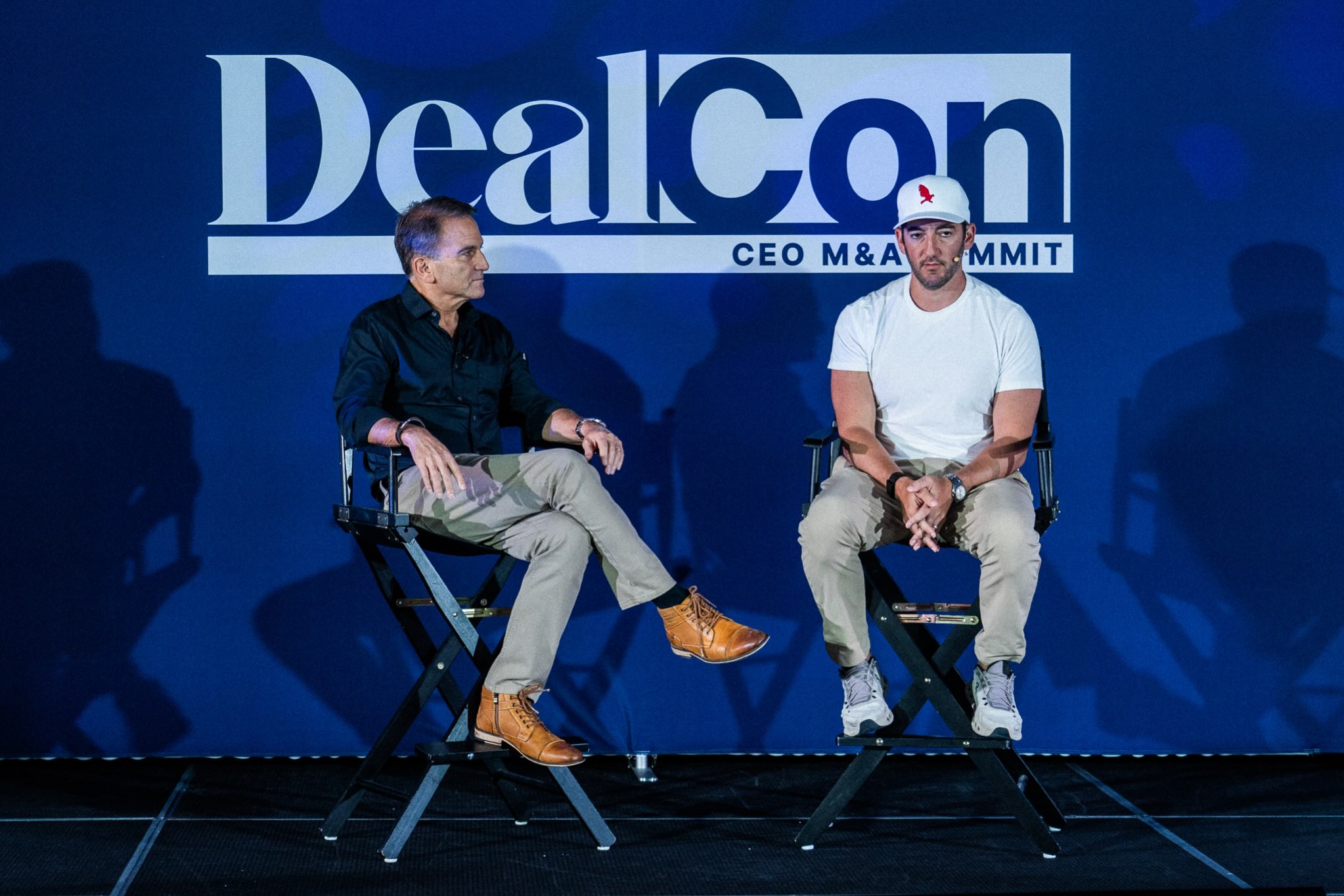 Erik Huberman walked Tom through 23 agency acquisitions. Zero cash at close.
Watch: my Coach Yu interview with Erik Huberman
Watch on YouTube · The M&A cut: Erik Huberman Is Buying Agencies While Everyone Else Runs for the Exit (7,000+ views) · the short: Erik Huberman is, more importantly, a good human
Robyn Siers — the lawyer who makes deals close fast
Every roll-up dies or lives in the paperwork. Robyn Siers is a partner at JonesSpross and the founder of Speed M&A™, the firm's method for executing middle-market M&A faster and more cost-effectively. Per her DealCon speaker bio, she has advised on 80–100 M&A transactions per year over the past decade — and she is Tom Shipley's own M&A attorney. On the DealCon stage since at least Nashville 2025, speaker again in Miami 2027; her Deal Playbook episode is the legal companion to everything above. (JonesSpross profile · Deal Playbook index)
Billy Batt — the pipefitter who became a deal maker
Billy Batt is my favourite identification story for contractors, because he was one. Eight years as a pipefitter and welder in Northern Canada's oilfields, running crews of 100–150. When the oilfield crashed in 2015 — with a daughter on the way — he taught himself marketing, built an agency for contractors, and co-founded Prime Acquisitions Group, an AI-and-technology-first M&A team closing deals across 15+ verticals. I interviewed him on exactly this: How to Sell Your Business for a Premium.
Billy was at DealCon Austin too ("Going to my favorite M&A event in Austin, Texas, next week. Who here would want some tickets?"), and the week after he got home he posted two more offers going out — including a $3.75M offer on a roofing company. That's the DealCon effect, measured in offers, not applause. And in Miami earlier this year, Billy and I and a bunch of the room ended up out on a boat, eating well and talking life — the real due diligence: you learn who people are when there's no stage.
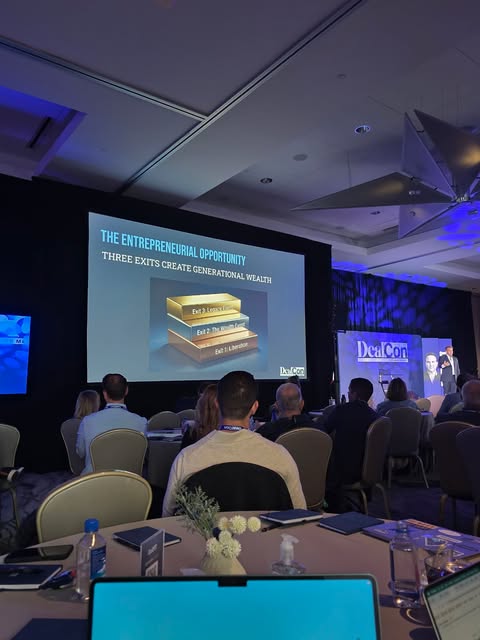 From Billy Batt's seat at DealCon — the "Entrepreneurial Opportunity" session.
Also in this circle, and worth naming because DealCon is where these relationships compound: Sam Woods and the other founders I first crossed paths with in these rooms — every edition my network (and deal flow) gets wider. Tom's Austin speaker list alone ran from Justin Donald and Cameron Herold to Erik Huberman and Robyn Siers to a panel of operators with 50+ acquisitions between them.
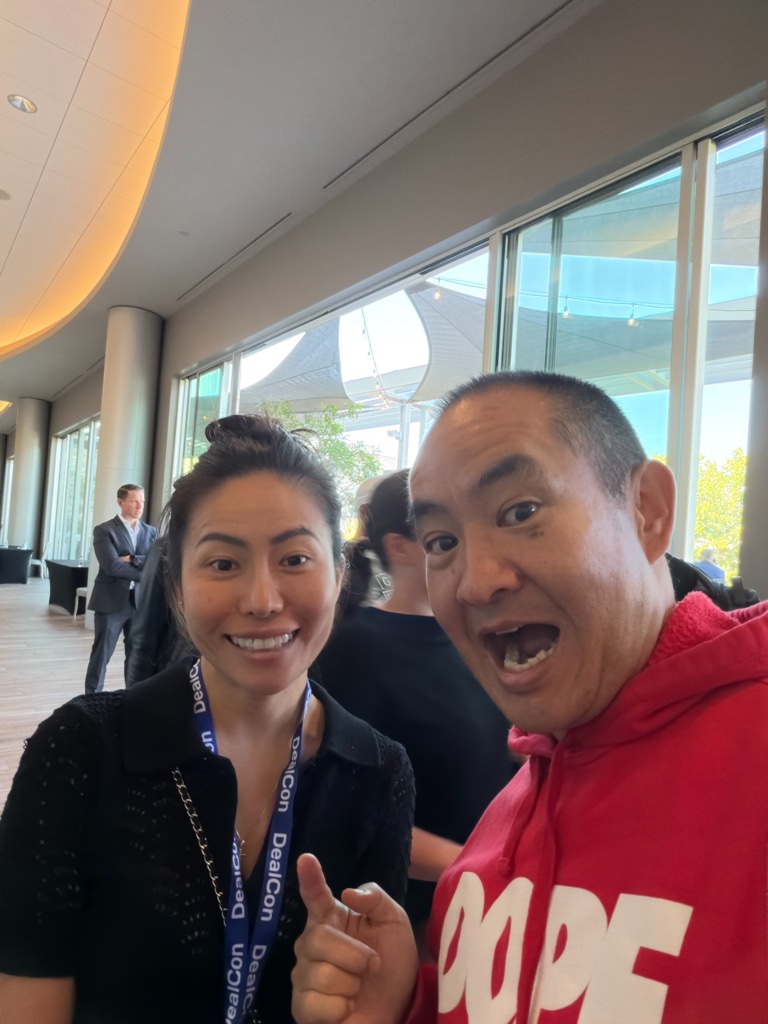 Lobby selfies between sessions. Half the deals start exactly like this.
The photo album — DealCon, in my camera roll and my feeds
Source posts for the photos above are in the Sources list below. A few more from the feeds:
- My founders group photo, Oct 22 — "You are only as good as the people you surround yourself with": Facebook
- DealCon after hours at Haywire — "incredible food, great drinks, and powerful conversations at every table": Tom's post
- Me + Tom in Miami on Facebook too: Facebook reel
- Nashville, February 2025 announcement (Robyn Siers tagged as a speaker/leader): Instagram
What I told Dan Leibrandt the week I got home
I mentor a group of young AI Builders, and one of them — Dan Leibrandt, who runs a podcast in home services and has built real authority and relationships with owners like Jake Sheldon and Jonas Olson — asked me what his next play should be.
My answer: equity. Stop trading all that authority for fees alone. Learn how deals are structured — earnouts, equity rolls, seller notes — and convert the trust you've built into ownership. I sent him a study list (Tom and Matt together, Matt on deal structures, Robyn Siers for the legal layer, home-services multiples, and the books: How to Make a Few Billion Dollars by Brad Jacobs — Matt's recommendation — and Buy Then Build by Walker Deibel), told him he should have been at DealCon Austin, and that he's coming to Miami.
Dan's situation is the reader's situation. If owners already trust you, you are sitting on deal flow. DealCon is where you learn what to do with it.
FAQ
What is DealCon? A private CEO M&A summit for 7–9 figure founders, co-founded by Tom Shipley and co-hosted by Matt Bodnar, teaching programmatic acquisitions: off-market deal flow, seller notes/earnouts/equity structures, roll-ups and exits. Held twice a year — recently Nashville, Austin, and Miami. Next: Miami, March 31–April 2, 2027. dealconlive.com
How many businesses close without ever selling? Per the Exit Planning Institute, 70% of companies put on the market do not sell, and only ~20–30% of listed businesses ever close a sale. DealCon (citing BLS/EPI/BizBuySell-IBBA) puts it at ~900 retiring-owner businesses closing daily because only 1 in 4 finds a buyer.
What is the silver tsunami? The baby boomer retirement wave: 2.9M businesses with owners 55+ (Project Equity via HBS); ~12M small businesses and nearly $10T in assets expected to change hands in the next decade (JPMorganChase).
How much is an HVAC, plumbing, or pest control business worth? Broker-synthesised ranges from closed deals: HVAC tuck-ins ~4–7× EBITDA (larger residential platforms up to ~9.9×), plumbing ~2.4–6.5×, pest control ~7–10× for tuck-ins and 11–15× at platform level. Recurring revenue and owner-independence move you up the range.
Can I buy a business with little money down? Sometimes — in private deals, seller notes, earnouts, and equity swaps can bring cash-at-close under 10% (DealCon's reported network average). With an SBA 7(a) loan, no: since June 2025 you need a real 10% cash injection, seller notes count only on full standby, and earnouts are not allowed. Either way, the business's cash flow must service the debt.
What is multiple arbitrage in a roll-up? Buying earnings cheap and owning them dear: add-ons bought at 3–6× EBITDA become worth 10–15× inside a platform. $1M of EBITDA bought for $4M is worth $10M inside a 10× platform — $6M created by structure.
Do I need to be a finance person to do this? No. Billy Batt was a pipefitter. The DealCon room is 70% first-time acquirers. You need clean financials, a deal attorney, a lender who knows acquisitions, and a room of people who have done it.
Two ways to do this
Do it yourself, free: Take the checklists above, listen to Deal Playbook and the interviews embedded here, read Buy Then Build, and come to DealCon Miami (March 31–April 2, 2027, Brickell Arch Hotel) ready with a buy box or a sellable business.
Work with people who do it every week: Tom and Matt run the room (dealconlive.com); Robyn Siers's Speed M&A closes the deals; and my team builds the authority that raises valuations — the personal brands, Knowledge Panels, and content systems that make an owner (or a buyer) the obvious choice in their market. That was my DealCon talk, and it's the work at Local Service Spotlight and BlitzMetrics. No hard sell — if the free path is enough, take it with my blessing.
Either way, don't be the owner who closes for zero. The wave is coming whether you surf it or not.
See you in Miami.
— Dennis
Sources
- DealCon official site & agenda — https://dealconlive.com/
- Exit Planning Institute, owner readiness — https://blog.exit-planning-institute.org/what-is-owner-readiness?hs_amp=true
- Harvard Business School / Project Equity, silver tsunami — https://www.hbs.edu/bigs/silver-tsunami-employee-ownership
- JPMorganChase, Powering 10 Million Small Businesses (via Fortune coverage)
-
CT Acquisitions, home-services PE & roll-up guides — https://ctacquisitions.com/guides/sell-home-services-business-to-pe/ · https://ctacquisitions.com/answers/what-is-pe-roll-up-strategy/
-
Western Companies, HVAC & Plumbing Services M&A Report, Feb 2026 — https://western-companies.com/
- DealSeam, pest-control PE roll-up tracker — https://dealseam.com/pest-control-pe-rollup-tracker-2026
- Matt Bodnar — https://mattbodnar.com/about/ · Eidolon Capital — https://eidoloncapital.com/
- Tom Shipley, Lifestyle Investor #269 show notes — https://lifestyleinvestor.com/tom-shipley/
- Robyn Siers, JonesSpross — https://www.jonesspross.com/team-member/robyn-siers/
- Billy Batt — https://www.billybatt.com/ · Dennis's interview: https://blitzmetrics.com/sell-your-agency-billy-batt/
- Dennis's own DealCon workshop page — https://dennisyu.com/dealcon/
Photos (source posts): - Hero, Austin: https://www.instagram.com/p/Dera1hIjx7Z/ - Dennis + Matt, off-stage: https://www.instagram.com/p/DeHnySxFigE/ - Miami reel still: https://www.instagram.com/reel/DUjdwKAiDgK/ - Closing group photo: https://www.instagram.com/p/DexjGQsO1o7/ - Podcast table, Austin dump: https://www.instagram.com/p/De7SGESGuiw/ - Erik Huberman session: https://www.instagram.com/p/DeuMSX9FtQt/ - Awards moment: https://www.instagram.com/p/Deux7lND41l/ - Haywire after hours: https://www.instagram.com/p/DewZjYHFudE/ - Haywire reception dinner: https://www.instagram.com/p/DevWyTKDutq/ - VIP night, COTA: https://www.instagram.com/p/DesxofHjrUU/ - Day 1 dump cover: https://www.instagram.com/p/DetEOVtjjOL/ - Tom closing post: https://www.instagram.com/p/DeyISjgu6uE/ - Testimonial (boat): https://www.instagram.com/reel/DemXic9OBA8/ - Matt + Dennis, Nashville: https://blitzmetrics.com/matt-bodnar-builds-his-personal-brand-by-co-creating-content/ - Billy Batt's post: https://facebook.com/100025067653288/posts/pfbid02gVtPJ5j3Y3gG4tzDFqDht6iFe9QbfWvWRFCpWKNHxqsRcmpUrsXB5DGvBsMpytUvl/ - Lobby selfie + session room: Dennis Yu camera roll, Austin, Oct 20, 2026.
Photo and video credits: Dennis Yu (camera roll, Austin Oct 20, 2026); Dennis Yu / Tom Shipley / Matt Bodnar social posts as linked. Multiples are broker/advisor ranges synthesised from closed deals, not a single official index; platform revenue figures are as reported in trade coverage. DealCon ticket pricing is the official site's early-bird listing at time of writing (Oct 27, 2026) — check dealconlive.com for current pricing.