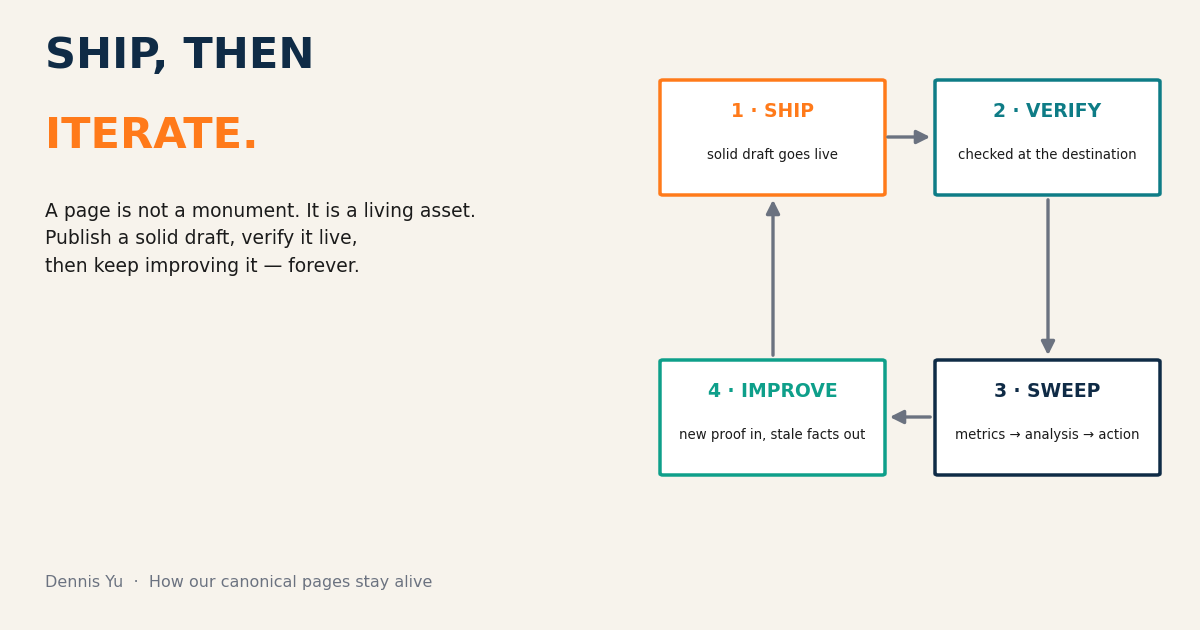
Your best page is rotting right now. Not because it was bad. Because you published it, felt done, and never touched it again. We run the opposite rule: ship a solid draft live, verify it, and then keep improving it for as long as the subject keeps living. This page teaches that rule, and it lives inside our full guide on how the agents run the company, next to the standing orders and the rest of the system.
Two young men, two opposite problems
Jeff Pebley is one of our AI apprentices. His canonical page on this site, Jeff Pebley's AI Journey, went up in October 2025. Good page. True page. Then Jeff kept living. He trained on Zoom calls for weeks. He built client work. A photo album of his apprenticeship grew to 132 items. Yesterday alone, six of his YouTube Shorts went live on the Local Service Spotlight channel, and eleven more articles about his work sat in production. None of that was on his page. The page was accurate the day it shipped and a little less complete every day after.
Jacob Hastings is the mirror image. Jacob came out of the gate hot: heavy output in his first couple of months, new material landing constantly. A page about Jacob back then needed fresh attention every week, and it got it. Then his output dropped to almost nothing. Same person, same page, completely different need. Checking his page every week now would burn hours to confirm that nothing changed.
One rule has to handle both of them. Here it is.
The rule
Every person, object, concept, and issue we work on gets one canonical page with the full inventory: every article, story, video, and proof item we have, linked together. One URL owns the subject. Everything else links into it, and it links back out.
The page ships as a solid draft, live, and then it iterates forever. Not when it is perfect. Perfect is a hiding place. A solid draft that a real reader can open beats a flawless draft sitting in a folder, because the live page can be checked, linked, cited, and improved, and the folder draft cannot.
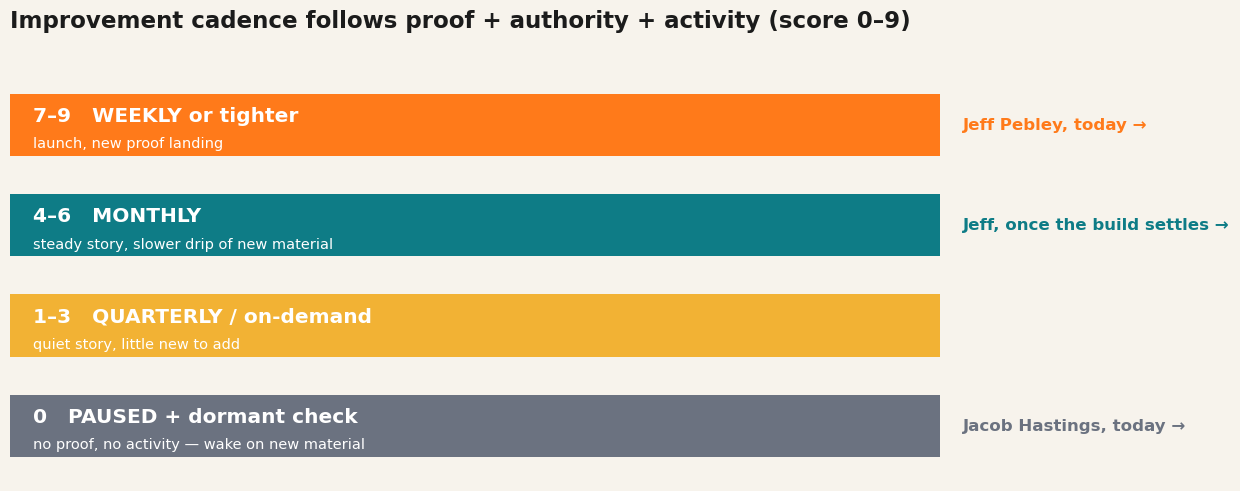
How often it improves is not a calendar rule. It follows proof, authority, and activity. A subject with strong proof, real authority, and new material landing gets swept weekly or tighter. A subject that slows down steps down to monthly. A subject that goes quiet steps down again, or pauses, and wakes back up the moment there is something new to add. Jeff is weekly right now. Jacob is nearly paused right now. Both answers are correct, because the cadence is a reading of the subject, not a habit.
That is the whole idea, and if you only read this far, you have it. Publish the draft. Verify it where it lives. Then let the subject's own pulse set how often you come back.
Why this is a system, not a tip
This rule is one gear inside a machine we have run for years, the 9 Triangles, nine three-sided frameworks that hold each other up. Three of them do the heavy lifting here, and the spec below names all of the connections:
- CCS: Content, Checklists, Software. This article is the Content. The sweep checklist in the spec is the Checklist. The schedules and skills that run the sweeps are the Software. A rule that lives in only one of the three dies in that one place.
- LDT: Learn, Do, Teach. Our apprentices, human and agent, climb the same ladder. In this article we teach it as Follow, Learn, Teach: follow a proven page and its checklist, learn by owning real sweeps, then teach by writing the update the next person follows. This article is a Teach artifact. So is every improvement a sweep makes and writes down.
- GCT feeds MAA. Every page starts from Goals, Content, Targeting. Every sweep runs MAA: Metrics, Analysis, Action. The numbers say what changed. The analysis says what it means. The action is the edit, the link, the cadence call. A metrics dump with no thinking is the failure mode we refuse to ship.
Underneath all of it sits the Content Factory, our four-stage machine: Produce, Process, Post, Promote. Canonical pages are where the factory's output accumulates. The sweep is how Promote feeds back into Process, so the next version of the page is better than the last.
Two doors
Door one: do it yourself. The full operating system, including the guide this article belongs to and the article guidelines every page is checked against, is public. Start with How the Agents Run the Company and the article guidelines our own pages have to pass.
Door two: have us build it with you. This is the system behind the AI Builder program and our consulting work. If you want your knowledge living on pages that keep getting better instead of quietly expiring, start with BlitzMetrics.
— Dennis Yu
Part 2 · The operating spec (for agents and operators)
Everything above is the human version. Everything below is the working specification. It is written so that any agent, or any human operator, can run a canonical page end to end without asking what to do next. Where this spec sets numbers, they are the fleet's current calibration of Dennis's rule, and the MAA loop in section 5 is how the numbers themselves get improved.
1. Definitions
- Canonical page. The single URL that owns a person, object, concept, or issue. It carries the full inventory for that subject and is the link target for every other mention. One subject, one canonical page. If a page already owns the subject, the job is to enhance that URL, never to mint a neighbor.
- Inventory. Every asset we hold on the subject: articles, stories, videos and Shorts, photos, transcripts, mentions, and proof items, each with its URL or file location. A canonical page is complete only when its inventory is complete or its gaps are recorded on the page's run record.
- Angle. The same evidence base, told for the page's home. dennisyu.com carries Dennis's personal angle, first person. Local Service Spotlight carries the program angle: proof that the AI Builder system works, told for prospective builders and clients. Repurpose by angle. Never duplicate text across the two.
- Living asset. A page under active stewardship: it has a named owner, a current cadence band, and a sweep history. A page with no owner is not finished. It is orphaned, and the fix is an owner, not a rewrite.
- Sweep. One improvement pass over a canonical page, run as an MAA loop, ending in verified live edits or a recorded no-change verdict.
2. The ship gate: what "solid draft" means
A draft is shippable when all of these are true:
- A GCT brief is written for the page: the Goal it serves, the Content (source-backed material only), and the Targeting (who it is for, in their words).
- The opening answers the title in plain words, names who the page is for, and links up to its parent guide.
- Every fact on the page traces to a source we hold. Nothing invented, nothing padded.
- The lead visual is real and topic-specific, and it renders on the first screen.
- First mentions of people and companies link to their real pages, fetched and confirmed.
- The page passes every draft-decidable item on the article guidelines checklist. Live-only items (served HTML, embeds, reciprocal links) are recorded as publish gates, not used as excuses to hold the draft.
Ship it. Then verify the live page at its public URL: page loads, title correct, first screen renders, links work. Only a verified live page counts as shipped.
3. The sweep checklist
Each sweep, in order:
- Inventory scan. Check every source the subject produces: new videos and Shorts, new articles, new photos, new mentions, new sessions or events. Add what is missing to the page inventory, with links.
- Stale-fact pass. Re-read the page against the record. Titles, roles, statuses, dates, and counts drift. Fix or remove anything no longer true. Time-bound anything that was true only for a period, instead of stating it in the present tense.
- Link pass. Every inventory item on the page links out, and the important ones link back. Reciprocal links are recorded on the run record. A missing reciprocal link is an open item with an owner, never a silent gap.
- Media pass. New visuals added, broken embeds replaced, players confirmed as players (an embedded player, not a pasted URL or a still).
- QA drift pass. Fetch the article guidelines fresh. Guidelines change; memory of last month's version is not a source. Walk the card against the live page and fix what fails.
- Angle pass. Confirm the page still speaks in its home angle, and check the sibling page on the other property carries the same new evidence in its own angle.
- Cadence call. Re-score the subject (section 4), set the next cadence, and write both on the run record with the reason.
4. Scoring the subject: proof, authority, activity
Score each signal 0 to 3 at every sweep. The anchors:
Proof (how much verified evidence the page can show) - 0: nothing verified yet. 1: one or two items. 2: a solid body of work, several items across one format. 3: a deep inventory across formats: articles, video, photos, third-party mentions.
Authority (how much the subject's name carries) - 0: unknown outside our walls. 1: known in our community. 2: recognized in their niche, with outside mentions. 3: a figurehead: their name itself is a reason people read.
Activity (how fast new material is landing) - 0: nothing new for a long stretch. 1: occasional item, slower than monthly. 2: steady, roughly monthly or better. 3: weekly or faster, or a launch in progress.
Cadence bands (total score) - 7 to 9: weekly or tighter. During an active build, the completion drive runs tighter than weekly; the sweep cadence starts when the build lands. - 4 to 6: monthly. - 1 to 3: quarterly, or on-demand when a source reports something new. - 0: paused, with one light dormant check per quarter: does the page still load, do its links still work, has anything new appeared?
Step-up triggers (any one moves the subject up a band, immediately): a launch or campaign starts; a batch of new inventory lands; the subject resumes activity after a quiet stretch; a major proof event lands (a panel, a feature, a book, a big mention).
Step-down rule: two consecutive sweeps at the current band that produce no new inventory and no needed fixes step the subject down one band. Never step down on a single quiet sweep; one quiet pass is weather, two is climate.
Event-driven updates ignore cadence entirely. When new material lands, the page gets updated when it lands, whether the next scheduled sweep is tomorrow or next quarter.
5. Every sweep is an MAA loop
MAA is Metrics, Analysis, Action, and it is the engine inside the sweep:
- Metrics. What changed since the last sweep, in numbers: inventory count before and after, new items by format, page traffic and search movement where we track them, link status counts.
- Analysis. What the numbers mean, in plain sentences. Which proof got stronger. Which section is stale. Whether the subject is speeding up or slowing down. Metrics with no analysis is the known failure mode of MAA, and a sweep that reports only numbers has not run.
- Action. The edits made this sweep, each verified live, plus the cadence call and its reason. Action items that belong to another lane get an owner and a date, in writing, the same day.
The fleet also runs a weekly MAA on the business itself: business metrics first, then traffic, then content performance. Page sweeps feed it. A canonical page that keeps winning in that review is a greatest hit, and the 9 Triangles 90/10 rule applies: put 90% of improvement effort on proven pages and offers, 10% on experiments.
6. Verification standard
- Verify at the destination. A change counts when the public page, opened fresh, shows it. A dashboard, a draft preview, or a staging copy is not the destination.
- Two-key rule for absences. Claiming something is missing, unpublished, or deleted takes two independent negative checks, at least one at the canonical destination itself. One missed check is UNVERIFIED, and the sweep says so.
- Read back what you wrote. After every publish or edit, fetch the served page and confirm title, first screen, links, and embeds on the served version, not the source file.
7. Link discipline
- SEO Tree: every canonical page has a parent guide it links up to, proof it links down to, and siblings it links across to. The parent for this rule is How the Agents Run the Company.
- Enhance, do not mint. Search before creating. An existing owner page gets the new material.
- Final URLs only. Link the canonical URL even when it lives on another property we run. Footer links and directory listings do not substitute for links in the body.
- Reciprocals are tracked. Each sweep's run record lists reciprocal links checked, added, or still open with an owner.
8. Where this fits in the Content Factory
The factory runs Produce, Process, Post, Promote. Canonical pages are built in Process and Post like any article: GCT first, source watched or read firsthand, checklist walked. The difference is what happens after Post. A normal article's job ends at Promote. A canonical page's job never ends: Promote's measurements flow back through MAA into the next sweep, which is a small Process pass on a living page. The completion drive that finishes a new subject's build converts into that subject's sweep at completion. It does not just stop and leave the page frozen at version one.
The checklist layer is CCS in action. The sweep checklist above is this page's checklist. The article guidelines are the fleet's article checklist, fetched fresh at every QA pass. The software layer is whatever runs the cadence: a scheduled job per subject, owned by the subject's goal, that removes or re-bands itself per section 4 instead of running forever out of habit.
9. Follow, Learn, Teach
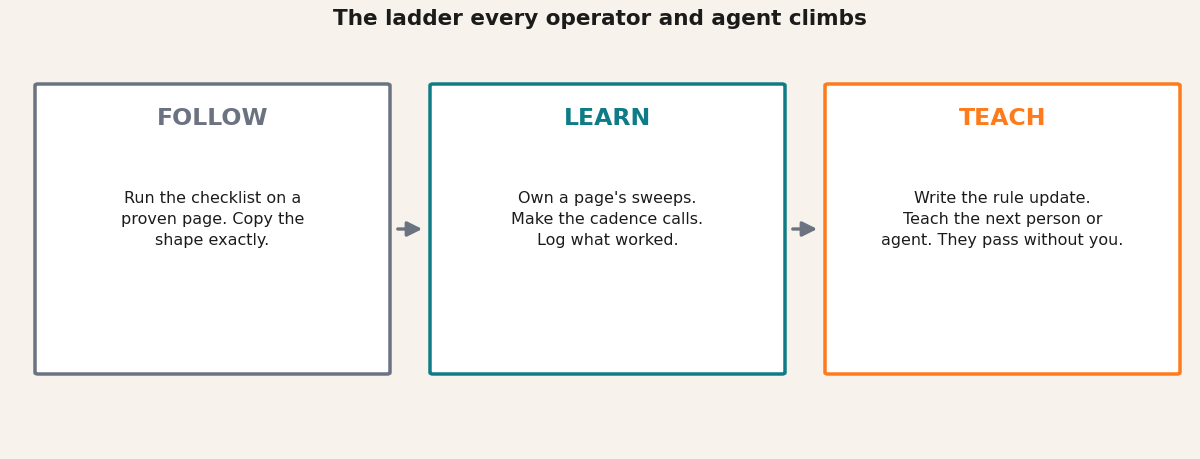
Nobody starts by inventing their own version of this system. They climb:
- Follow. Run the sweep checklist on a proven page, exactly as written. Your job is fidelity: every item, in order, with a run record. You are learning the shape of the work.
- Learn. Own a page. Make the scoring and cadence calls yourself, and write the analysis in your own words. Your calls get reviewed against outcomes. This is where judgment forms: two sweeps that find nothing teach you as much as two that find gold.
- Teach. Write the rule change, the worked example, or the guide update that the next operator follows. Teaching is complete when your student, human or agent, runs a sweep that passes review without you in the room. Mastery is a student who passed.
This article is a Teach step, and the fold-in packet that carries this rule into the next edition of the guide is part of the same step. When a sweep teaches you something the spec got wrong, the Teach move is to fix the spec, in the open, the same week.
10. Ownership and reporting
- One owner per page, until the improvement is verified live. Handing a sweep to another lane does not hand off ownership.
- Sweeps report only material changes and genuine decisions. A no-change sweep is silent to Dennis and loud in the run record.
- A build's completion condition is: canonical page live and verified, inventory complete or gaps recorded, reciprocal links verified, and the sweep created with its first cadence band set. Anything less is a build still in progress.
11. Worked examples
Jeff Pebley, today. Proof 3 (six Shorts live, eleven-plus articles produced, a 132-item album, six recorded training sessions). Authority 1 (known inside our community, building outside recognition). Activity 3 (a build landing right now). Total 7: weekly band, with a completion drive running tighter than weekly until every page is live. As the build settles, expect Activity to fall to 1 or 2 and the page to step down to monthly. That step-down is the system working, not the story ending.
Jacob Hastings, then and now. In his first couple of months: Proof 2, Authority 1, Activity 3, total 6, monthly trending weekly during bursts. Today: Activity 0 after a long quiet stretch, Proof unchanged at 2, Authority 1, total 3, and two quiet sweeps would step him to the bottom band: quarterly existence checks, waking on any new material. If Jacob publishes again next week, the step-up trigger fires and he is back on a real cadence the same week.
A dormant subject. Proof 1, Authority 0, Activity 0, total 1: on-demand only. The page still gets its quarterly dormant check, because links rot and facts expire even when people go quiet. Paused never means abandoned. It means the page waits, accurately, until there is something true to add.
12. Sweep run record (copy this)
Subject / canonical URL:
Owner:            Date:
Scores: Proof _ / Authority _ / Activity _ = Total _
Band before:      Band after:      Reason:
Metrics: inventory before _ → after _; new items (list); link status:
Analysis: (what the numbers mean, 2–5 sentences)
Actions shipped + verified live (URLs):
Reciprocal links: checked _ / added _ / open (owner + date) _
Next sweep due:   Event triggers that would wake it sooner:
13. Failure modes this rule exists to kill
- The frozen page. Published once, never swept. Accurate on launch day, quietly wrong within a season.
- The hostage draft. Held for perfection while the subject's real work goes undocumented. Ship the solid draft.
- The duplicate URL. A second page minted next to the owner because nobody searched. Enhance the tree.
- The calendar habit. Weekly sweeps on dormant subjects and monthly sweeps on launches, because the schedule was set once and never re-scored.
- The metrics dump. Numbers with no analysis and no action. MAA with the middle and end missing.
- The silent gap. A missing reciprocal link, a missing format, a missing source, noted nowhere. Record it, own it, date it.
Sources: The ship-then-iterate rule and the adaptive-cadence doctrine, Dennis Yu, October 25, 2026 (standing rule, fleet record). Jeff Pebley build state verified at the destinations October 24–25, 2026: six Shorts live on the Local Service Spotlight channel; canonical page: dennisyu.com/jeff-pebleys-ai-journey-building-a-personal-brand-from-scratch/. The 9 Triangles, including LDT (Learn, Do, Teach), CCS (Content, Checklists, Software), GCT (Goals, Content, Targeting), and MAA (Metrics, Analysis, Action), and the pairing "GCT feeds MAA": theninetriangles.com. Article QA standard: localservicespotlight.com/article-guidelines/. Parent guide: dennisyu.com/how-agents-run-the-company/.