
“Why would someone spend $200 versus just going to YouTube — or asking ChatGPT? What value are you adding? If I’m the organizer, I have to answer that question.”
That’s the question at the center of my conversation with Timothy Arthur, host of the Eventapalooza podcast and founder of e3 Webcasting, his production company. Tim has spent more than 20 years producing video around the globe, and he films and streams the kinds of conferences I speak at. So when he had me on his show, we skipped the war stories and got into the mechanics: how organizers, speakers, and production vendors turn footage they already own into next year’s ticket sales.
This conversation comes from my appearance on Eventapalooza, where Tim interviews event producers, marketers, and technologists. Watch the full episode below, or listen on Spotify.
Here’s the short answer to the $200 question. If your event only delivers information, you lose to a free chatbot. If it delivers implementation — scored attendees, practitioners on stage, and footage converted into skill files that AI agents can execute — people pay, and they keep coming back. The rest of this article is that playbook, with the real examples Tim pulled out of me.
The $200 Question Every Organizer Has to Answer
The default answer is a celebrity keynote. Magic Johnson is famous, but he’s not going to help an HVAC owner close the next acquisition. I watched Hillary Clinton speak at the Marketo Summit: she arrived with Secret Service, spoke for 45 minutes, and left without shaking a hand. She gave a compelling talk that had nothing to do with marketing automation.
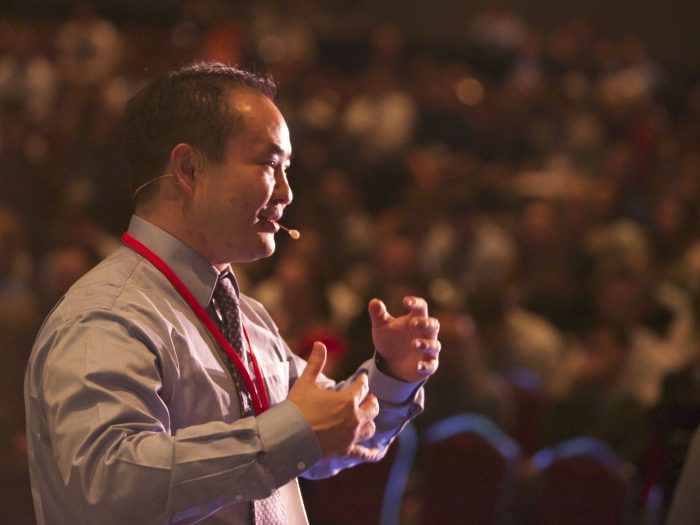
When I spoke at that same summit, I took the opposite approach. I introduced the topic, then handed the stage to the young adults who actually ran the ads and filmed the content, and to Jason Miller, who ran digital marketing at Marketo. As I put it to Tim:
“What’s more powerful — me saying we’re a top lead-gen source for Marketo and here’s our documentation? Or Jason Miller logging into the ads account and showing you exactly how he did everything, versus me, the vendor?”
Fame fills a room once. Proof fills it every year. That principle drives everything else in this playbook.
Score the Room Before the Keynote
At DealCon, a mergers-and-acquisitions conference run by Tom Shipley, I didn’t give the talk I would have given a year earlier. Tom gave me the attendee list, so I scored every person in the room before I walked on stage:
“I scored based on what your strengths are, where your online reputation is, what you say you do versus what I can find credibly that you do — and what the credibility gap is, and what we need to do to fix it.”
The attendee who fixes air conditioners and wants to buy ten more HVAC companies got a list of acquisition targets matching his profile. Everyone’s jaw was on the floor, because “instead of talking about it, we actually did the work.” Then we handed every attendee the agents we’d built for their business, so it wasn’t just some audit — it was completely actionable.
We practice what we preach here: the DealCon agent workshop page is public, with the skill files and the authority audits we ran for attendees. No email gate. That’s the standard the modern conference has to meet.
Put the Practitioner on Stage, Then Give Away the Playbook
The Golden State Warriors hired us after other agencies drove plenty of likes and impressions but couldn’t sell tickets. “In our first year, we spent a million dollars and drove $38 million in provable sales through Ticketmaster.” But the point isn’t the number — it’s who told the story on stage.
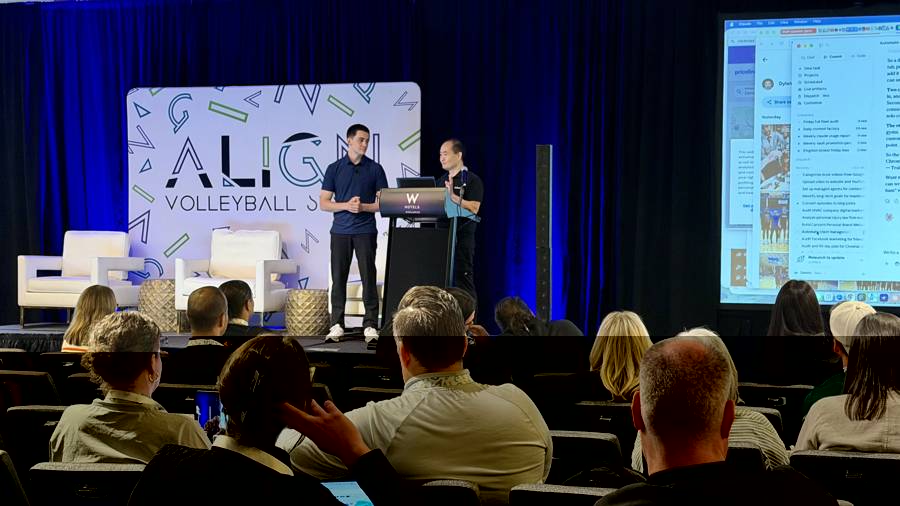
Instead of me presenting, Daniel Brusilovsky, who ran technology and special projects for the Warriors, logged in and walked the audience through everything himself. When organizers in Norway invited me to keynote the stadium event Richard Branson had headlined the year before, I brought Daniel so we could tag-team it. He did it; he should show it.
And we never pitched from that stage. “We never said, ‘Come hire us.’ We said: this is how we did it. We published a PDF for you. Go download it — you don’t have to give us an email address. Give it to your Claude and have it go to town.” The full Golden State Warriors playbook is still up, and giving it away has driven more business than any pitch we’ve ever made.
Your Footage Is a Gold Mine — If You Turn It Into Skill Files
Tim sees the waste from the production side, and he named it better than I could:
“We’ll go to an event, capture it — but then the event doesn’t do anything with it. At best it gets uploaded to YouTube, or they stumble across it. There’s a whole gold mine of content sitting on YouTube for that client.”
Organizers spend a year building session tracks, record everything, then hibernate for three days after the show while the footage goes into the attic. That archive can become articles on the organization’s website, highlights in the newsletter, and clips for the speakers. But the biggest opportunity is newer than all of that:
“You could turn it into a skill file, so anyone using ChatGPT or Claude can just download the skill — like in The Matrix, you plug the thing into the back of your head and now you can fly the helicopter.”
A session organized around achieving a result is a recipe, and a recipe converts cleanly into a skill.md file that AI agents use to actually do the work — log into systems, run ads, answer the phone — not just summarize the talk. We maintain a public Skill Pack Library and an open roster of our agents built exactly this way, and our AI has watched years of conference sessions we’ve captured for the organizers we serve.
The Costco Sample Principle
One conference organizer pushed back: if people can download the skill files, why would they attend? It’s the opposite. “They taste your skill files. They watch some snippets on YouTube. It’s like watching the trailer for a movie — seeing the trailer is what makes you want to see the actual movie.” The sample on the toothpick at Costco is what sells the whole bag.
What the CEO of American Airlines Taught Me
My first mentor was Al Casey, the CEO of American Airlines, and he told me a lot of things I didn’t want to hear about myself. When I was young, I argued that the internet would kill business travel. He said: “No — it’s the exact opposite. People are going to want to meet more. They’re going to want to travel more.”
Tim made the same point from his world: attendance didn’t fall when sports started broadcasting games — it increased. Give away the content, and you sell the room. The session recordings are the broadcast; the event is the stadium.
Hire an Apprentice, Not an Agency
Every organizer tells me they want to implement this, and a week later they’ve been too busy. So here’s the solution I gave Tim. Find a sharp, underemployed 21-year-old — maybe a recent graduate convinced AI took their job — and make them your in-house apprentice, orchestrating a team of agents for social media, video editing, and website building.
Then structure the pay so their incentives are your incentives: a base salary around $3,000 a month depending on the city, plus 2% of ticket sales, a dollar per qualified email lead, and $5 per webinar registration. Connect them to your CRM, your attendee list, and your session feedback. “Now you have a really smart internal marketing person who cares, who’s motivated, who learns quickly, and who is incentivized to do it the right way.”
Contrast that with affiliates — random people you pay for sales without ever seeing what they’re doing. Your own apprentice shows their face on Zoom every Friday, and you’ve created a job for another young adult. That’s the entire agenda behind the Spotlight Network: “I retired 20 years ago. I’m overtly telling you my agenda — I’m trying to get more jobs for young adults. They don’t have to be hired by me. I just want to create the jobs.”
There are over a million plumbers, roofers, landscapers, and agents in this country, and nearly every association they belong to runs a conference. I’ve keynoted for 10,000 funeral directors, and Zach Phillips has had me teach in the NAMM U education program at The NAMM Show, the music industry’s biggest trade show. The kid earning $12 an hour in a musical instrument store can learn to run the store’s marketing between customers — and the same is true for the young adult sitting in your registration data.
Webcasting as a Profit Center, Not an Expense Line
This part of the conversation was for Tim directly, and for every AV and production vendor. Organizers file webcasting under expenses, next to catering, badge printing, and parking. Vendors reinforce it by competing on gear and price, which is a commodity game.
The reframe: “I’m not just an expense line. We should be a profit center for you.” The vendor who captures the footage is holding the raw material for next year’s registrations. Tie your work to the registration system and the marketing program, prove the ROI of repurposed content, and include the agent-driven repurposing in your package without charging extra.
Then do the move that makes you unforgettable. After each session, hand every speaker a package they never asked for: a summary of their talk, the highlights already clipped, and recommendations for their own website based on the footage. “Not a Trojan horse — a Christmas gift that showed up.” The speaker is ecstatic, and the organizer who sees you did it for every speaker isn’t comparing you on price next year.
And the pilot light stays on year-round: “Most events, everything happens around those two or three days, and then there’s nothing for the other 360 days. What if we created engagement in between? Then it’s: ‘I’ve been watching this guy on YouTube for months — I feel like I know him. Now I want to see him in person.'” Which is the whole point of a live event.
The Curve Is Not Linear
Tim asked whether AI could pull all this off cost-effectively. Two months earlier, my honest answer would have been no. “AI does not improve in a linear fashion. That’s what catches people. It’s hit the curve where it’s gone straight up — and this is not one of the AI hype things.”
We track exactly what the models can and can’t do in our Content Factory AI Capability Index, and the doing of the work is now like assembling IKEA furniture: tedious, well-documented, step by step. Our SOPs run 200 pages because thousands of young adults execute from them — and if our SOPs aren’t up to date, our execution fails. For proof this runs outside the conference world, see how we put ten digital employees to work running a youth volleyball club.
This article is itself the loop in action. Our agents produced it from Tim’s footage, following our published article posting guidelines — the same repurposing system we’re describing, doing the describing.
Taste It
I gave Tim homework, and it applies to every organizer reading this. Take this episode, feed it to Claude or whatever AI you use, and say: “Dennis came up with some ideas. Be the devil’s advocate. Be as cynical as possible, but be honest with me — how much of this applies to my conference, and is it a good thing to do or not?” You have to give it permission to be honest, or it will compliment you to death.
I already know what it’s going to say. I want you to hear it in your own words, from your own data. The excuses — too busy, no budget, nobody capable — wash away the moment you identify one motivated young adult and hand them the skill files.
Thank you, Tim, for asking the questions organizers actually ask, and for being the rare production professional who does something with the gold mine. Subscribe to Eventapalooza on Spotify and connect with Tim Arthur on LinkedIn — and if you run events, tell us what your AI said when you asked it to be honest. We’d love to help you turn your footage archive into next year’s sold-out room.