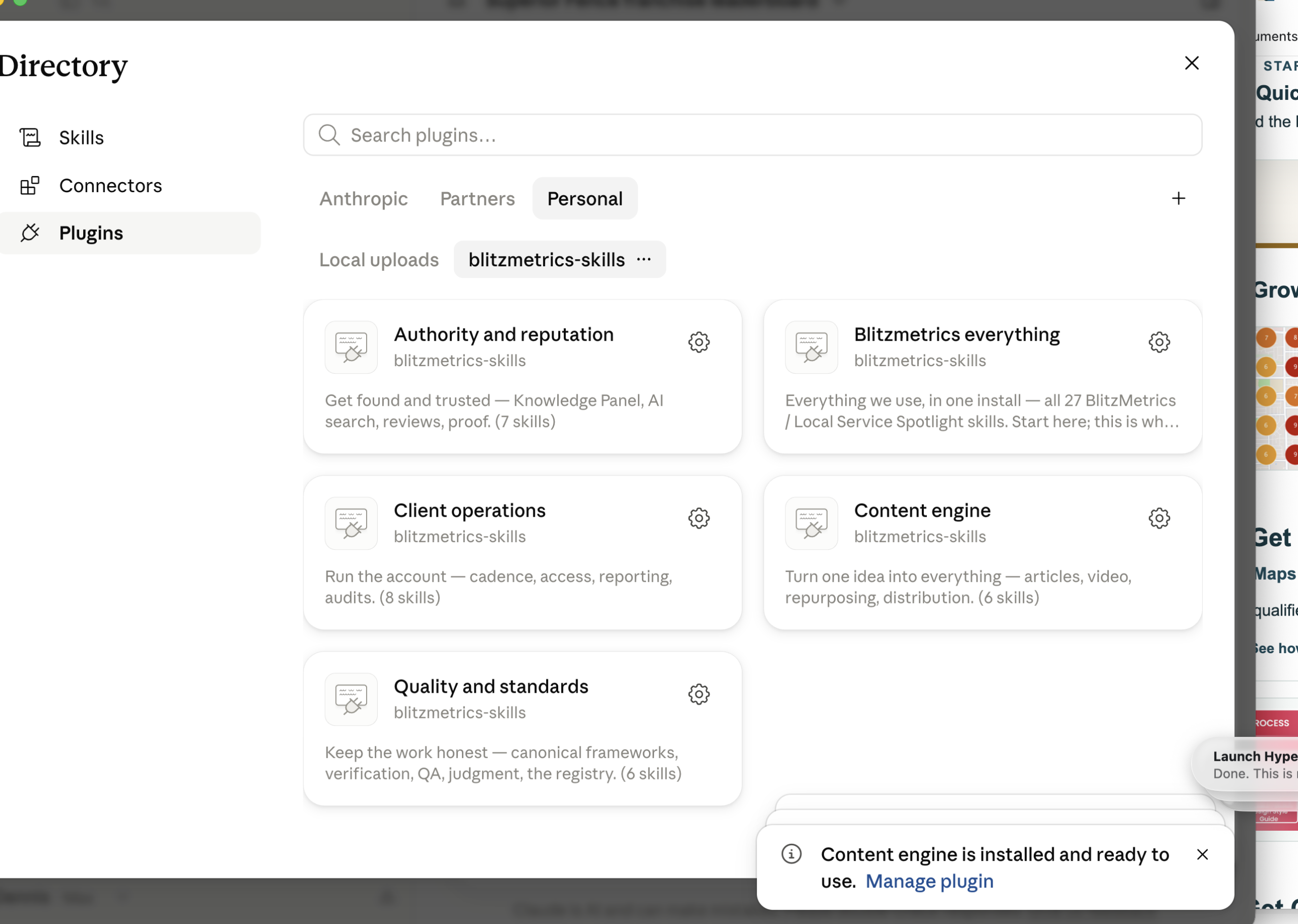
I added one GitHub repository to Claude. Claude showed me five plugin cards, asked for GitHub access, and changed five plus signs into gears. I built the repository—and I still had to stop and work out what the interface was telling me.
The screen compresses a GitHub repository, a marketplace, five plugin bundles, 27 skills, and a GitHub synchronization permission into one small panel. Those are different things.
Nothing was broken. All five cards were installed successfully. But the clean setup for most people is to keep BlitzMetrics everything and uninstall the four narrower bundles, because the all-in-one bundle already contains every one of their 27 skills.
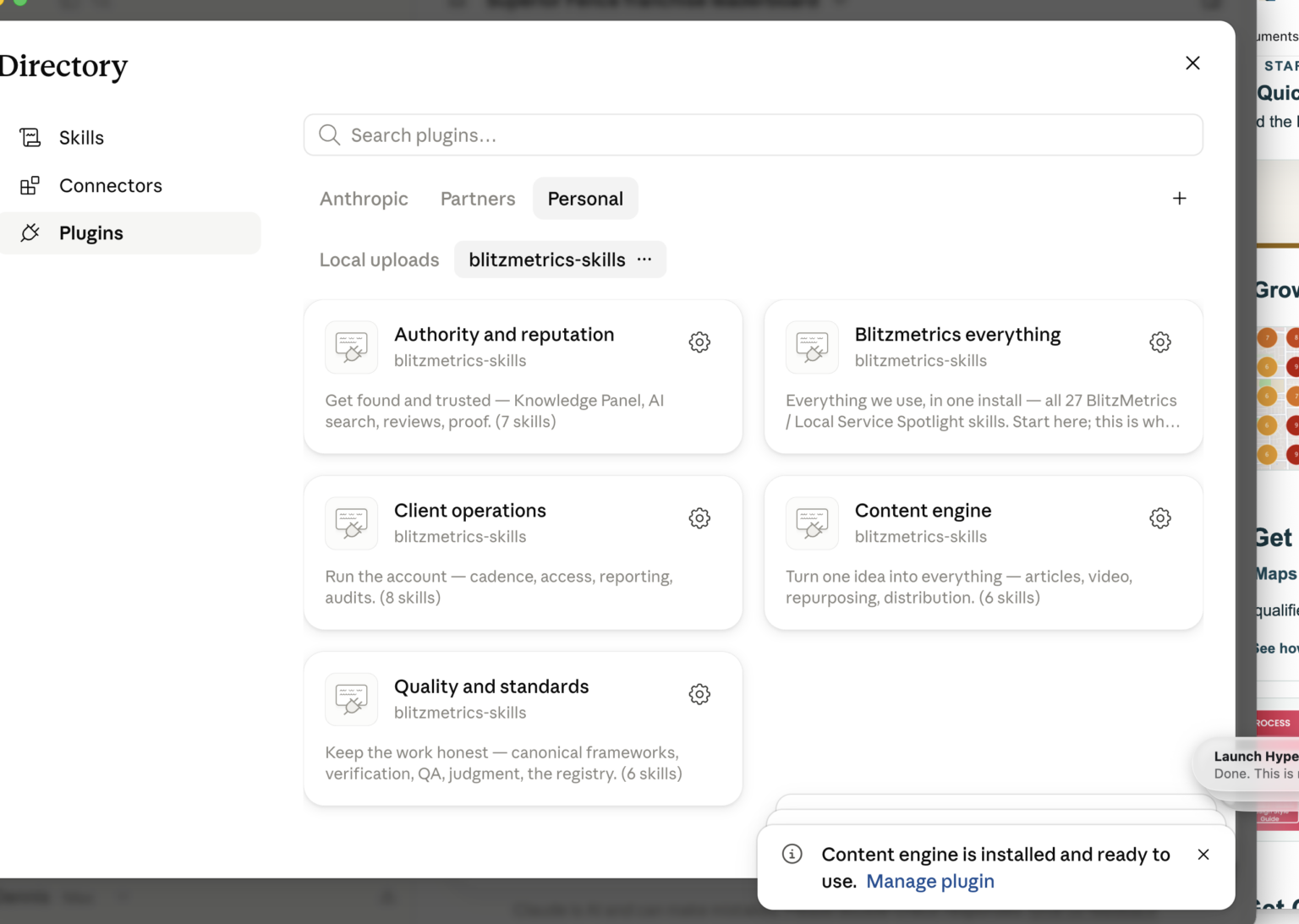
Why did one GitHub repository produce five plugin cards?
Because a repository is the source, while a marketplace is a catalog. One catalog can list several packages. Anthropic’s personal plugin guide describes adding a marketplace from a GitHub repository and then separately installing the plugins you want from that marketplace. Our canonical plugin explanation covers the permanent source-and-update model; this article is the field guide to the permission screen and five-card result I actually encountered.
blitzmetrics-skills. Adding it reveals the choices; it does not install all of them.
You can inspect the exact catalog in our public marketplace manifest. Anthropic also documents that one marketplace can contain multiple plugin entries.
What do marketplace, plugin, skill, agent, and scheduled job mean?
These words are often used as if they were interchangeable. They are not.
| Layer | Plain-English meaning | What it does not mean |
|---|---|---|
| Repository | The workshop where source files, tests, history, and releases live. | It is not automatically installed in Claude. |
| Marketplace | The catalog Claude reads from that workshop. | Adding the catalog does not install every item in it. |
| Plugin | An installable bundle that can include skills, agents, hooks, or connectors. | One installed plugin is not necessarily one running agent. |
| Skill | A reusable set of instructions and resources for doing a particular kind of work. | A skill does not wake itself up or own a recurring responsibility. |
| Agent | A worker given a role, goal, tools, context, and responsibility for an outcome. | An agent is not just a folder with instructions. |
| Scheduled job | A trigger that asks an agent or workflow to run at a particular time or cadence. | Installing a plugin does not schedule any jobs by itself. |
| Receipt | Evidence that a named version was installed, activated, tested, and accepted. | A green icon alone is not proof that a real task passed. |
Our companion guide, A Skill Is a Function. An Agent Is a Person, explains that distinction in more depth. The Definitive Guide to Claude Scheduled Jobs covers the timing layer.
What did the plus sign and gear icon mean?
After I clicked each plus, Claude created five user-installed plugin records and showed a confirmation that the Content Engine was ready to use. So the plus-to-gear change was a genuine installation state change—not just a cosmetic toggle.
Did I need to install all five BlitzMetrics bundles?
No. The five cards are two different ways to choose the same library.
BlitzMetrics everything
One all-in-one bundle containing every current BlitzMetrics and Local Service Spotlight skill. Install this if you want the whole operating system.
Authority and reputation
Knowledge Panels, AI search, public proof, reputation gaps, and entity visibility.
Content engine
Content Factory, definitive articles, video repurposing, Dollar-a-Day, and business websites.
Client operations
Access, cadence, measurement, weekly MAA, SEO, security, subscriptions, and Sales Every Day.
Quality and standards
Evidence, recursive QA, model judgment, Nine Triangles, registry, and shared operating rules.
The four topical bundles are alternatives to the all-in-one bundle, not add-ons. Their counts are 7 + 6 + 8 + 6 = 27, with no overlap among those four. Together they equal the same 27 skills inside BlitzMetrics everything.
Installing all five did not corrupt anything. It created 54 plugin-qualified skill memberships representing 27 unique skills: each skill appeared once in BlitzMetrics everything and once in exactly one topical bundle. Anthropic documents that plugin skills can be namespaced by plugin, so this need not create a hard name collision. But it is redundant and can make the skill list and Claude’s routing more confusing.
Use one of these patterns:
- Install BlitzMetrics everything if you want all 27 skills.
- Install one or more of the four topical bundles if you want a smaller, focused toolset.
- Do not install the all-in-one bundle and all four topical bundles at the same time unless you are deliberately testing packaging behavior.
Which GitHub account should Claude have access to?
The answer follows repository ownership.
Our marketplace URL is github.com/dennisyu/blitzmetrics-skills. That repository belongs to the personal GitHub account dennisyu. If Claude asks for GitHub App access for this marketplace, the narrowest correct grant is:
Install or authorize Claude on the Dennis Yu personal account, choose “Only select repositories,” and select dennisyu/blitzmetrics-skills.
Authorizing the Local Service Spotlight organization was not needed for this particular repository. It would be appropriate only when Claude needs to synchronize a repository owned by that organization. Granting both did not explain the five cards and did not create five plugins; it simply gave the GitHub App access in two different account scopes.
GitHub separates installing an App on an account or organization from authorizing that App to act for a user. Its official documentation explains that those are separate permission grants. That is technically sensible, but it is not obvious when Claude sends you through both screens.
Should I remove Claude from the Local Service Spotlight organization?
Review it; do not guess. If Claude does not need any Local Service Spotlight-owned repository, use least privilege and remove that organization installation or limit it to the exact repository it needs.
- For a personal account, go to GitHub Settings → Applications → Installed GitHub Apps → Claude → Configure.
- For an organization, go to Organization Settings → Third-party access → GitHub Apps → Claude → Configure.
- Choose Only select repositories wherever possible.
- Keep
dennisyu/blitzmetrics-skillson the Dennis Yu installation. - Remove or narrow the Local Service Spotlight installation unless an organization-owned repository actually needs it.
GitHub documents those exact review and configuration paths. The official listing is the Claude GitHub App.
What does “Sync automatically” really promise?
On my personal Cowork screen, Claude displayed an automatic-sync toggle and then requested GitHub App access. That proves what this version of the interface asked me to configure. It does not prove every future release will arrive automatically on every device.
Anthropic documents three related surfaces with different behavior:
- Personal Cowork marketplace: the public guide documents adding a GitHub repository and syncing its marketplace, but it does not publish a precise personal auto-sync trigger or cadence.
- Organization Cowork marketplace: Anthropic documents a GitHub App and webhook flow, including version-bumped pull requests and manual Update controls. That is an organization feature, not proof of identical personal behavior.
- Claude Code marketplace: the command-line product has its own marketplace auto-update and plugin reload behavior.
My rule: treat “auto-sync enabled” as a configured intention. Call it successfully synchronized only after a named installation receives a later release, and call it accepted only after a fresh task passes a real canary test.
For team and enterprise behavior, read Anthropic’s organization marketplace guide. For Claude Code, use the separate plugin discovery and update guide.
What is the clean setup I recommend?
- Add the marketplace once. In Cowork, go to Customize → Plugins → Personal plugins → + → Add marketplace → Add from a repository.
- Use the source URL. Enter
https://github.com/dennisyu/blitzmetrics-skills. - Grant the narrow GitHub scope. If prompted, authorize the Dennis Yu personal installation for only
dennisyu/blitzmetrics-skills. - Install one packaging strategy. For most users, click the plus only on BlitzMetrics everything. Use topical bundles instead only when you intentionally want a smaller set.
- Confirm the state. The plus should become a gear. That proves the plugin is installed and manageable.
- Start a fresh task. A running task may retain an older loaded version. New work gives the plugin a clean activation opportunity.
- Run a canary. Ask for a bounded task that clearly requires one installed skill, then save the prompt, result, timestamp, and version evidence.
For this release, our canary prompt was:
Use the content-agent skill to verify this public video embed without playing it: https://www.youtube.com/embed/6M_QdmNx1pQ
That prompt also tests the mute-first media rule we just propagated through every skill. The test should use metadata, captions, screenshots, or muted playback—not make sound through the user’s speakers.
What should I do if I already installed all five?
You do not need to start over. Keep the marketplace and keep BlitzMetrics everything. Open the gear on Authority and reputation, Content engine, Client operations, and Quality and standards, then uninstall those four topical bundles. Verify that each card returns to a plus.
Do not remove the entire blitzmetrics-skills marketplace, because that is also the catalog and update source for the all-in-one bundle. Do not remove unrelated local plugins merely because they appear elsewhere in the directory.
If you prefer the smaller bundles, do the reverse: uninstall BlitzMetrics everything and keep only the topical bundles you actually use.
How do I know the skills are really there?
Separate the states instead of collapsing them into “done”:
Available — the release exists in the public repository.
Installed — the plugin is present for a named user and machine.
Synced — the installed files match a named release.
Activated — a fresh task actually loads and uses the intended skill.
Accepted — the real test passes and leaves evidence.
On my machine, the five cards were installed, and their local files matched merged release 33d1f0e byte for byte. That proves installation and synchronization for that machine. It does not make every future run automatically accepted.
Where can I inspect the rest of this system?
This article explains one confusing screen. The broader system is public too:
- The public BlitzMetrics skill repository is the source of truth for the current files, manifest, tests, and release history.
- What Is the BlitzMetrics Claude Plugin? is the canonical definition of the plugin, source, and update model.
- The Skill Pack Library maps skills to packs, agents, and recurring jobs.
- The installation guide gives the member-facing click path.
- How I Work With AI is my operating and etiquette hub.
- Dennis OS shows how agents claim work, share state, and leave receipts.
- From Brain to Bot explains the path from human knowledge to SOP, skill, and agent.
- Persistent Agents covers recurring responsibility and outside verification.
- Claude Scheduled Jobs covers the role, skill, access, goal, and cadence needed for reliable recurring work.
This is Content · Checklist · Software in miniature. We encountered a real point of friction, documented what the screen actually did, converted it into a clean checklist, and left the source and receipts where anyone can inspect them.
The goal is not to imply that every interface is obvious. The goal is to make the next person’s first attempt easier than mine.
Frequently asked questions
Why did Claude show five plugins after I added one GitHub repository?
The repository contains one marketplace manifest that lists five plugin bundles. A marketplace is a catalog, so one repository can expose several installable packages.
Does the gear icon mean the plugin is running?
No. It means the plugin is installed and can be managed. Installing it makes its capabilities available; it does not launch an autonomous agent or create a scheduled job.
Should I install BlitzMetrics everything and the four topical bundles?
No. Install the all-in-one bundle or selected topical bundles. The four topical bundles together contain the same 27 skills as BlitzMetrics everything.
Did installing all five break Claude?
No. The skills are plugin-namespaced, but the setup is redundant. Each of the 27 skills appears through the all-in-one bundle and through one topical bundle, so the cleaner setup is to choose one packaging strategy.
Which GitHub account needs access to the BlitzMetrics repository?
The repository is owned by the Dennis Yu personal GitHub account, so authorize that account and limit the Claude GitHub App to dennisyu/blitzmetrics-skills. The Local Service Spotlight organization needs access only for repositories it owns.
Why does a public repository need GitHub App access?
Public readability and repository synchronization are different capabilities. In this Cowork flow, the auto-sync option requested Claude GitHub App access so Claude could maintain the marketplace connection.
Will personal Cowork auto-sync every future release?
Do not assume that without a receipt. Anthropic documents adding and syncing personal marketplaces, but its public personal guide does not specify a precise auto-sync trigger or cadence. Verify a later release on the named installation.
How do I remove the duplicate bundles without removing the marketplace?
Open the gear on each unwanted topical bundle and uninstall it individually. Keep the blitzmetrics-skills marketplace and the BlitzMetrics everything bundle.
Interface note: screenshots and observed states in this article were captured in Claude Desktop/Cowork on August 14, 2026. Product labels and icon placement may change; the repository, plugin, skill, permission, and verification distinctions remain useful.