Case study · August 25, 2026 data snapshot
A strong podcast appearance is not valuable because it makes someone “famous.” It is valuable when one good conversation becomes a durable set of assets and documented relationship signals that people and systems can find and evaluate later.
When Sean and I met this week, we agreed that every guest should receive a dated authority brief showing what the appearance actually created, what changed afterward, and what is still unknown. This analysis is the starting point for that promise.
The flashy number was 405.6 million. It was not the useful number.
We matched accepted public Instagram and YouTube accounts to 600 of 1,648 working guest-name rows, or 36.4%. Those public account counts summed to 405,573,174 across 575 distinct Instagram profiles and 101 YouTube channels. That sounds enormous. It is also easy to misuse.
It is not 405.6 million unique people. It is not reach, impressions, podcast downloads, or a promise that anyone saw an episode. One person may follow several accounts, and a follower count is not the same thing as attention.
Does a larger following guarantee a larger podcast result?
No. In this matched historical sample, follower count and stored episode views moved almost independently. Spearman’s rank correlation was 0.066; log-Pearson correlation was 0.042.
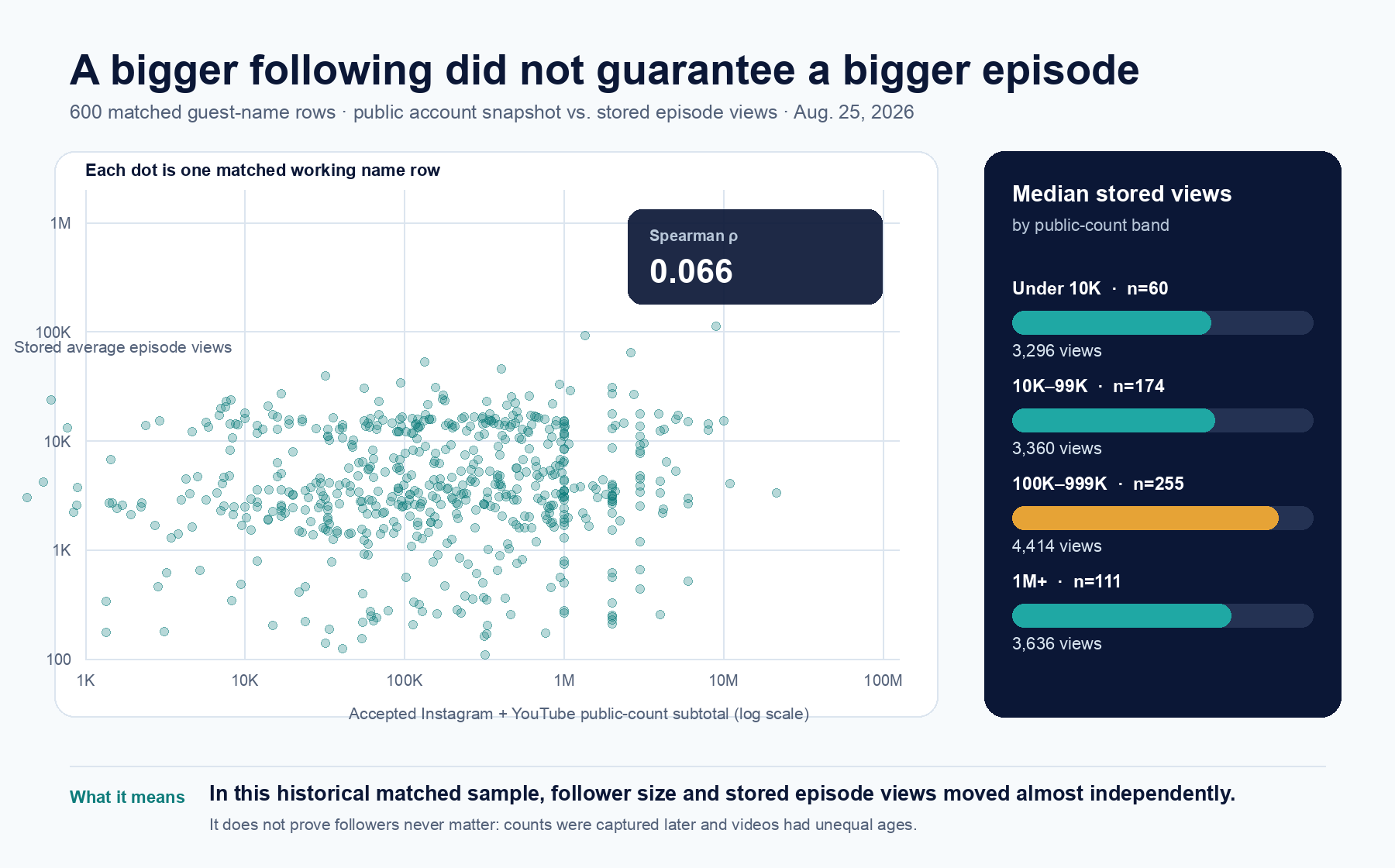
The 100,000 to 999,999 public-count band had a median of 4,414 stored views across 255 matched rows. The 1 million-plus band had a lower median of 3,636 across 111 rows. This is descriptive, not causal. The account counts were captured after the episodes, videos had different ages, and we did not measure editorial fit as a variable.
Visibility is a graph, not a megaphone. The useful question is not “How many followers do all the guests have?” It is “What verifiable relationship and reusable asset did this conversation create?”
Why does this matter more to dealmakers than to people chasing followers?
A dealmaker rarely needs everybody. They need the right buyer, partner, recruit, investor, or referral source to understand who they are and why the relationship is credible.
A substantive appearance on Digital Social Hour’s YouTube channel, Apple Podcasts, or Spotify can become useful long after release if the surrounding system is built correctly. The episode alone is media. The episode connected to a transcript, guest page, source links, schema, clips, and follow-up measurement is infrastructure.
What can one podcast appearance become?
A real conversation
A specific story, expertise, point of view, and named relationship with the host.
A canonical episode
One stable episode URL with the video, transcript, date, guest, topics, and primary call to action.
A guest proof page
A stable, maintained page on SeanKelly.io that points to the guest’s entity home, the main page that clearly identifies the person, and the original episode.
Connected entities
Consistent names, contextual links, and schema describe the person-show-topic relationship.
Reusable distribution
Clips, email, social posts, sales follow-up, and advertising reuse the same source conversation.
Measured outcomes
UTMs and one lead ID that follows a person from the form through the CRM and payment connect visits to real outcomes.
Schema describes a relationship. It does not manufacture authority. Google’s own documentation says structured data helps it understand page meaning, but does not guarantee a search feature. Google also generates Knowledge Panels automatically. No agency controls or can honestly promise a panel, ranking, citation, introduction, or deal. See Google’s structured-data policies and Knowledge Panel guidance.
What business movement did we actually observe?
During the later of two equal 30-day windows, July 26 to August 24 versus June 26 to July 25, 2026, the Digital Social Hour site recorded 9,230 visitors versus 3,706, a 149.1% increase. Google-referred visits moved from 372 to 950, up 155.4%. YouTube-referred visits moved from 215 to 501, up 133.0%.
Rows surviving the same “non-obvious-test” application filter moved from 23 to 67, up 191.3%. That is useful funnel movement. It is not proof of paid bookings, collected revenue, close rate, or return on ad spend because the application, calendar, CRM, and payment systems were not yet joined by one lead ID that follows each person from form submission through payment.
Traffic and application-table movement. The dated site analytics and production table support the window-to-window counts above.
A durable content footprint. The prepared cohort contained 1,685 unique video records with stored view values and linked guest records.
Booked and paid guests. Application rows are not bookings. We need calendar, CRM, and payment read-back.
Deals caused by appearances. Introductions and revenue require opt-in attribution and follow-up, not a success-story assumption.
The name-collision problem is more interesting than a “confidence score”
Google’s Knowledge Graph Search returned at least one candidate for 1,424 of 1,648 normalized name labels in the prepared cohort. But 1,014 name rows returned multiple exact-name Person candidates. That is not proof of a visible Knowledge Panel. It is evidence of why identity resolution matters.
A founder with a common name may have plenty of press and still be hard for machines to distinguish. A clear entity home, consistent profiles, independent sources, and unambiguous links make the evidence easier to reconcile. They do not create notability where none exists.
The value-add I want every guest to receive
Instead of handing a guest a vanity “authority score,” I would give them a short Guest Authority Brief at four moments: before publication, at publication, day 30, and day 90.
- Identity: Does search return the right person, or several namesakes?
- Assets: Are the episode, transcript, clips, images, and source links complete?
- Entity relationships: Do the guest site, SeanKelly.io, DSH, podcast directories, and social profiles agree?
- Discovery: What appears for a fixed set of branded search and AI prompts, captured with dates and raw answers?
- Network activity: Which introductions were requested, accepted, and answered?
- Business outcomes: Which meetings, opportunities, referrals, and closed deals can be tied to a shared lead ID?
Every line should be marked PROVEN, CORRELATED, SELF-REPORTED, or UNKNOWN. That is far more useful to a serious operator than a made-up score that hides the evidence underneath it.
What does a paid Digital Social Hour appearance buy?
Some Digital Social Hour guest packages are paid commercial placements, not independent editorial endorsements. Payment covers the deliverables stated in the selected package, such as recording, production, distribution, promotional assets, or community access. The paid relationship should be disclosed prominently on the episode and derived clips. No package guarantees views, rankings, press coverage, AI citations, Knowledge Panels, introductions, deals, or revenue.
That distinction makes the offer stronger. A buyer can evaluate the assets DSH controls, while we separately measure the outcomes nobody can honestly promise.
Have a story worth a real conversation?
Review Digital Social Hour’s guest options and the exact production deliverables before deciding.
Review DSH guest optionsNeed the authority layer built around your content?
Our $7,500 Personal Brand Authority implementation addresses the documented identity, source, site, schema, mention, and measurement gaps included in the signed scope. We commit to the agreed deliverables, not a Knowledge Panel or ranking.
See the Personal Brand Authority setupMethodology and limits
The working cohort contained 1,715 prepared episode-linked records and 1,648 normalized name labels. Those labels are not verified unique people, and the 1,715 records should not be described as the current live published archive.
The 405,573,174 account subtotal used exact accepted profile URLs, deduplicated by platform URL. It included only accepted public Instagram and YouTube counts available for 600 working name rows. X, LinkedIn, TikTok, Facebook, and unverified or missing accounts remained unknown.
The stored YouTube view values summed to 21,823,331 across 1,685 unique video records in the prepared cohort. These values had different capture dates and episode ages. The correlation is observational and does not establish causation.
The Google Knowledge Graph result is a candidate match, not a panel check or authority score. No rendered name-query panels were checked in this batch. The raw guest-ranking table remains private because it contains unresolved identities, namesake collisions, and automated categories that could be mistaken for judgments about real people.
The underlying source exports and calculation records are retained for audit, but they are not public because they include unresolved identity matches. This page publishes the aggregate method, findings, and limitations.
Frequently asked questions
Does schema create authority?
No. Schema can describe a real person, show, episode, and relationship more clearly. It cannot manufacture independent notability or force a search engine or AI model to cite the page.
Can a podcast appearance produce deals?
An appearance can contribute to deals, but this analysis did not measure causal impact. Track introductions, replies, meetings, opportunities, and revenue with consent and a shared lead ID.
Does a paid appearance guarantee distribution or views?
It guarantees only the written production and distribution deliverables in the agreement. Audience response and business outcomes vary.
Can you guarantee a Knowledge Panel?
No. Google generates panels automatically. We can improve entity clarity, source quality, site structure, and monitoring, then report what changes.
Episode images and names document published appearances; they do not imply that any guest endorses Sean Kelly, Dennis Yu, Digital Social Hour, or these services.