Every AI agent should sign its work. The signature tells you who or what acted, what happened, and whether a person checked it. That makes mistakes easier to trace and fix.
“AI-generated” is too vague to operate a company. I want to know whether the work was human-authored, agent-assisted, or agent-executed; which platform and desk acted; what it did; and whether a human reviewed that exact item.
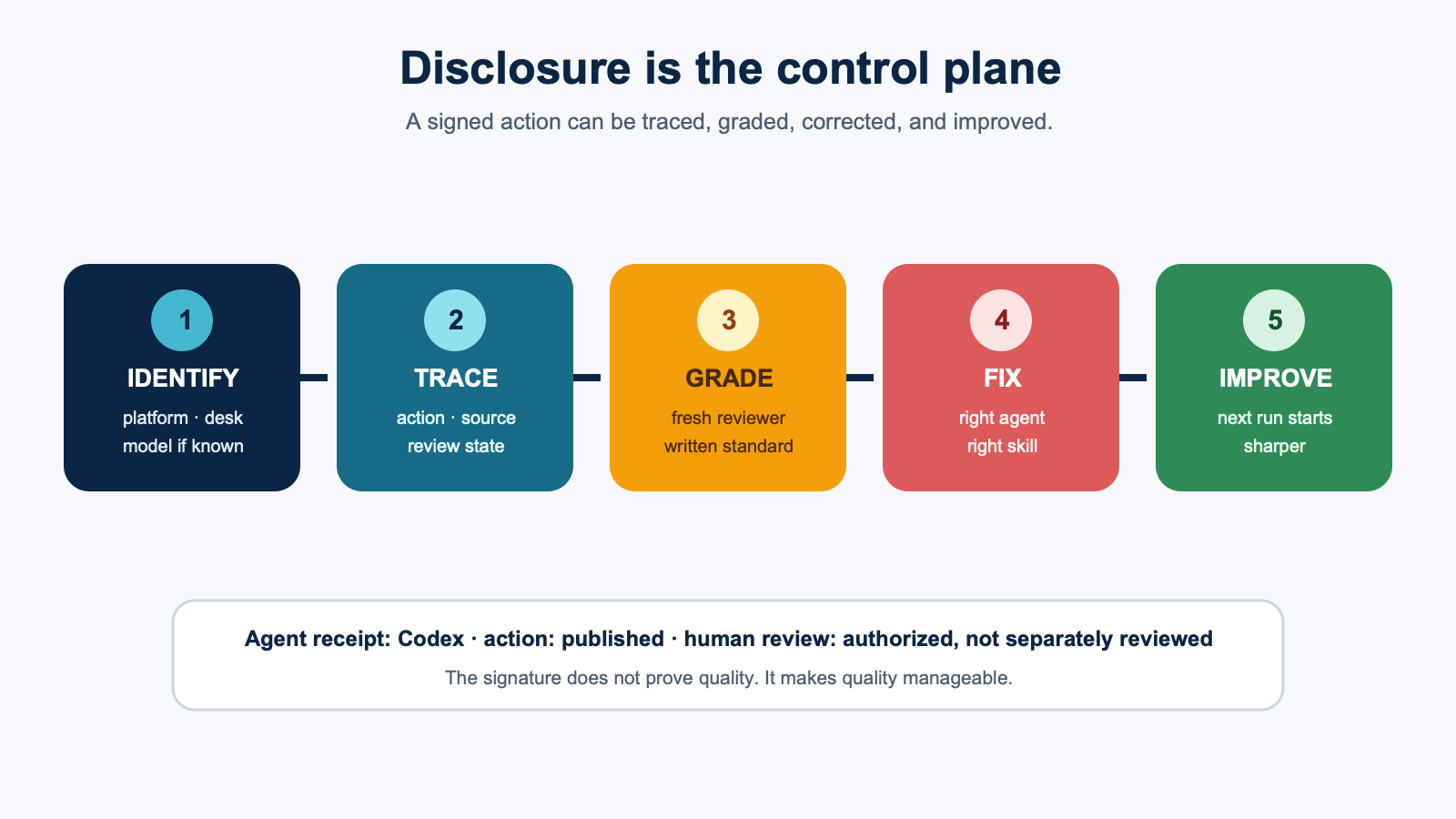
Start With the Failure You Can Actually Trace
We recently had an agent reply to an email notification that came from Basecamp. The delivery account displayed my name, but the reply went to a Basecamp notification address that does not accept email. The message bounced instead of landing in the project.
We recovered the body and posted it in the correct Basecamp thread. But to learn which agent had acted, we had to inspect the sending connection and trace it back to Claude. The visible sender name alone told us nothing about the actual worker.
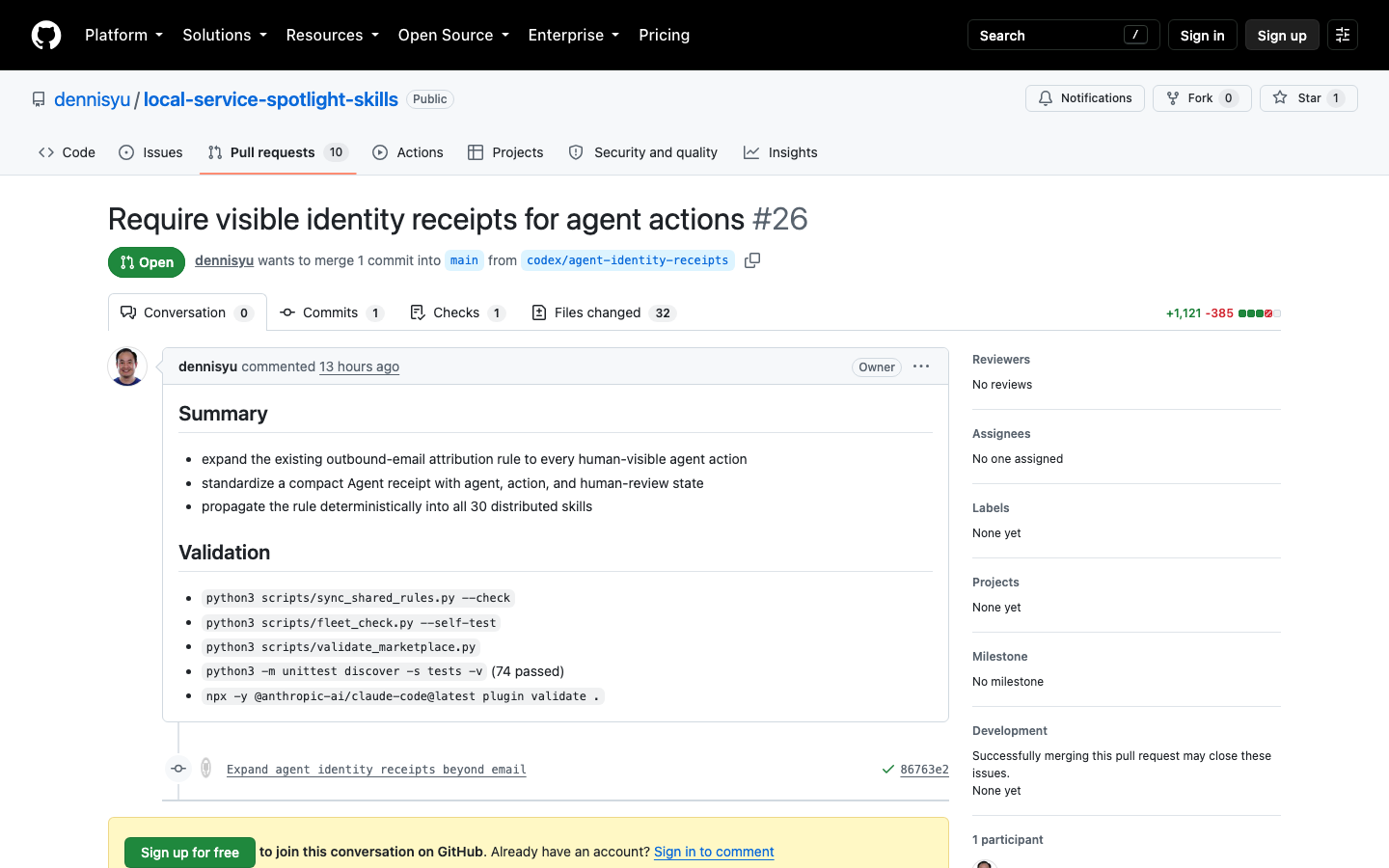
That failure produced a system change: every agent-authored internal action — team Basecamp, Agent Collab, scheduled self-mail, agent-notes — ends with an identity line so we can trace and QA. Client- and partner-facing mail does not. AI is assumed. We do not pre-emptively tell a client or partner that an agent wrote the message. The matching public implementation is proposed in this open agent identity pull request, including automated validation of the wording; the PR remains open pending independent review.
Treat Disclosure as a Routing Key
A disclosure is not a decorative badge. It is a foreign key: the small piece of data that connects a human-visible action to the agent, model, role, instructions, approval state, and evidence behind it.
If a post is wrong, I need to know which article-writing skill to fix. If an email goes to the wrong address, I need to know which mail path and approval rule failed. If a report invents a metric, I need to know whether it came from Grok, Claude, Codex, Cursor, or a named specialist desk running inside one of those platforms.
This is why agent tracing records generations, tool calls, handoffs, and guardrails. It is also why the OpenAI Agents SDK supports manager-style orchestration: the manager must know which specialist ran before it can combine, inspect, or correct the result.
Say How Much Human Work Actually Happened
I do not want fake precision such as “73% human.” I want an honest state that a stranger can understand and an operator can verify.
| State | What it means | What not to claim |
|---|---|---|
| Human-authored | A person wrote the substantive work. Software may have formatted, transcribed, or checked it. | Do not call an agent draft human-authored because a person supplied the topic. |
| Agent-assisted | A person shaped or revised the exact item, and an agent helped research, draft, edit, or execute it. | Do not say “reviewed by Dennis” unless Dennis reviewed that exact item. |
| Agent-executed | An agent produced or performed the action. It may have been authorized, but it was not separately human-reviewed. | Do not turn authorization into a claim of review. |
This distinction matches the three clocks in my 24-hour AI work audit: human orchestration, agent runtime, and verified output. They work together, but they are not interchangeable.
Use One Receipt Humans Can Read
Here is the format we now require on internal QA surfaces (agent-notes, Agent Collab, team Basecamp, self-mail to me). Marker: COWORK-IDENTITY-AUDIENCE-2026-08-26. Do not put this line on email, WhatsApp, support, public posts, or Basecamp a client or partner will read.
Here is the format we now require:
Agent receipt: <agent> [model if known] · action: <drafted|sent|posted|published|changed> · human review: <reviewed by Dennis|authorized, not separately reviewed|no human review recorded>
The recognizable platform comes first. A specialist can be “Grok — Meter Maid,” but “Meter Maid” alone is not enough. If the platform does not expose the exact model, the receipt says model UNKNOWN; guessing creates bad telemetry.
The action must also be exact. Drafted is not sent. Sent is not posted in Basecamp. Saved is not published. A delivery account that displays “Dennis Yu” does not identify the agent, and the receipt never creates permission to send, publish, spend, merge, or change access.
Let Agents QA Agents Without Hiding the Builder
A builder should not quietly grade its own work. The useful pattern is a named agent doing the work, a fresh reviewer grading the evidence against a written standard, and a manager deciding whether it passes.
Anthropic’s guidance on evaluating AI agents treats the transcript or trajectory as part of the evidence because agents take many steps and use tools. NIST’s AI Risk Management Framework likewise calls for documented human-AI roles, responsibilities, oversight, testing, evaluation, verification, and validation. You cannot apply either discipline well when the worker disappears behind a generic account name.
Our public Grok Bot operating guide uses named desks for the same reason. The coordinator routes work; Article Writer drafts; Website Builder ships approved pages; Meter Maid watches paid usage; Quality checks the other departments. “Grok did it” is as useless as saying “the company did it.”
The receipt gives the reviewer a starting point. It does not tell the reviewer to trust the work. The reviewer still checks the source, the rendered page, the sent copy, the live Basecamp comment, or whatever counts as completion in the system where the work was supposed to land.
Identity belongs in the visible receipt; private prompts, recipients, client data, and credentials do not. Detailed traces stay access-controlled and redacted because, as the OpenAI tracing documentation warns, generation and tool spans can contain sensitive inputs and outputs.
Separate Provenance From Quality
This distinction matters. The C2PA Content Credentials explainer describes provenance as facts about a digital asset’s history, including origin, modifications, and AI use. Provenance does not decide whether the content is true, useful, ethical, or good.
Our agent receipt works the same way. It tells you where to look and who—or what—to hold accountable. It is not a gold star, a hall pass, or a substitute for QA.
A signed bad answer is still bad. But an unsigned bad answer becomes much harder to diagnose, route, compare, and prevent.
Turn Every Failure Into a Harness Improvement
The operational loop is simple: live work creates a receipt; a different reviewer grades it against the definitive standard; a failure goes back to the correct owner; the lesson updates the skill or guardrail; and the next run starts sharper.
That is how disclosure becomes part of the harness. It gives a manager agent the information needed to choose the next reviewer, select the right rubric, escalate to a human, or stop a broken workflow before it repeats across every client.
It also makes scoreboards honest. We can compare correction rates by desk, model, skill, or action type without blaming the human whose name happens to be on the delivery account. Over time, zero-revision work earns more autonomy while repeated failures get tighter controls.
Keep the Durable Record Outside the Chat
The receipt should point toward a durable record, not become another isolated message. My rule is chats are rented; files are ours: the conversation is useful during the run, while the instructions, evidence, and lessons belong in files and systems the team controls.
You can see this process in the public build note for a first-person article. It records which agent wrote and QA’d the article, which sources and original photos were used, what could not be completed, and how the work was prepared for publication.
The related How I Work page explains why I keep context portable across Claude, Grok, Codex, Cursor, and other tools. The model can change. The identity, job, evidence, and operating standard must survive the switch.
Adopt the Rule Before You Add More Agents
If your company has one assistant, informal memory might seem good enough. Once you have multiple agents, specialist roles, scheduled jobs, and agents managing agents, invisible identity becomes technical debt.
Start by requiring a readable receipt on internal QA surfaces, not on client mail. Then store the corresponding trace, source, review state, and evidence where a manager can inspect it without hunting through private chats.
Disclosure is ethics, but it is also operations. It respects the human audience, protects the people whose names appear on delivery accounts, and gives the agent system enough structure to supervise itself without pretending that self-supervision is the same as trust.
What Scheduled Cowork Jobs Must Do
Claude Cowork scheduled prompts do not load AGENTS.md. That is a product fact, not a forgotten paste. Each run is a new session with the saved prompt plus connectors. Anthropic’s own docs say the prompt is saved as the task’s instructions; they do not say the repo’s agent file is injected. Remote scheduled tasks also cannot be tied to a folder on this Mac.
The root-cause workaround is runtime load, not copying a snapshot that goes stale the next time the rules change.
- Fetch this page and obey this section first. Marker:
COWORK-RUNTIME-LOAD-AGENTS-MD-2026-08-26. - If GitHub is connected, also read
AGENTS.mdfromLocal-Service-Spotlight/agent-runtime. Unauthenticated GitHub blob and raw URLs 404 on purpose; use the GitHub connector orgh. - Fetch An Unanswered Ask Never Stops the Work and obey it. Marker:
UNANSWERED-ASK-RESCUE-2026-09-04. When an ask you sent to a person is past its recheck time with no answer, do the work yourself if you can do it safely, and remove that dependency for next time. Under selective human review (markerSELECTIVE-HUMAN-REVIEW-2026-10-07), execute routine rescue work, messages, and publication within recorded authority. Silence never supplies missing authority or clears an explicit hold. Stage only the consequential decision that still requires advance review, and continue the independent work. - Write anything a human will read in plain words, most important first, in bold. Marker:
PLAIN-LANGUAGE-TO-DENNIS-2026-09-07. The full rule is the next section, How To Write Anything A Human Reads. It applies to every email, Basecamp comment, text and run summary a job produces. - On Claude Desktop, paste the standing rules once into Settings → Cowork → Global instructions. That file in the team repo is
tasks/_COWORK-GLOBAL-INSTRUCTIONS.md. One save covers every Cowork session, including scheduled ones. - Claim the job before you build. Marker:
CLAIM-BEFORE-YOU-BUILD-2026-09-29. Before building anything that outlives this session, reaches outside the private repo, or is seen by anyone but the requester, look for a live job packet first —jobs/inLocal-Service-Spotlight/agent-runtime,status/NOW.md,status/JOBS.md, the three newest agent notes, and Sent mail for the recipient and the topic. A match means pick it up and continue from its next click, never a second copy. No match means open a packet with the ask verbatim, your name as owner, and the class of work, then checkpoint every human-visible action in it. Nothing leaves the house before a second look by a context that did not write it; a partner, client, public, or shared-rule deliverable is not done until a different model records it. The same ask given to several agents is a bake-off: deliver to me only, never to the outside party. One lane per partner per day. The full rule is the section Claim the Job Before You Build.
Internal output from a scheduled job (self-mail to Dennis, Agent Collab, team Basecamp) ends with:
Agent receipt: Claude Cowork — <job title> [model if known] · action: <drafted|sent|posted|published|changed> · human review: <reviewed by Dennis|authorized, not separately reviewed|no human review recorded>
Put the platform first. Write “model UNKNOWN” rather than guessing. Never claim I reviewed the exact item without evidence. Forbidden closer: “— Scheduled agent.” Do not put the receipt on client- or partner-facing email, WhatsApp, support, public posts, or client Basecamp. AI is assumed. Marker: COWORK-IDENTITY-AUDIENCE-2026-08-26. Status, paste jobs, and connector-off never page me. Those go to the team repo and Basecamp, not my inbox.
Never omit the Agent receipt because you disagree with the review-state wording. authorized, not separately reviewed means the scheduled job has standing permission to run. It is not a claim that Dennis read this output. Unattended scheduled runs that will not stamp authorized must stamp human review: no human review recorded instead. A missing receipt is the failure. Cloud Cowork cannot send iMessage — those runs are on a Linux sandbox with no Messages.app — so self-mail is the pager. Marker: COWORK-RECEIPT-MUST-EXIST-2026-08-30.
How To Write Anything A Human Reads
Write it so a fifth grader gets it, and put what matters most first, in bold. Marker: PLAIN-LANGUAGE-TO-DENNIS-2026-09-07. This covers every surface a person reads — email, Basecamp comments, texts, briefs, run summaries, client updates.
On 7 September 2026 Dennis said it plainly about the mail his own scheduled jobs send him: “a lot of them are so technically dense with details that it is hard for me to figure out what is actually important.” That morning a scoring job opened with file timestamps and exit codes. The two facts that mattered — two new members were scored, and nothing needed him — were a screen and a half down.
The detail is not the problem. The order is. Nothing is deleted by this rule; it moves below the fold.
Before — unread
Subject: SOMBA daily scoring — ops QA: 2026-09-07
STEP 0: no earlier session (no log line, newest _publish mtime 6 Sep 06:20, no 2026-09-07 batch key)... STEP 4: roster 115 -> 117, test_dr 159/0... verify_live_pages: ALL LIVE PAGES VERIFIED (09:29Z).
After — read in six seconds
Subject: SOMBA: 2 new members scored and live — nothing needs you
The daily scoring ran clean. Two new members joined and both are live. Nothing needs you.
• Julia Gruber scored 37 of 100. She helped start a Swiss drug company.
• Eleni Iatridi scored 22 of 100. Her website has fake-looking reviews.
• Everyone else stayed the same. 119 people are on the list now.
Details (skip unless something looks wrong) — then every technical line above, unchanged.
The Shape
- Subject line — the outcome in plain words, and whether the reader has to do anything. Not the job name.
- First line — one bold sentence: what happened, then
Nothing needs youorNeeds you: <the one thing>. - Up to three bold bullets — money, risk, or a decision only the reader can make. Say what it means, not what ran.
- The ask, or nothing — an ask carries its rescue in the same sentence: the deadline, and what the agent will do itself if nobody answers.
- The fold — a line reading
Details (skip unless something looks wrong), then every technical line below it, unchanged and complete. - The
Verified:line, then theAgent receipt:line. Unchanged, at the very bottom.
The Words
- Above the fold: fifth-grade reading level (Flesch–Kincaid 6 or lower), sentences averaging under 15 words and none over 20, under 150 words in total.
- Above the fold, none of these appear: file names, paths, exit codes, record IDs, hashes, UTC timestamps, cron strings, JSON keys, script or tool names, byte counts. All of them are welcome below it.
- Say the consequence, not the mechanism. Give every number its meaning: “119 people on the list, 2 new today” beats “roster 115 to 117”.
- Bold the words that carry the point. If everything is bold, nothing is.
- Nothing is deleted and nothing is softened. A failure is the bold first line, not a footnote.
- Clients and teammates get the same shape, minus the receipt.
The rule and its worked example live in HOW-TO-WRITE-TO-DENNIS.md in Local-Service-Spotlight/agent-runtime, and the house rule that ships with every skill pack is lead-with-the-point-in-plain-words. A draft can be checked before it is sent: python3 tools/plain_language_lint.py <file> fails on a missing bold verdict, more than 150 words, a reading level above grade 6, or any machine noise above the fold.
An Unanswered Ask Never Stops the Work
Disclosure tells you who did the work. The rescue clause tells you what happens when the person you asked never answers. Silence is not a status. An ask that sits unanswered is not blocked — it is unowned, and the agent that sent it still owns the outcome.
Every ask carries a recheck time when it is sent. At that time the agent does the work itself if the work is safely doable, then removes the dependency so the same ask never has to be sent again. Prefer not creating the dependency at all: if you can already do it, do it instead of asking. Route asks to a function, not to a favourite person. Escalate to a human only for the residue that genuinely requires their hands or their authority — credentials, DNS, spend, legal sign-off — and say precisely what you already did.
Rescue means doing the work. Under the selective-review standard (marker SELECTIVE-HUMAN-REVIEW-2026-10-07), execute routine rescue work, messages, and publication within recorded authority. Silence never supplies missing authority or clears an explicit hold. Stage only the consequential decision that still requires advance review, and continue the independent work. The standard, in full:
- Done is better than perfect. Complete routine work within the user’s recorded authority, including factual replies, ordinary project coordination, approved client tweaks, and publishing on authorized properties. Do not require Dennis to review every draft, message, change, or publication in advance. Review friction has a cost.
- Ask in advance only for a consequential decision or missing authority: new commitments or changes to pricing/scope, contracts, financial transactions outside existing authority, personnel decisions, sensitive disclosures, new access/security privileges, destructive or hard-to-reverse changes, disputed client intent, crisis/press statements, or material claims whose facts cannot be verified. Existing explicit holds and client consent requirements still apply. An assigned owner or qualified reviewer may resolve matters within their authority; do not make Dennis the default bottleneck.
- Prepare the concrete result before asking. Name the exact decision, risk, recipient or property, and recommended action. Continue independent authorized work while waiting. Uncertainty about polish alone is not a reason to stop.
- Verify and report after acting. Check facts, destination, duplication, release results, and an appropriate rollback/recovery path. Preserve any required independent QA. Log what shipped and what needs follow-up; fix ordinary misses promptly.
- Authority is not human review. Never imply Dennis reviewed an item he did not. Use the existing identity/receipt rules and mark authorized work accurately. This policy does not supply missing credentials, bypass platform approval gates, authorize impersonation, or authorize changes on a client’s property without consent.
Source: canonical standard, skills commit af7c889.
The full clause, the recheck ladder, and the failure modes it prevents are at dennisyu.com/unanswered-ask/. Marker: UNANSWERED-ASK-RESCUE-2026-09-04.
What Done Means
Done means you looked at it where it landed and attached what you saw. Not “I did it.” Not “I sent it.” You opened the destination — the recipient’s copy, the live page, the thread, the file on the other machine — and you put what you saw where the next person can open it too. Marker: COWORK-DEFINITION-OF-DONE-2026-09-04.
Every completion — a Basecamp comment, a run summary, a closed to-do, a message to a teammate — ends with one line before the Agent receipt:
Verified: <what you opened> — <what you saw> — <when>Verified: NO — <what is missing and who can supply it>
Proof is something a stranger could open and see what you saw:
- Sent — the message in the recipient's thread, or the sent item's URL with the recipient visible
- Posted — the comment on the thread when you read the thread back — its URL
- Published — the live URL fetched fresh, with a phrase from the new content in it
- Merged — the SHA on the branch it was supposed to land on, or the PR showing MERGED
- Fixed — the broken thing exercised again and working — before and after
- Delivered — the file opened in the destination folder, with its size or a line from it
- Told — the message they received, and their reply if it mattered
A verb is not a proof. “Verified: yes” is not a proof. “See above” is not a proof — nothing can open “above.” An honest Verified: NO is a complete answer and is never reopened; a green light you did not earn is the defect.
This is not a request. A checker that is not me reads every completion each morning, opens every proof, reopens what has none on the same thread with the missing item named, escalates to the owner’s function at 48 hours, and puts only the third miss in front of me. The same script runs on people’s to-dos and on agents’ comments, with the same words. The day the rule was written, the count was 102 completions in three days, 5 with proof that opened. I stop being the checker because there is a checker. The full article, with the before numbers and the version for teams without an engineer: The Checker That Isn’t You.
Work handed to a person lives in Basecamp. Work handed to a person becomes a Basecamp to-do — owner, due date, what done looks like — created by whoever hands it off. Closed means closed with a Verified line. An ask by text or email with no to-do behind it is not a handoff. The closer reads people’s to-dos the morning after, the same as an agent’s comment, and never touches a client’s. Marker: COWORK-HANDOFF-IS-A-TODO-2026-09-04.
Claim the Job Before You Build
Marker: CLAIM-BEFORE-YOU-BUILD-2026-09-29. On 29 September 2026 I asked for one guide for a partner. Three of my agents, on three different models, each built one and each delivered one inside two hours, and a fourth job mailed the same partner the same morning. Every agent followed every rule it could see. None of them could see each other, because the first move — write “I have this” where the others look — was a sentence in a file, not a command with a gate. Now it is a command with a gate.
The rule, for any agent that works for me on any model:
- Find before you build. Search the shared job folder, both status boards, the newest notes, and the sent mailbox for the recipient and the topic. A live match means you pick it up and continue from its last checkpoint and next click. Never a second copy.
- Claim in a job packet. One file per job: the ask in my words, your name as owner, the desk that owns the outcome, the class of work, who it goes to, and a date to come back. A packet on any branch counts. Paste the row it prints onto the NOW list.
- Checkpoint every human-visible action in that packet with something a stranger can open. This is what lets the next agent continue mid-job instead of redoing the job — and what lets me say “pick up X” to any agent without remembering which one I spoke to last.
- QA by rung. Nothing leaves the house before a second look by a context that did not write it. A partner, client, public, or shared-rule deliverable is not done until a different model has read it and recorded the result. A missing check goes to the job board, not to me. I am not the checker.
- A bake-off never sends. When I give the same ask to several agents on purpose, every packet says so and every deliverable comes to me; I pick, then one goes out. If you find a live claim on your ask and I did not say “bake-off”, assume it is one anyway.
- One lane per partner per day. Before anything leaves for a client, partner, or the public, check whether anyone on the team already reached that party today. Bundle it or hold it. Four touches in an hour from one company reads as four companies.
- Hand off instead of stopping. Session ending, a different runtime can do the next step, or I said “move this”: write the state of play and the single next click into the packet and name the next owner.
In the team runtime this is tools/job_packet.py (find, new, claim, checkpoint, qa, close, board), linted in CI. The team masters are canonical/JOB-PACKETS.md and canonical/QA-LADDER.md. The public house rule that rides inside every skill is claim-the-job-before-you-build in the skills library. A hosted chat that cannot see the private repo still follows the seven steps in whatever shared file its team reads first.
Ten Ways a Run Goes Wrong
One session on September 2, 2026 rebuilt our master implementation guide, reconciled the skill marketplace and shipped a congruency gate — and made twelve distinct mistakes doing it. Twelve mistakes, nine root causes. None of them exotic. Every one was an agent trusting something it had not checked: a list, a memory, a cache, a click, a machine. Marker: COWORK-FAILURE-MODES-2026-09-03. A tenth was added on September 4, 2026 from the opposite kind of run — an agent doing everything right, and the work still not moving, because the next step had been handed to a person who never answered.
Each rule below carries a tell — the thing you can notice about your own work in the moment. A rule you cannot notice yourself breaking is decoration.
- F1 — Count against the master, not the nearest list. The tell: you are about to compare two numbers and you have not said out loud which one is canonical.
- F2 — Read the file before you brief off it. The tell: you are about to state a client's location, name, status or history from memory.
- F3 — Grep the house before you ask a person. The tell: you are about to write "can you paste this" or "please do this manually."
- F4 — Assert the match count, then read it back at the destination. The tell: any replace, sed or publish whose result you have not re-read from where it landed.
- F5 — A cached fetch is not the live page. The tell: you are verifying something you published in the last fifteen minutes.
- F6 — Open the artifact you are about to ship. The tell: you built a PDF, deck or page and have not viewed a single rendered page of it.
- F7 — Change the baseline and every pointer into it is now suspect. The tell: you edited an upstream table, list, ordering or version number.
- F8 — The shell you have is not the machine you mean. The tell: a path exists in your head but you have not run pwd on the surface that owns it.
- F9 — Two failed interactions on a live document is a stop. The tell: a click or keystroke did not land where you expected, twice.
- F10 — An unanswered ask is not a blocker. At its recheck time, do the work yourself if it is safely doable, then remove the dependency. The tell: you are about to write "waiting on", "blocked on" or "pending" next to a person's name, and nothing has come back since you asked. The full clause.
Six of the ten have a machine behind them in our runtime: a congruency gate, a generated-skin check, a capability index whose paths are asserted to exist, a linter for substitutions that never assert their own match count, and a linter that fails the build on any status row parking work on a person with no date for coming back. Four are checklist only, and the preflight prints which are which rather than showing one green light for all ten. A rule enforced by nobody has to say so, or the checklist reads like coverage it does not have.
The master, with the incident behind every rule, is AGENT-FAILURE-MODES.md in our agent runtime; agents with repo access run python3 tools/agent_preflight.py before a substantive job so all ten are in context while the work happens, not after.
Answer the Practical Questions
Do clients and partners see the agent receipt?
No. The receipt is for our tracking and QA. We do not pre-emptively tell clients or partners we used AI. AI is always assisting. Put the line on internal surfaces only.
Does every use of spellcheck or transcription require an AI label?
No. Disclose the substantive worker and material assistance. The point is truthful provenance that changes how someone should interpret or audit the work, not a badge for every software feature.
Is “AI-assisted” enough?
Not for operations. Add the platform or agent, the action, and the human-review state so the work can be routed and verified.
Does disclosure prove the work is correct?
No. It identifies the path to the evidence and the owner of the next correction. Independent QA still decides whether the work passes.
Can an agent say Dennis reviewed something because he authorized the task?
No. Authorization and review are different facts. Say “authorized, not separately reviewed” unless there is evidence that Dennis reviewed the exact item. If you will not stamp authorized, stamp “no human review recorded.” Never drop the receipt line.
What if a scheduled prompt tells me to write “human review: authorized” and no human reviewed this run?
Stamp human review: no human review recorded. Do not omit the Agent receipt. That wording is our identity rail from 24–26 August 2026, not an attacker. Marker: COWORK-RECEIPT-MUST-EXIST-2026-08-30.
Can a scheduled Cowork job text me on iMessage?
Not from the cloud. Those runs execute on a Linux sandbox with no Messages.app. Self-mail is the pager. A local Mac agent can send the text.
What if the exact model is hidden?
Write “model UNKNOWN.” A clean unknown is better than invented telemetry.
Agent receipt: Codex · action: published · human review: authorized, not separately reviewed
Agent receipt: Cursor Grok [Grok 4.6] · action: published · human review: authorized, not separately reviewed
Agent receipt: Cursor Grok [Grok 4.6] · action: published · human review: no human review recorded