I run AI on two laptops at home, all day and all night. This week I finally priced out what that work costs if I just buy it from the cloud instead. About 40 cents a day.
If you're thinking about buying a Mac Studio or a loaded laptop to run AI at home, read this first. I already own the machines. I already did the work. I measured it. This is the math on the local Qwen setup I run, real numbers from my own queue.

The five power bank confession
I travel with five power banks. Two laptops, five power banks, and a bag of cables I can't close properly anymore.
The laptops run a local AI model around the clock, turning my podcast recordings into draft articles. The model never stops, so the batteries never stop draining. A decent chunk of my travel day is just power bank rotation. Charge one, drain one, swap. I've built a tiny power company in my backpack without meaning to.
Somewhere in an airport, a warm power bank in each hand, I had the obvious thought. What is all this actually saving me?
What my laptops do all day
The setup works. I'm not knocking it. Two Macs run a 27-billion-parameter Qwen model, quantized down to 4-bit so it fits in laptop memory. One is chewing through a client's podcast archive. Mine chews through my own recordings. Between them they've processed about 476 hours of audio, and there are still roughly 800 hours sitting in the queue. At the current pace that's 10 to 20 weeks of non-stop cranking.
My home Mac finishes about 26 episodes a day. Each episode takes it about 21 minutes of drafting. Steady, honest work. It's just not much work, once you price it.
And there's a ceiling I can't buy my way past. GLM-4.6 has 355 billion parameters. Even at 4-bit, the weights alone need about 178 GB of memory. My biggest Mac has 128 GB. The cloud models aren't slightly bigger than what's on my laptop. They're a different sport, running on hardware nobody carries through an airport.
So I ran the test
I took 10 episodes my laptops had already drafted and re-ran them through cloud models on OpenRouter. Same episodes. Same prompts, same pipeline. Then I checked the output quality against the transcripts, because a cheap draft that invents facts is not a draft.
One finished episode, every call included, costs $0.0155 on Qwen3-235B. Call it a cent and a half, for a model roughly nine times the size of mine. GLM-4.6 runs about 6 cents an episode. And instead of waiting in a queue measured in weeks, each episode came back in 4 to 9 minutes.
The math nobody posts
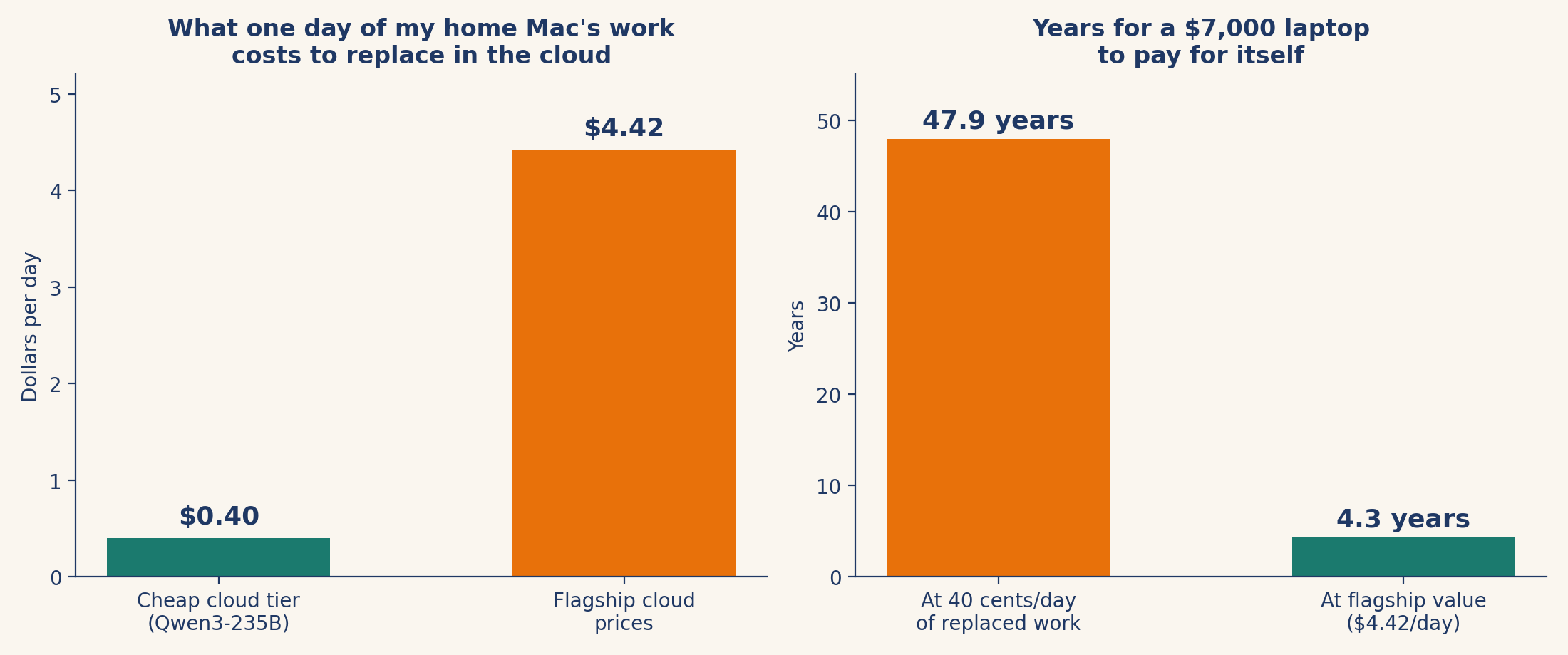
Twenty-six episodes a day at a cent and a half each comes to $0.40 a day. That's what a full day of my home Mac's grinding is worth at cloud prices. Be generous and credit the laptop at flagship cloud prices instead. Now it's about $4.40 a day.
A serious local AI laptop costs around $7,000. At 40 cents a day, it pays for itself in 48 years. At the flagship number, about 4.4 years, and that assumes it runs perfectly around the clock, never stalls, never fills its own disk with photo downloads. Mine do stall. My travel Mac did fill its disk. Reality is worse than the chart.
The backlog is the part that got me. All 1,145 remaining episodes, the queue I've been nursing for months, costs under $20 to clear at the cheap cloud tier. Under $200 at flagship prices. I've been carrying five power banks to defend a twenty-dollar bill.
The local AI crowd will tell you cloud prices are a trick. A sale. Prices get jacked up later, so lock in hardware now. Here's the hole in that story. The frontier model might hold its price, sure. But the price of a fixed level of capability keeps falling, about 10x a year, because the engineering keeps getting better: distilled models, sparse models that only wake up part of the network per question, better chips. What cost $20 per million tokens a few years ago costs pennies now. The capability I actually need gets cheaper every year. A laptop in a closet only gets older. You can't stockpile future compute.
Why smart people are hoarding anyway
They're not hallucinating everything. Memory prices really are spiking, because every AI data center on Earth is buying RAM at the same time. Cloud pricing really is part subsidy. The labs are spending investor money to win the platform war; everybody knows it. And sovereignty is a real thing. Nobody can rate-limit a machine sitting in your house.
But listen to what the sovereignty argument is actually about. Alex Karp talks about nations. Defense. State-level secrets, state-level stakes. I'm processing podcast transcripts and drafting blog posts, most of which I then give away for free. That's a sandwich in a bank vault. The toilet paper comparison writes itself: March 2020, the fear was understandable, the garage full of stockpile was still not a strategy.
Then why do my AI bills keep going up?
This is the part that confused me, so I'll save you the confusion. My per-token cost has collapsed. My total AI spend keeps climbing. Both things are true at the same time, and there's a name for it: the Jevons paradox. When something gets cheaper, you don't bank the difference. You use so much more of it that you spend more overall.
Cheaper compute didn't shrink my operation. It blew it up. A fleet of agents running around the clock. Twenty-page audits. A thousand-episode backlog I never would have attempted at 2023 prices. Reasoning models that burn 50 times the tokens per answer, because I keep ordering the top shelf. My bills aren't proof that compute got expensive. They're proof I got ambitious.
What local is still good for
I'm not throwing the laptops away. Truly private material, stuff that should never leave the building, still belongs on a local model. If the machines are sitting there anyway, overflow work is basically free. And running a model yourself teaches you things no API dashboard will.
What local is not anymore is a way to save money. That part's just over. Production moves to the cloud, where the big models live. The laptops go back to being laptops. The power banks retire, and my back is grateful.
Run your own numbers
Before you buy hardware, get three numbers. What your machine finishes in a day. What that same work costs from two or three cloud models. The price of the machine divided by the daily saving. If your payback comes out in decades, you don't have an investment. You have a hobby that makes fan noise. Hobbies are fine. Just call it one.
The full setup, queue state, and test method live in my local Qwen write-up and on the fleet meter page. Want it run for you? This is the kind of system we build and measure for clients, and how our agents run the company is the place to start.
Don't defend a $20 bill with $7,000 of hardware and five power banks. Run your numbers first.