Use a local AI worker for drafts your lead worker can check. Here is how Cursor and Grok Bot direct Qwen on my Macs, and why Muse doesn’t. Start with a small draft task; the lead worker still checks the result and controls the next action.
This guide is part of Cursor and Local Qwen Are Not the Same Qwen. Next, explore How to Install Local Qwen (MLX, No Ollama), or Four Lunch Tickets: How Claude, ChatGPT, GrokBot, and Cursor Actually Bill You.
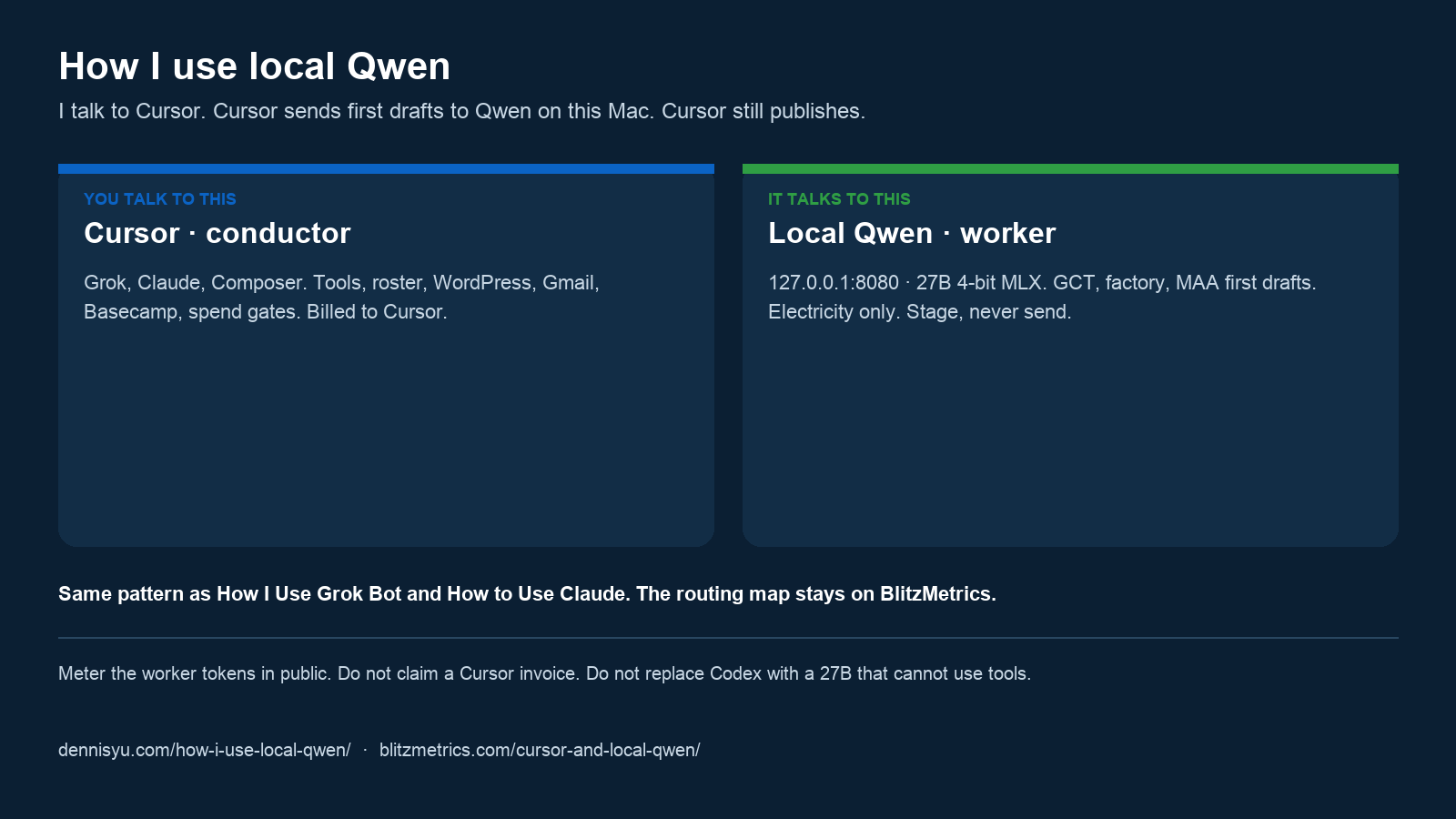
I do not talk to Qwen. I talk to a conductor: Cursor on the Mac, or Grok Bot with Local execution turned on. The conductor has the tools, roster, publishing, Gmail, Basecamp, and spend gates. Muse, my Meta agent, can’t conduct Qwen. It has no shell on my Macs (who can drive the Mac worker). When the work is a GCT (Goals, Content, Targeting: the goal, material, and audience) screen, a Content Factory (our four-stage process for using real content) first draft, or a weekly MAA (Metrics, Analysis, Action: results, meaning, and next steps), the agent on this Mac sends that slice to local Qwen at 127.0.0.1:8080. This page is the desk playbook, the same job as How I Use Grok Bot and How to Use Claude. The routing map — three things people call “Qwen” — stays at Cursor and local Qwen. We show the worker tokens in public because that is building in public, not a pitch deck after the fact.
Next: how my phone video archive feeds this worker — Phone Video → Local Qwen Content Factory.
Grok Bot
Named desks. Can drive the Mac worker through Local execution.
Claude
How to use Claude. Judgment, Cowork, the itemized usage log.
ChatGPT
How I work Custom Instructions. Codex closes loops. 500 million tokens.
You are here
Cursor or Grok Bot + local Qwen. Worker on loopback. Meter below.
Want the payoff, not the plumbing? This page is the setup. For the actual agency jobs I batch on it overnight (video triage, recording-to-draft, review mining, caption variants), read 21,919 Videos, Zero Interns: How I Batch Marketing Agency Work on Local Qwen.
What does it actually save? I priced one real batch, 1,813 items and 706 hours of media: about $5 to $15 of electricity on local Qwen vs $200 to $560 on cloud APIs. See $10 of Electricity vs $500 of API Tokens.
How much video can one Mac actually process? Measured from my logs: one hour of video keeps a Mac busy for about one to two hours. My M5 Pro finishes about 40 hours of video a day and my M3 Max about 18, for roughly 1 to 2 cents of electricity per hour of video, versus 28 to 79 cents on cloud APIs. See the throughput table and charts.
Which Qwen, and which Mac? Dense Qwen3.8-27B for quality marketing drafts, MoE models like 3.6-35B-A3B for zippy demos, and why more RAM beats a newer chip: the plain-English guide.
Who can drive the Mac worker (and who can’t)
Cursor and Grok Bot can manage local Qwen on my Macs. Muse cannot. Local Qwen is an MLX worker on each Mac at 127.0.0.1:8080, pinned to mlx-community/Qwen3.8-27B-4bit. It writes drafts. It never publishes, sends, or spends. To run it, you need a shell on that Mac. Cursor has one because it runs as an IDE on the Mac while I watch. Grok Bot is a cloud agent, but when I turn on Local execution in the Grok Bot app on a Mac, it can run commands on that Mac too. Muse lives in WhatsApp and the cloud. It has no shell on my Macs, so it can’t touch Qwen.
| Who | Where it runs | What it can do with local Qwen |
|---|---|---|
| Cursor | IDE on the Mac, with me watching | The original path on this page. Sends GCT, Content Factory, and MAA first drafts to the worker and checks what comes back. |
| Grok Bot (Local execution on) | Cloud agent that reaches the Mac through the Grok Bot app | Starts and stops the LaunchAgents, revives a hung mlx server, refills the overnight queues, clears lock deadlocks, and pulls audio from Google Drive while the Mac is online. |
| Hermes | Command line on the Mac | Can call the worker on loopback as a cheap bridge for other runtimes. It doesn’t manage queues. See How I Use Hermes Agent. |
| Muse (my Meta WhatsApp agent) | Cloud and WhatsApp only | Nothing. Muse runs Facebook, Instagram, WhatsApp, and Threads. No Mac shell, no LaunchAgents, no local Qwen. |
A real example from this week
The Qwen server on my travel Mac hung. Two mlx servers were running, neither one answering, and drafting had slowed to about zero tokens per second. A leftover phone-video job (phone-video-plane-soak) kept starting the second server. Grok Bot turned that job off, cleaned up the stuck processes, and brought the 4-bit server back at about 12 tokens per second. Office Hours drafting picked up again with roughly 17 to 22 hours still queued. My home Mac had died on battery overnight. Grok Bot fixed a bash/zsh bug in its article job, restarted the article pass, and queued the people-enrich LIGHT job behind it, about 15 hours or more of work that runs without WiFi. I never opened a terminal. I just sent chat messages from the Macs.
Why Muse doesn’t run Qwen
Muse is my Meta agent. It owns Facebook, Instagram, WhatsApp, and Threads, and it’s good at that job. But Muse is cloud-only. It can follow a checklist and run jobs inside Meta, but it can’t log into my Mac, watch a LaunchAgent, or restart a hung server. So Meta work goes to Muse in WhatsApp, and Qwen ops stay with Grok Bot or Cursor. Don’t ask Muse to restart a Mac server. It can’t. How the two split the work: Meta Muse in my multi-agent fleet and where your agents talk.
Qwen is still not a thirteenth named desk on How I Use Grok Bot. It’s the worker the conductors call. Grok Bot desks reach the Mac through Local execution. Qwen does the drafting.
Why this is public
We charge for time. We do not charge for knowledge. If the only copy of a workflow lives in a chat, it dies with the session. That is the lesson from my friend and co-founder Chris Rummel, written on Building in Public: Learn, Do, Teach. Content, Checklist, Software. This page is the Content. The numbered steps on the install article are the Checklist. The logger in local-qwen-agents/lib/usage.py is the Software. Agents refresh the meter about once a day when new completions exist. Nobody should have to remind them.
The Claude version of this honesty is already live: 2,009 sessions, 95.5 million output tokens, $15,345 API-equivalent. Local Qwen’s first day will look tiny next to that. Publish the tiny number anyway. Inflating it would violate the same rule.
Meter honesty: the block above was last rebuilt 27 August 2026. Work since then, including the overnight queues Grok Bot runs on both Macs, isn’t in it yet. I’d rather show an old number with its date than make one up. The next rebuild will come from the same usage.jsonl log.
Fleet fixes that now run automatically (October 14, 2026)
Every fix that works gets written down here, so the agents and the people running them follow the same rules. These four are live on both Macs.
- GPU transcription, gated by the Qwen lock. Whisper now runs on the GPU only while it holds
client-qwen.lock, so it never competes with Qwen for memory. On an 80-minute Office Hours file it took 68.9 seconds on the GPU versus 1,485.9 seconds on the CPU, which is 0.86 versus 18.6 minutes per hour of media, about 20 times faster. Matthew’s real CPU average had been 78.7 minutes per hour of media over 29 files. Details and the throughput table. I’ll re-measure daily totals after a full day on the GPU. - No more silent stalls. Matthew Januszek’s lane sat idle for 16 hours. It was waiting on a job that only transcribed and never released the lock, and on a video download that had failed. Nothing was broken enough to throw an error, so nobody noticed. The fix has two parts. First, lock ownership rules: whoever takes a lock must release it, a job that only transcribes can’t block drafting, and a failed download gets skipped and logged instead of holding the line. Second, the keep-busy check that runs three times a day now asks one question about every lane: has it drafted something since the last check? If not, it gets fixed right then.
- Drafts come out ready to publish. After Qwen writes an episode article, a post-processing step adds the episode embed (YouTube, or the audio player), a thumbnail, and a link back to the podcast directory. Before, every draft needed those added by hand at publish time.
- No duplicate work. Before an episode is queued, we check whether it already has an article. If it does, the directory card links to that article and Qwen skips it. On my podcast queue that dropped 25 episodes that were already written up.
What I actually do at this desk
- Talk to a conductor: Cursor (Grok, Claude, or Composer) when I’m at the Mac, or Grok Bot from chat when Local execution is on. Those have tools. Qwen doesn’t.
- Leave Cursor’s model picker alone. Do not paste
127.0.0.1into Override OpenAI Base URL. Cursor’s cloud cannot open my loopback. Forum receipt: localhost is not supported. - Let the standing Cursor rule send GCT / factory / MAA first drafts to
qwenwithout asking me. If you never see a local command in the chat, we are still burning Cursor tokens for that draft. - Let the conductor publish, draft email, and post to Basecamp. Local Qwen stages. It does not send.
- After the worker runs, the completion is appended to
usage.jsonlwith tokens and wall time — never the prompt text, never a secret. The public block is rebuilt from that file.
What Qwen is allowed to do, and what it is not
| Qwen (worker) | Cursor (conductor) | Codex / ChatGPT | Grok Bot | Muse (Meta) |
|---|---|---|---|---|
| GCT first pass, factory first drafts, MAA first draft, OG card lines, bulk variants | Judgment, voice, roster, WordPress featured_media, live verify, spend gates | Close-the-loop jobs with Gmail, Basecamp, and independent QA. Expensive. High quality when it finishes the loop. | Named always-on desks. Meter Maid. With Local execution on a Mac, it starts, revives, and refills the port 8080 worker. It isn’t the worker. | Facebook, Instagram, WhatsApp, Threads. No Mac shell, no local Qwen. |
On 25 August 2026 the internal GitHub notes were Codex 43, Grok Bot 16, Cursor Grok 6, Claude 2. That is who closed loops that day. Qwen drafted Open Graph card lines for wave 1, failed a 20-key JSON on wave 2 (conductor titles still published), and was skipped on wave 3. Do not read “we installed Qwen” as “Codex is cheaper now.” The meter exists so that sentence can become true later, with evidence.
How the dollar column is calculated
Local Qwen API cost is $0.00. Cursor still bills the conductor. We do not have a per-request Cursor invoice, so we do not invent one. The public dollars are Anthropic list prices applied to the worker tokens — the same method as the Claude usage log and the Kimi vs Claude factory math (rates pulled 20 July 2026):
- Sonnet 5 intro through 31 August 2026: $2 in / $10 out per million tokens
- Sonnet 5 from 1 September 2026: $3 / $15
- Haiku 4.5 bulk tier: $1 / $5
- Fable 5 if the same tokens had run premium: $10 / $50
A failed parse still spent local tokens and still counts. Unusable copy is not “savings.” Wave 3 with no Qwen call is logged as skipped so the skip is visible. Electricity on this desk is treated as $0 — the Mac charges at hotels and restaurants. The fan and the heat are the real bill. Paid seats still follow Four Lunch Tickets. $100/day is 100 copies of the first public snapshot (~9.5M worker tokens), not 100 chats, and is not the current run rate. The living meter on the routing page is the current window.
Install, then come back here
Hardware and commands: How to install local Qwen (MLX, no Ollama). Routing, three lanes, Cursor Auto limits: Cursor and local Qwen. Portable OS for any model: How I Work With AI. Where agents talk: four surfaces. Conductor desk: How I Use Grok Bot. Cheap loopback bridge: How I Use Hermes Agent. Meta agent (not a Qwen conductor): Meta Muse in my fleet.
FAQ
Is this a second canonical article about Qwen?
No. One concept, one URL. The master is Cursor and local Qwen. This page is the dennisyu.com desk skin, the way How I Use Grok Bot is the desk skin for Grok Bot.
Will you update this without me asking?
Yes. After Qwen completions, the logger writes a row. When new work exists and the public block is stale (about a day), the conductor rebuilds the HTML and republishes the usage block. That is the software half of Content, Checklist, Software.
Did we save 43 cents to $2, and could that become $100 a day?
The first public snapshot, yes: about $0.43 Sonnet-intro equivalent, about $2.13 Fable. One hundred copies of that window is the $43–$213 band whose midpoint is $100. The living meter is the current window (this republish ~$0.52 / $2.59). That is overnight factory volume, not one hundred GCT screens. Quality is not identical — Qwen drafts, Cursor publishes. Codex still closed more loops on 25 August. The money map for paid seats is usage buckets.
Can Grok Bot manage local Qwen, or only Cursor?
Both. Cursor was the first conductor. Grok Bot can do it too when Local execution is on in the Grok Bot app on that Mac. It starts and stops the LaunchAgents, revives a hung mlx server, and refills the queues. It never makes Qwen publish, send, or spend.
Can Muse manage local Qwen?
No. Muse is my Meta WhatsApp agent, and it’s cloud-only. It runs Facebook, Instagram, WhatsApp, and Threads, and it has no shell on my Macs. Send Muse Meta work in WhatsApp, not Qwen ops.
Can Qwen replace Codex?
No. Codex has tools. Local Qwen drafts. Cursor can copy Codex’s close-the-loop pattern. Qwen cannot hit WordPress, Gmail, or Basecamp.