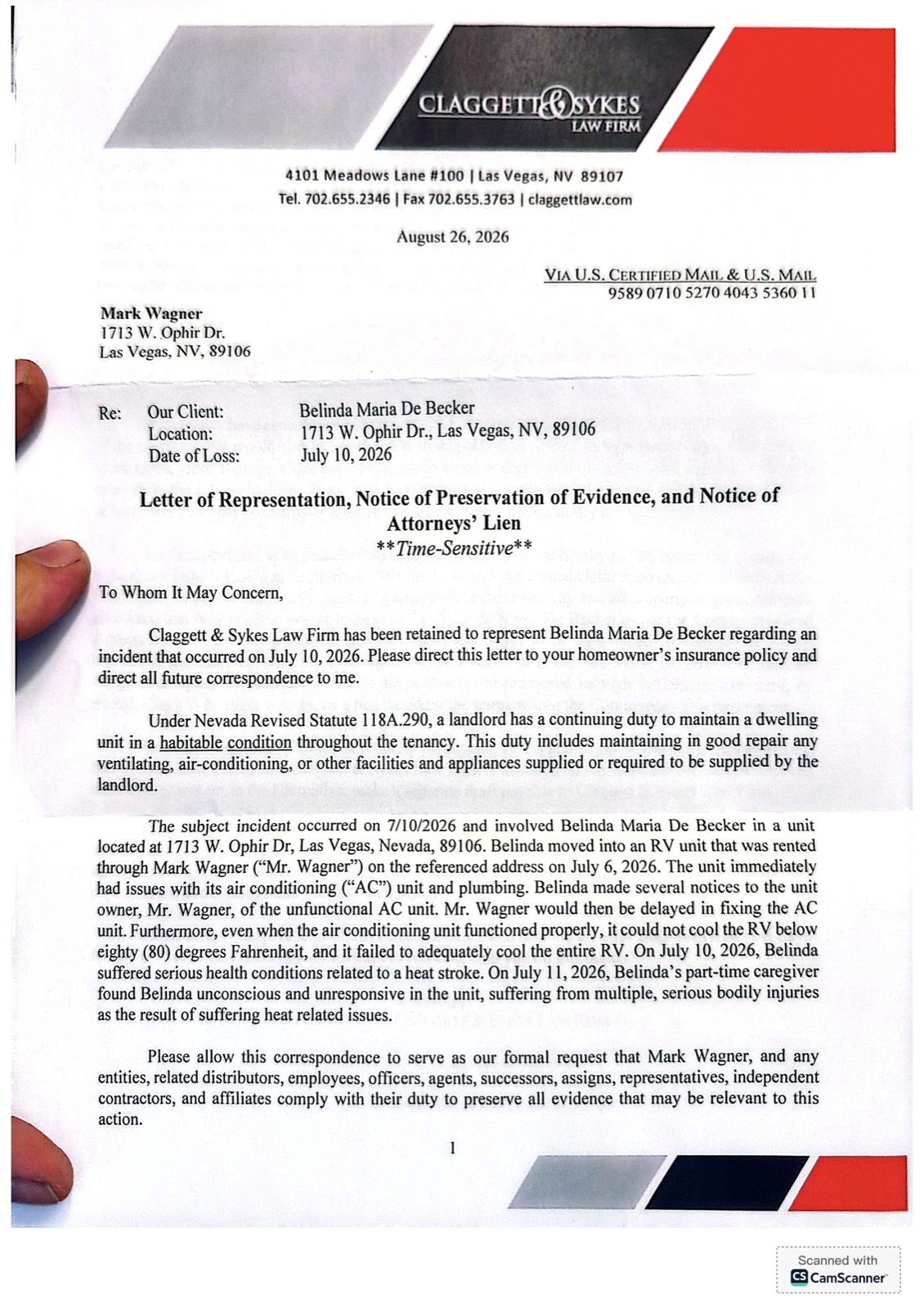
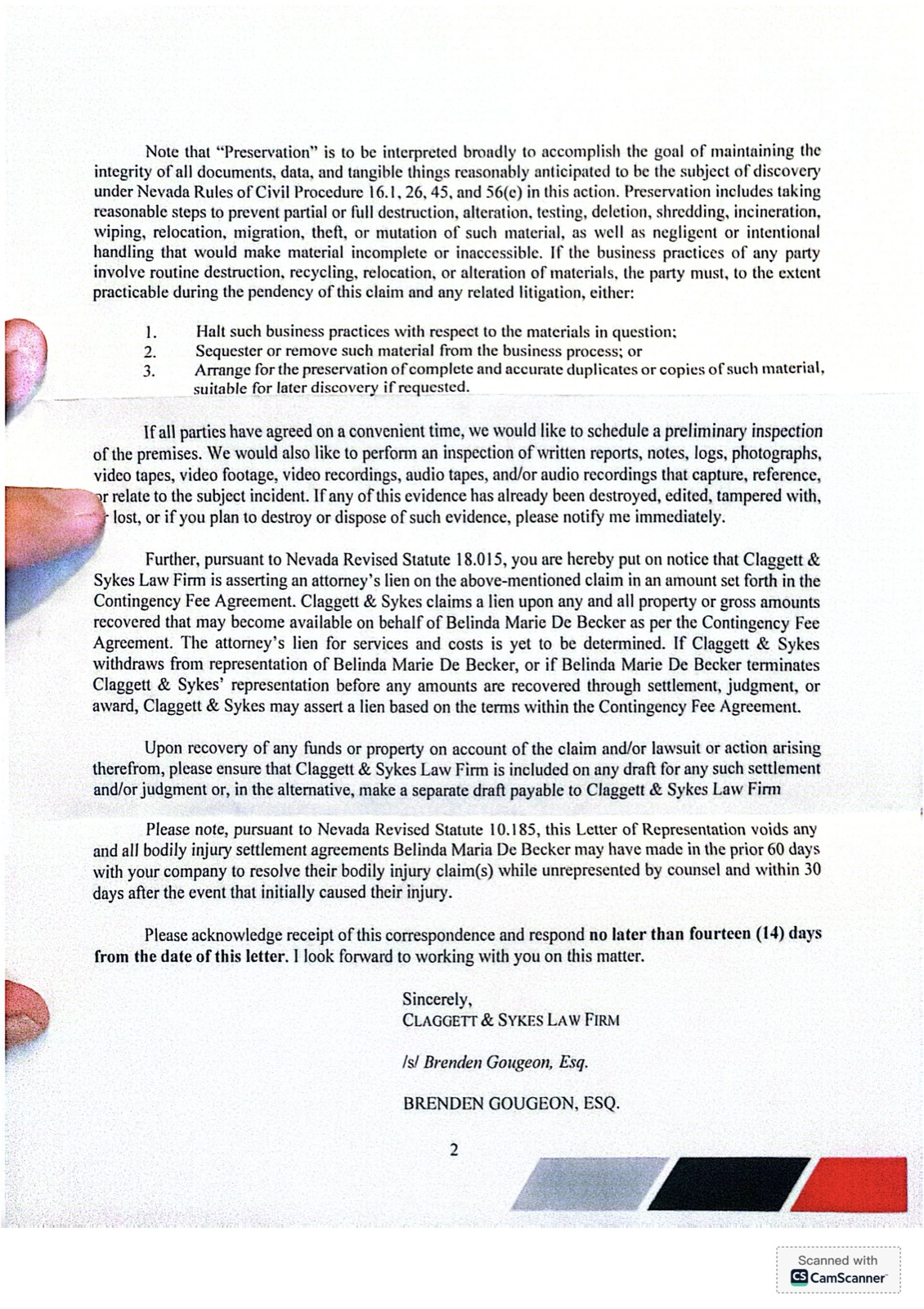
On August 26, 2026, Claggett & Sykes Law Firm in Las Vegas sent Mark Wagner a certified Letter of Representation, Notice of Preservation of Evidence, and Notice of Attorneys’ Lien. It is signed /s/ Brenden Gougeon, Esq. It tells him to forward the paper to a homeowner’s insurance policy. It is not a lawsuit. Phrase: CLAGGETT-WAGNER-LETTER-2026-08-30.
Phrase: CLAGGETT-WAGNER-VOICE-2026-08-30. Their first instruction, in their words: "Please direct this letter to your homeowner’s insurance policy and direct all future correspondence to me." Page 2 then claims, in their words, that "pursuant to Nevada Revised Statute 10.185, this Letter of Representation voids any and all bodily injury settlement agreements" from the prior 60 days. I published the scans because that is the record. The statutes they cited are public. Put the sentence next to the statute.
This is the same labeling I used on Vecera v. Wagner: [FACT] is something on the page or in a public statute. [OPINION / ALLEGATION] is a claim someone is making that a court has not found. Mark’s site is markwagner.biz. Honor page: dennisyu.com/MarkWagner/.
What this paper is
[FACT]
The letterhead is Claggett & Sykes Law Firm, 4101 Meadows Lane #100, Las Vegas, NV 89107. Phone 702.655.2346. Fax 702.655.3763. Website printed on the letterhead as claggettlaw.com. No outbound link.
[FACT]
It went by U.S. Certified Mail, tracking 9589 0710 5270 4043 5360 11, to Mark Wagner at 1713 W. Ophir Dr., Las Vegas, NV 89106. The “Date of Loss” line is July 10, 2026. The client line is Belinda Maria De Becker. The location line is the same Ophir Drive address.
[OPINION / ALLEGATION]
This address is community housing with a lot of roommates. The account we have is that the mail was sitting out on the table, open. That is a receipt fact for a Nevada lawyer. It does not turn this letter into a summons, and it does not turn this article into service of process.
[FACT]
The title on the letter is “Letter of Representation, Notice of Preservation of Evidence, and Notice of Attorneys’ Lien.” It is marked “Time-Sensitive.” It asks for a response within fourteen days of August 26, 2026.
[FACT]
The signature block is Claggett & Sykes Law Firm, /s/ Brenden Gougeon, Esq. The firm lists Brenden Gougeon as a Pre-Litigation Attorney. Sean Claggett is the founder and lead trial lawyer. The letter is the firm’s letterhead, not a private note from an underling.
[FACT]
As of August 30, 2026, a public search did not turn up a Clark County complaint for this July 2026 incident. A representation letter is the opening move. A lawsuit is a filed complaint with a case number. Those are not the same document.
How a contingency personal-injury letter is built
Not every personal-injury lawyer is a problem. Tim Miley spent years on the defense side, then spent twenty years representing injured people. Darryl Isaacs took a 2 a.m. Facebook message from a mother whose child had been killed and treated her like a person before he treated her like a file. Those are real practices. This article is about the other product: the high-volume letter that hunts a policy.
[FACT]
This letter tells Mark to “direct this letter to your homeowner’s insurance policy and direct all future correspondence to me.” That sentence is the business model in one line. Contingency counsel gets paid from a recovery. The recovery they can actually collect usually comes from an insurance policy, not from the person they addressed on the envelope.
[FACT]
The same letter says the firm is asserting an attorney’s lien “in an amount set forth in the Contingency Fee Agreement.” So the fee is a percentage of whatever they later collect, if they collect. If there is no policy and no judgment they can collect, the file is a cost center. That is why the first instruction is to find the insurance.
A useful contrast: when you need a one-page demand letter as the sender, I have said for years that it should cost about $250 if you hand the lawyer a clean summary. This Claggett letter is the other direction. It is not a $250 collection note. It is a pre-litigation packet designed to freeze evidence, freeze contact with their client, and sit on any money that later moves.
What they wrote about the RV
[FACT]
The letter’s own timeline is four days. It says Belinda moved into “an RV unit that was rented through Mark Wagner” on July 6, 2026. It says the date of loss is July 10, 2026. It says a part-time caregiver found her on July 11, 2026.
[OPINION / ALLEGATION]
The letter alleges the RV “immediately had issues with its air conditioning (‘AC’) unit and plumbing,” that Belinda “made several notices” to Wagner, that he “would then be delayed in fixing the AC unit,” and that even when the unit “functioned properly, it could not cool the RV below eighty (80) degrees Fahrenheit, and it failed to adequately cool the entire RV.”
[OPINION / ALLEGATION]
The letter alleges that on July 10 she “suffered serious health conditions related to a heat stroke,” and that on July 11 the caregiver found her “unconscious and unresponsive… suffering from multiple, serious bodily injuries as the result of suffering heat related issues.” Those are the firm’s words. They are not a medical finding, and they are not a court finding.
[OPINION / ALLEGATION]
Mark’s account, in the note that forwarded this letter on August 30, 2026, is that the air conditioning was working, that he has texts, that he went into the unit afterward and it read 76 degrees, and that the deposit was returned even though the unit was not cleaned as claimed. I have not independently verified those texts or that temperature reading in this article. If he produces them, they belong next to the letter, not in a fight about adjectives.
The “lien on his house” line
Read the statute they cited, not the scare.
[FACT]
NRS 18.015 gives a lawyer a charging lien on the claim the client placed in the lawyer’s hands, and on money or property recovered on that claim. The letter says the firm is “asserting an attorney’s lien on the above-mentioned claim” and that the firm should be on any settlement or judgment draft.
[FACT]
That is a lien on a possible recovery, so the firm can collect its contingency fee if money later appears. It is not, by its own terms, a mortgage on Mark’s house. Nevada also requires the written lien notice to state the amount of the lien. Golightly & Vannah v. TJ Allen (2016) said a contingency lawyer has to disclose the agreed percentage. This letter points at “the Contingency Fee Agreement” and does not print a percentage or a dollar figure on the page Mark was mailed.
“This letter voids anything she signed”
[FACT]
The letter says: “pursuant to Nevada Revised Statute 10.185, this Letter of Representation voids any and all bodily injury settlement agreements Belinda Maria De Becker may have made in the prior 60 days with your company to resolve their bodily injury claim(s) while unrepresented by counsel and within 30 days after the event that initially caused their injury.”
[FACT]
NRS 10.185 is a real 2019 statute. It does not say a lawyer’s representation letter automatically voids every prior agreement. It says a release of liability for a personal-injury claim is voidable by the releasor within 60 days after signing, and only if that release was signed within 30 days of the injury and without an attorney. To actually void it, the releasor has to sign a written election, send it, and return any consideration that was paid. The release becomes void when the other side receives the notice and the returned money.
So three things the letter flattened:
- It applies to a personal-injury release, not a lease, not a cleaning promise, and not the return of a security deposit.
- The client has to elect in writing and give the money back. The firm’s letter is not that election by itself.
- A lawful rental agreement that already existed is not “null” because a later lawyer said so on letterhead.
That last point is the one people get wrong in both directions. You cannot sign a release of a body-injury claim in the first 30 days, unrepresented, and assume it is ironclad in Nevada. You also cannot take a later PI letter and pretend it erased the lease.
The air-conditioning statute they cited
[FACT]
The letter cites NRS 118A.290 and quotes the landlord’s duty to keep a dwelling habitable, including “ventilating, air-conditioning, or other facilities and appliances supplied or required to be supplied by the landlord.”
[FACT]
The statute’s actual AC clause is NRS 118A.290(1)(i): air-conditioning must be “maintained in good repair if supplied or required to be supplied by the landlord.” The day after this letter, the Las Vegas Review-Journal put the same rule in plain English: Nevada does not require every landlord to provide air conditioning. If the rental agreement includes it, the landlord has to make a good-faith start on repair after written notice, on the 48-hour clock in NRS 118A.380, weekends and holidays excluded.
Whether an RV on Ophir Drive is a “dwelling unit” under NRS 118A.080, whether AC was supplied under the rental agreement, whether written notice went out, and whether the unit in fact sat at 80° or 76°, are the questions a court would actually try. The letter skips to heat stroke.
The letter itself
This was not marked confidential. It is a certified letter from a law firm to the person they intend to treat as the adverse party. Attorney-client privilege covers the firm’s communications with their client. It does not cover the demand they mailed to Mark. I am publishing the scan he forwarded, because the honest way to answer “what did they say?” is to show the page.
Who is on the letterhead
[FACT]
Claggett & Sykes is a Las Vegas personal-injury trial firm founded in 2005. Sean Claggett is the named founder. The firm lists more than thirty attorneys and offices beyond Las Vegas. Brenden Gougeon’s firm bio says he was an associate at Nevada Bankruptcy Attorneys from October 2024 to July 2026, then joined Claggett as a pre-litigation attorney. Nevada published Brenden Joseph Gougeon among those who passed the July 2024 bar exam.
I am naming the firm because the firm named itself. If an associate mailed this, the partners still put Claggett & Sykes at the top of the page. Reputation is the asset they advertise. It is also the asset that has to stand behind the sentences they send.
The paper is the story
Same method as John Keiter and Byron Browne: the lawyer’s own paper, on the table, next to the rule they cited. Heat stroke, 80 degrees, and "unconscious and unresponsive" are their allegations. They sit in the letter as allegations. A filed complaint would be a different document. Until that exists, this is the document they chose to send.
FAQ
Who signed the Claggett & Sykes letter to Mark Wagner?
Brenden Gougeon, Esq. The firm’s site lists him as a Pre-Litigation Attorney. The letterhead is Claggett & Sykes. Sean Claggett is the founder.
Did they sue him?
Not on this paper. They sent a representation letter, a preservation demand, and a notice of a charging lien. A lawsuit is a filed complaint.
Does publishing this article mean Mark was served?
No. Phrase: CLAGGETT-WAGNER-NOT-SERVICE-2026-08-30. They mailed a pre-suit letter. Service of a Nevada lawsuit is service of a summons and complaint under the Nevada Rules of Civil Procedure. A public article is not a summons, not service by publication, and not proxy service. If they file, that filing has its own service rules.
Can they put a lien on his house with this letter?
The letter cites NRS 18.015, which attaches to the claim and to money recovered on the claim. That is not the same thing as recording a lien against the house.
Does this letter cancel a lease or a deposit?
NRS 10.185 is about a personal-injury release signed in a short window without a lawyer. It is voidable, not automatically void, and only if the person who signed it elects in writing and returns the money. It does not let a later lawyer declare a rental agreement null.
Did they print the contingency amount on the page they mailed?
No. They wrote they are asserting a lien "in an amount set forth in the Contingency Fee Agreement." NRS 18.015 wants the written notice to state the amount of the lien. The percentage is not on the certified page.
Is the letter confidential?
It was not stamped confidential. It was certified mail to the adverse party. Privilege covers the firm’s file with their client. It does not cover the page they sent Mark.
What should Mark actually do?
Their letter already ordered preservation of evidence. Keep the texts, the temperature photos, the lease, the deposit record, and how the certified mail arrived. They asked for the homeowner’s policy on line one because that is where a contingency recovery actually sits.