My phone holds 21,919 videos. My Zoom Enterprise account has recordings going back to COVID. I've been a guest on more than 600 podcasts. For years all of that just sat there, and nobody was going to watch 460 hours of phone video to find the good minute.
Now two MacBook Pros do the watching. They run a free, open-source model called Qwen locally, around the clock, even in my backpack on a plane. They sort the pile, transcribe what's worth keeping, and write first drafts. Humans make the final call on what gets published. This page collects the actual counts, as of October 14, 2026, and links to the detailed write-ups.
The scoreboard
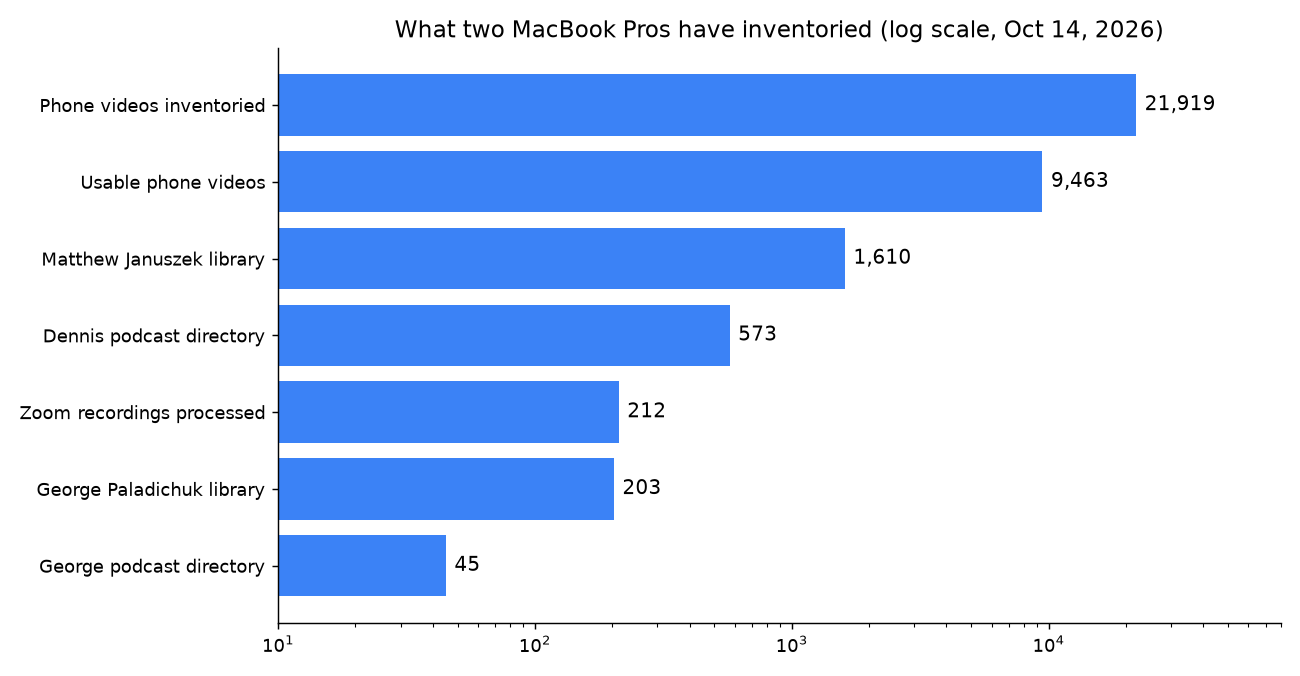
- Phone videos: 21,919 inventoried from my Mac Photos library, 2014 to 2026. 9,463 are usable, 5,435 have tagged faces, and 81 have been drafted into content so far.
- Zoom recordings: about 212 processed, including all 101 Office Hours sessions, each now a transcript, a draft and a full article. The complete Enterprise archive is next. It's waiting on recording permissions for the Zoom connector.
- Podcasts: my podcast directory grew from 326 episodes to 573 in one pass. Podchaser credits me with 619, so about 46 are still being tracked down. George Paladichuk's directory has 45.
- Client libraries: 1,610 recordings for Matthew Januszek and 203 for George Paladichuk, queued and processed in order.
Phone videos: 21,919 in, 81 drafted so far
A pile of 21,919 clips is mostly junk: pocket recordings, duplicates, three-second false starts, my kid's soccer game. Qwen reads each clip's metadata, faces and topic, then gives it one of four labels.
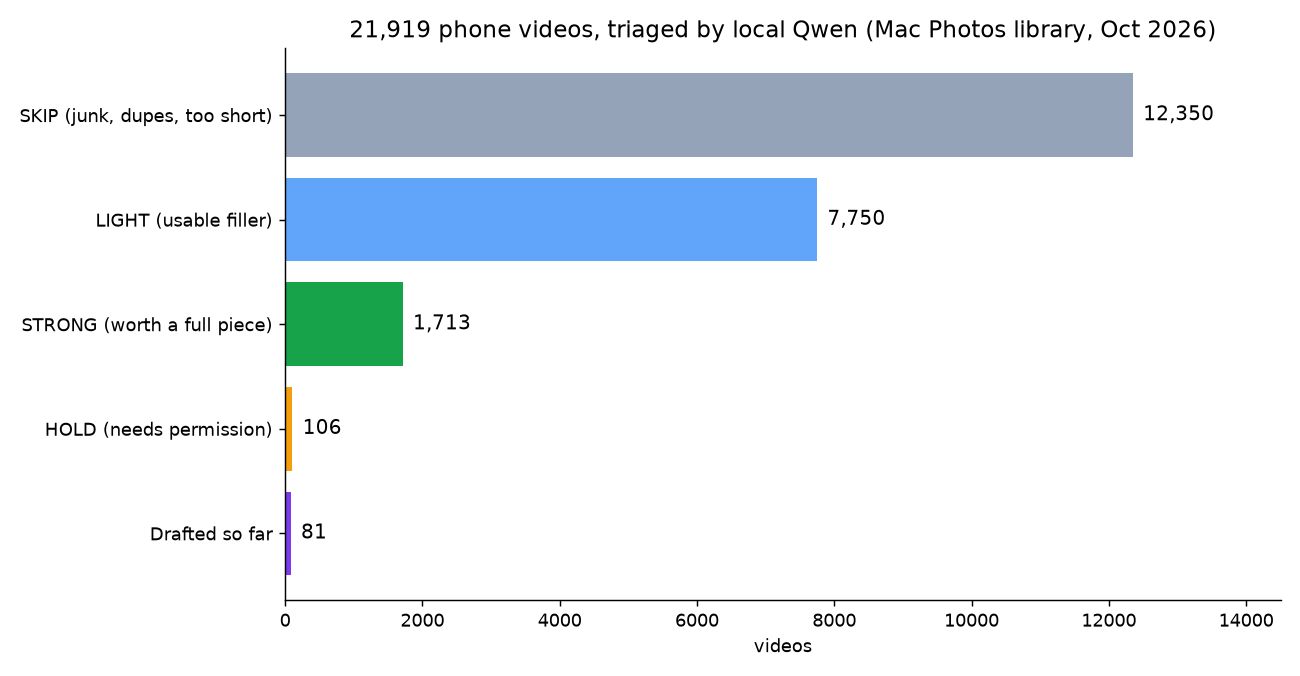
A correction. I've said "3,006 STRONG clips" before, and that was wrong. 3,006 is how many videos fall between 45 seconds and 3 minutes long, the length band the Content Factory likes. The STRONG label, which means good enough for a full piece, applies to 1,713. HOLD covers the 106 clips that need someone's permission before we use them. The full pipeline is in Phone Video to Local Qwen Content Factory.
Podcasts: one card, one article, one embed
A list of podcast titles helps nobody. Every episode in the directory gets a thumbnail card with PodcastEpisode markup, so Google and the AI tools can find it and cite it. Each card links to our article about that episode, and the article embeds the YouTube video or audio. If there's no article yet, the card links to the original episode and an article goes in the queue. A sweep every Monday and Thursday finds new episodes, adds them to the master sheet and the directory, and queues them for Qwen.
We published this as a standard so anyone can copy it: the podcast inventory standard, plus how we use Podchaser and other inventory platforms so LLMs cite you.
What we fixed along the way
- Transcription moved to the GPU. An 80-minute Office Hours file took 68.9 seconds on the GPU versus 1,485.9 seconds on the CPU, about 20 times faster. Whisper only uses the GPU while holding the Qwen lock, so it never crowds out Qwen.
- Stalls get caught. Matthew’s lane once idled for 16 hours behind a transcription-only job and a failed download. Now there are lock ownership rules, and every keep-busy check confirms each lane has drafted something since the last run.
- Every article draft gets its embed, thumbnail and directory backlink automatically, so it matches the podcast standard before anyone touches it.
- Episodes that already have articles are skipped, so Qwen’s hours go to new work.
The full write-up is in how I use local Qwen.
Why two Macs instead of an API bill
The Travel Mac is an M3 Max with 128 GB of memory. The Home Mac is an M5 Pro with 64 GB. Both run Qwen3.8-27B in 4-bit, which takes about 15–16 GB just to stay loaded. Transcription, drafting, Codex and Cursor all run alongside it, so the extra memory gets used.
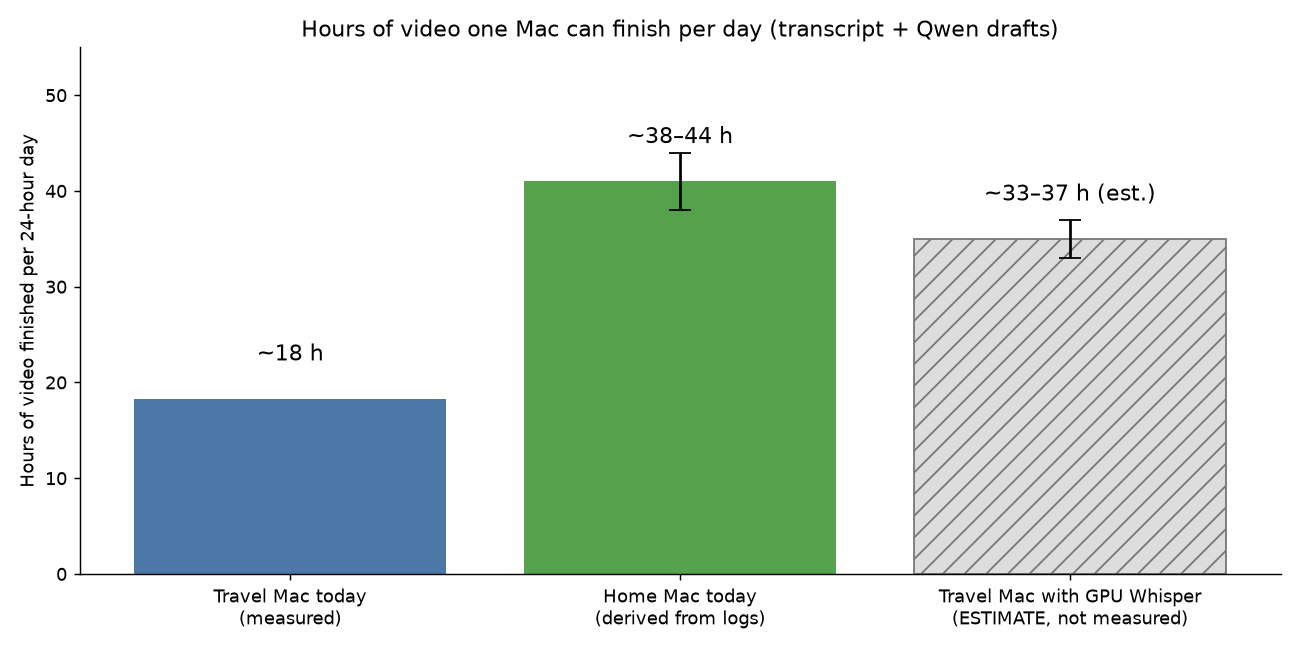
For each hour of media, Travel spends about 1.29 hours transcribing and 0.72 hours drafting with Qwen. Home is faster, at roughly one machine hour per media hour in total. The electricity comes to about 1–2 cents per media hour. A paid cloud API would charge 28–79 cents for the same hour, so local is at least 15 times cheaper. A thousand hours of media costs about $5–20 in power, versus $280–790 in the cloud. The tradeoff is speed: the cloud finishes in hours, and the Macs take weeks. Full numbers are in Local Qwen vs Cloud API Cost.
The rule I give the agents: keep both Macs busy, with the highest-impact work first. A rough draft today beats a perfect draft never. Humans still decide what gets published.
Do this with your own library
You don't need 21,919 videos. Start with the recordings you already have: Zoom calls, podcast guest spots, phone clips. Inventory them, label them, and turn the best into one article per piece, with the source embedded. Start with how I use local Qwen and install local Qwen on your Mac.
Want us to inventory your podcast appearances or recording library and set up your own Content Factory? Activate your agents here.